65_HS1-834228961_62-HQ-83894_Section_006
65_hs1-834228961_62-hq-83894_section_6 · page 130 of 271
Text
This text came with the file. It may have mistakes. When the text and the image disagree, the image is right.
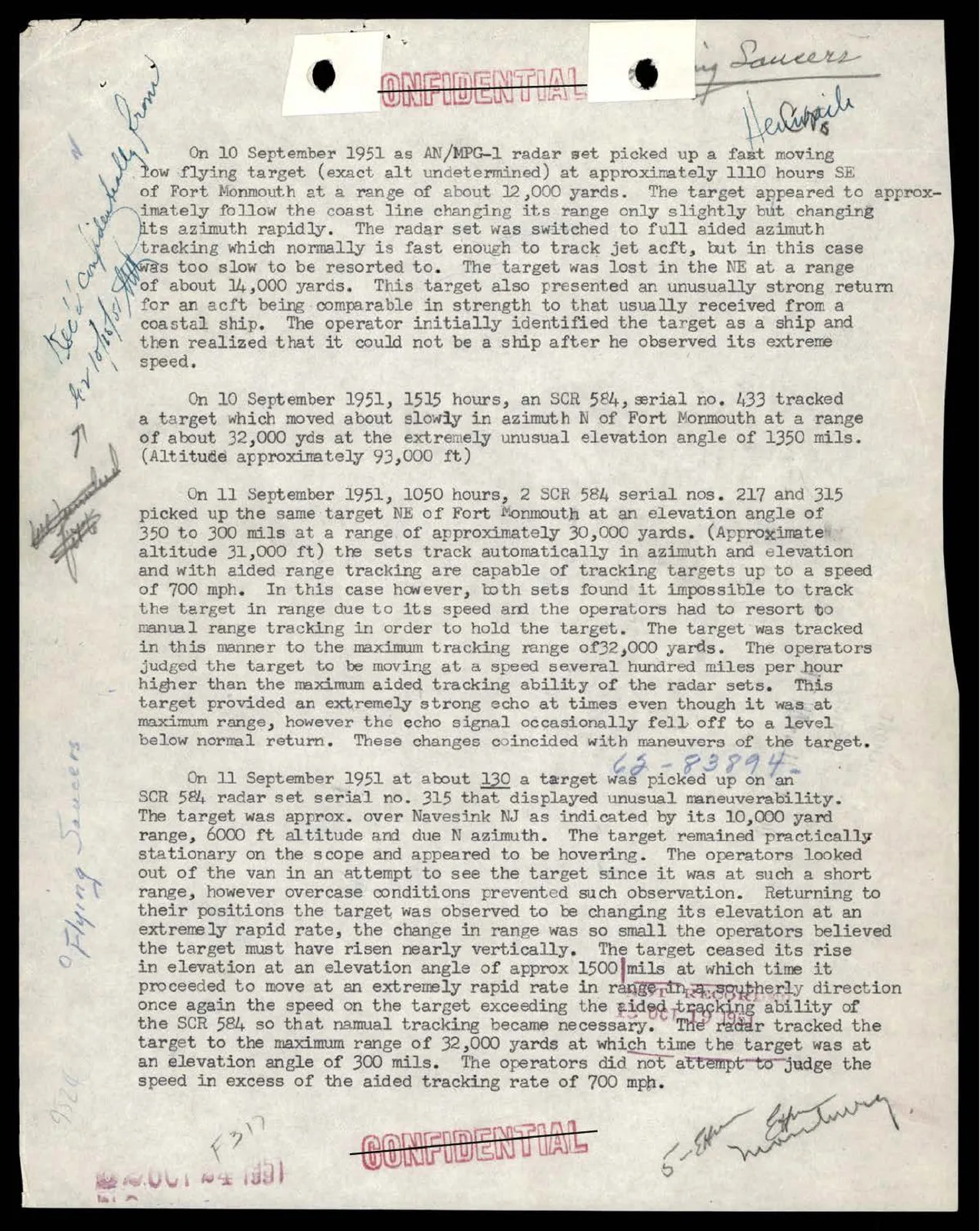
'~ t ~~ ~ 4 On 10 September 1951 as AN/MPG-l radar set picked up a fas:t moving ow flying target (exact alt undetermined) at approximately 1110 hours SE of Fort Monmouth at a range of about J2 ,000 yards. The target appeared to approx imately follow the coast line changing its range only slightly but changing 'ts azimuth rapidly. The radar set was switched to full aided azimuth tracking which normally is fast enoUe::h to track jet acft, rut in this case as too slow to be resorted to. The target was lost in the NE at a range of about 14,000 yards. This target also presented an unusually strong return for an acft being comparable in strength to that usually received from a coastal ship. The operator initially identified the target as a ship and then realized that it could not be a ship after he observed its extrerre speed. On 10 September 1951, 1515 hours, an SCR 584, rerial no. 433 tracked a t arget which moved about slowiy in azimuth N of Fort Monmouth at a range of about 32,000 yds at the extremely unusual elevation angle of 1350 mils. (Altituae appro.xin:ately 93, 000 ft) On 11 September 1951, 1050 hours, 2 SCR 584 serial nos . 217 and 315 picked up the same target NE of Fort l"!onmouth at an elevation angle of 350 to 300 mils at a range of approximately 30,000 yards. (Appro~ima.te altitude 31,000 ft) the sets track automatically in azimuth and elevation and with aided range tracl<ing are capable of tracking targets up to a speed of 700 mph. In this case hcwever, 1:oth sets found it impossible to track the target in range due to its speed am the operators had to resort tbo mantal range tracking in order to hold the target. The target was tracked in this manner to the maximum tracking range of32,000 yards . The operators judged the target to be moving at a speed several hundred miles per hour higtler than the maximum aided tracking ability of the radar sets. This target provided an extremely strong echo at times even though it was at maximum range, however the echo signal occasionally fel~ off to a level below norlll9.l return. These changes coincided with maneuvers of the target. ., ~:; ; On ll September 1951 at al:out 130 a target was picked up on an SCR 584 radar set serial no. .315 that displayed unusual ma.neuverability. The target was approx. over Navesink NJ as indicated by its 10,000 yard range, 6000 ft altitude arrl. due N azi.muth . The target remained practically stationary on the scope and appeared to be hovering . The operators looked out of the van in an attempt to see the target since it was at such a short range, however overcase conditions prevented such observation. Returning to their positions the target was observed to be changing its elevation at an extrenely rapid rate, the change in range was so small the operators believed the target must have risen nearly vertically. The target ceased its rise in elevation at an elevation angle of approx 1500,mils at which tirre it proceeded to move at an extrenely rapid rate in r~~~e.rly direction once again the speed on the target exceeding the fid~r:'.~k;~qg ability of the SCR 584 so that namual tracking became necessary. Tltef' :ta!<far tracked the target to the maximum range of 32 ,000 yards at which time the target was at an elevation angle of 300 mils. The operators did-i;or-a~~udge the speed in excess of the aided tracking rate of 700 mpp .