The Central Intelligence Agency and Overhead Reconnaissance; The U-2 and OXCART Programs, 1954-1974
CIA-UAP-003 · page 214 of 406
Text
This text came with the file. It may have mistakes. When the text and the image disagree, the image is right.
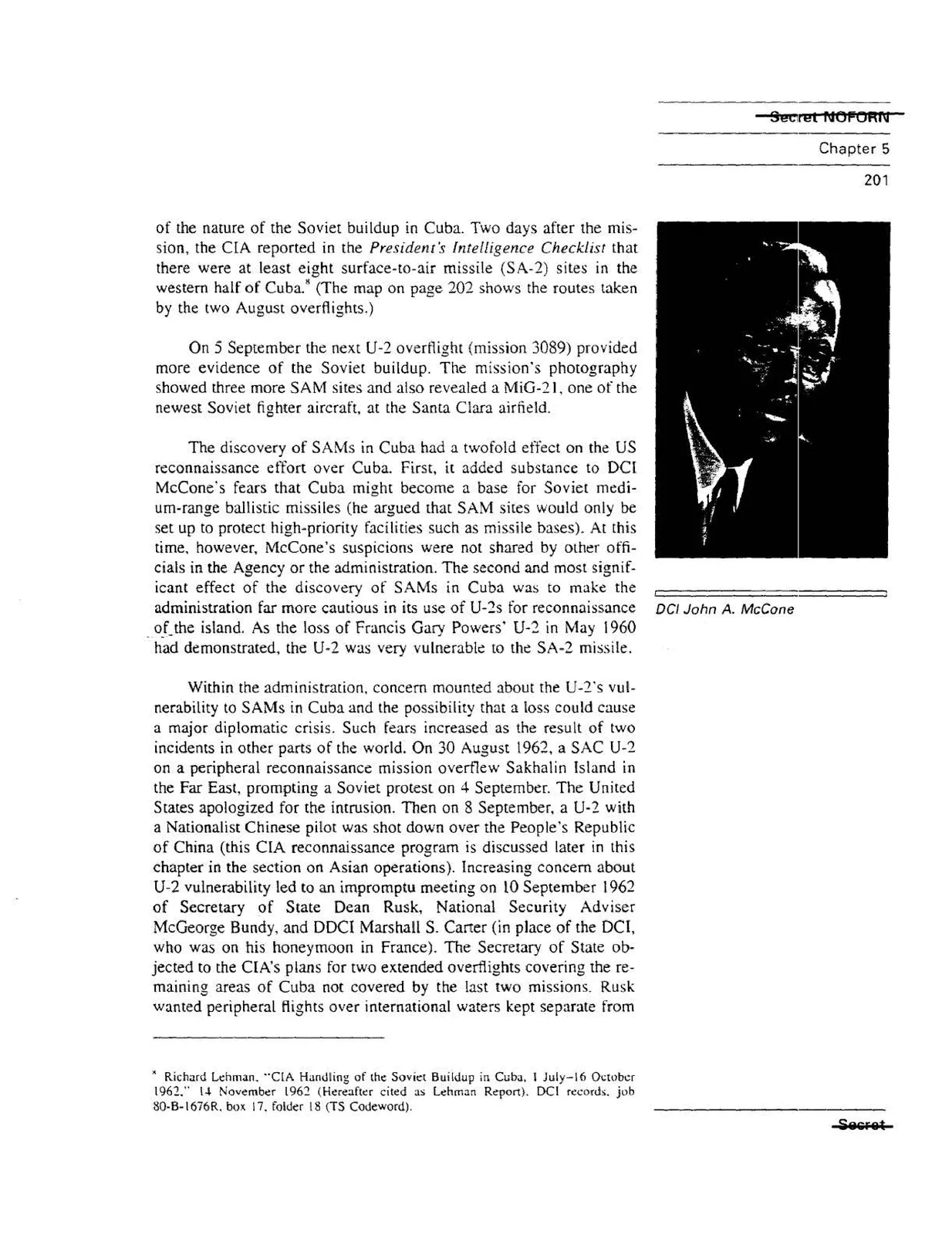
201 Chapter 5 of the nature of the Soviet buildup in Cuba. Two days after the mis sion, the CIA reported in the President '.s Intelligence Checklist that there were at least eight surface-to-air missile (SA-2) sites in the western half of Cuba. 8 (The map on page 202 shows the routes taken by the two August overflights.) On 5 September the next U-2 overflight (mission 3089) provided more evidence of the Soviet buildup. The mission's photography showed three more SAM sites and also revealed a MiG-2 I, one of the newest Soviet fighter aircraft. at the Santa Clara airfield. The discovery of SAMs in Cuba had a twofold effect on the US reconnaissance effort over Cuba. First, it added substance to DCI McCone·s fears that Cuba might become a base for Soviet medi um-range ballistic missiles (he argued that SAM sites would only be set up to protect high-priority facilities such as missile bases). Al this time. however. McCone's suspicions were not shared by other offi cials in the Agency or the administration. The second and most signif icant effect of the discovery of SAMs in Cuba was to make the administration far more cautious in its use of U-2s for reconnaissance DC/ John A. McCone . o_f_the island. As the loss of Francis Gary Powers· U-2 in May 1960 had demonstrated, the U-2 was very vulnerabk to the SA-2 missile. Within the administration. concern mounted about the U-2's vul nerability to SAMs in Cuba and the possibility that a loss could cause a major diplomatic crisis. Such fears increased as the result of two incidents in other parts of the world. On 30 August 1962, a SAC U-2 on a peripheral reconnaissance mission overflew Sakhalin Island in the Far East, prompting a Soviet protest on 4 September. The United States apologized for the intrusion. Then on 8 September. a U-2 with a Nationalist Chinese pilot was shot down over the People's Republic of China (this CIA reconnaissance program is discussed later in this chapter in the section on Asian operations). Increasing concern about U-2 vulnerability led to an impromptu meeting on lO September 1962 of Secretary of State Dean Rusk, National Security Adviser McGeorge Bundy, and DDCI Marshall S. Carter (in place of the DCI, who was on his honeymoon in France). The Secretary of State ob jected to the CIA's plans for two extended overflights covering the re maining areas of Cuba not covered by the last two missions. Rusk wanted peripheral flights over international waters kept separate from • Richard L.:hman. ··CIA Handling of the Soviet Buildup in Cuba. I July-16 October 1962." 14 November 1962 (Hereafter cited as Lehman Report). DCI rc:cords. job 80-B-1676R. bol\ 17. folder I 8 (TS Codeword).