The Central Intelligence Agency and Overhead Reconnaissance; The U-2 and OXCART Programs, 1954-1974
CIA-UAP-003 · page 257 of 406
Text
This text came with the file. It may have mistakes. When the text and the image disagree, the image is right.
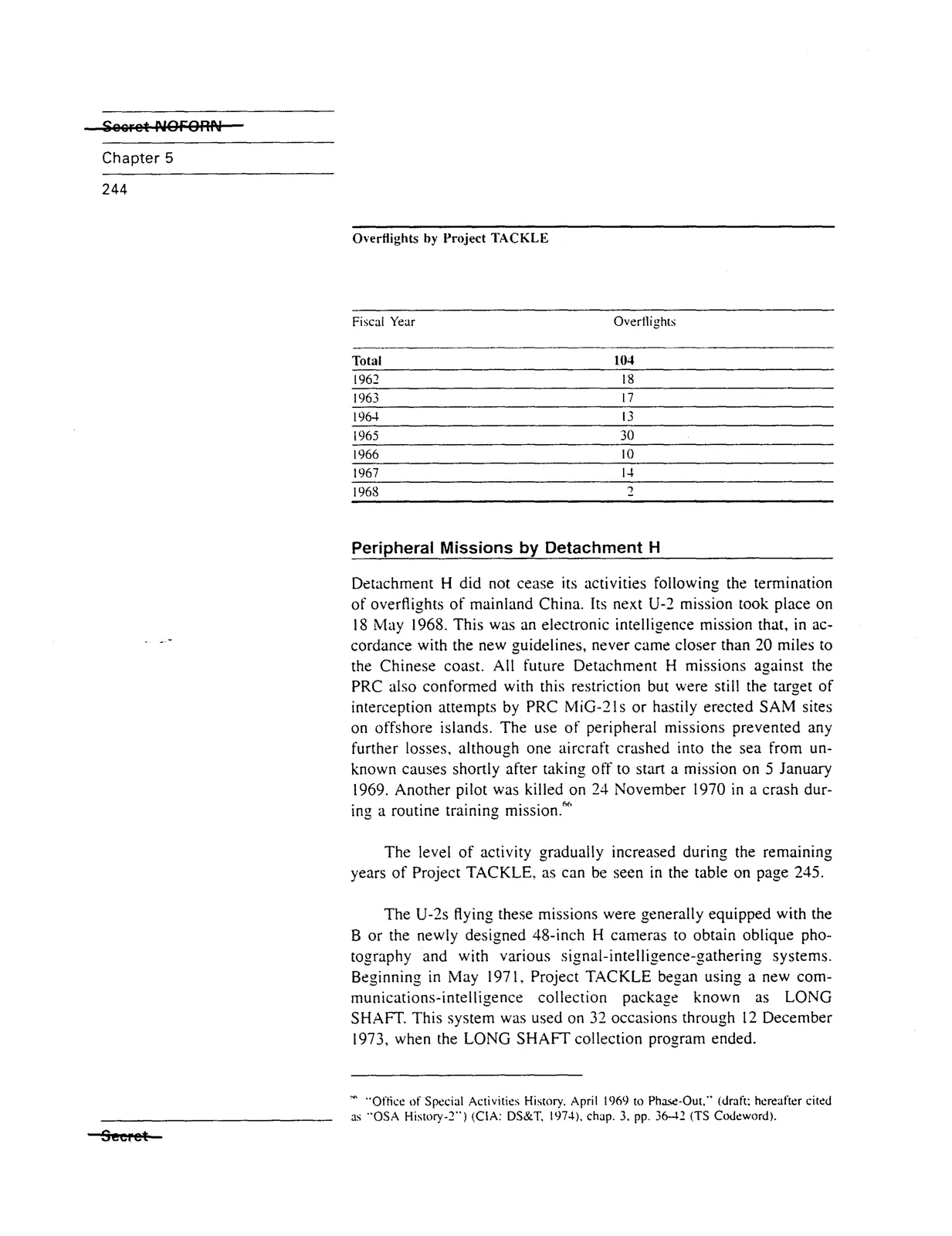
244 ~eeFet NOFOAN Chapter 5 Overflights by Project TACKLE Fiscal Year Overflights Total 104 1961 18 1963 17 1964 13 1965 30 1966 10 1967 14 1968 1 Peripheral Missions by Detachment H Detachment H did not cease its activities following the termination of overflights of mainland China. Its next U-2 mission took place on 18 May 1968. This was an electronic intelligence mission that, in ac cordance with the new guidelines, never came closer than 20 miles to the Chinese coast. All future Detachment H missions against the PRC also conformed with this restriction but were still the target of interception attempts by PRC MiG-2ls or hastily erected SAM sites on offshore islands. The use of peripheral missions prevented any further losses, although one aircraft crashed into the sea from un known causes shortly after taking off to start a mission on 5 January 1969. Another pilot was killed on 24 November 1970 in a crash dur • . • . • . f,(, mg a routine training m1ss10n. The level of activity gradually increased during the remaining years of Project TACKLE, as can be seen in the table on page 245. The U-2s flying these missions were generally equipped with the B or the newly designed 48-inch H cameras to obtain oblique pho tography and with various signal-intelligence-gathering systems. Beginning in May 1971, Project TACKLE began using a new com munications-intelligence collection package known as LONG SHAFT. This system was used on 32 occasions through 12 December 1973, when the LONG SHAFT collection program ended. "" ·•oftice of Special Activities History. April 1969 to Phase-Out." (draft: hereafter cited as "OSA History-2") (CIA: DS&T, 1974). chap. 3. pp. 36-41 (TS Codeword). Secret