The Central Intelligence Agency and Overhead Reconnaissance; The U-2 and OXCART Programs, 1954-1974
CIA-UAP-003 · page 261 of 406
Text
This text came with the file. It may have mistakes. When the text and the image disagree, the image is right.
•
·
248
Sec.et NOFOAN
Chapter 5
r-------..,•••••••-.-.-;-
•-.: ·< :; -~~..i{~~1:;}{~~f:~}'::.••
·····,~--;)~~t~1i· ~·;;:t..,f;~..\;;.;..,~:.~·~~~:::S
··~~~ii::'.
- ·· -
-~
~--
-
,_ ..
~ ...
~
-
~
:.
·""!-··· .
...
,>,, •
•
-·..,.,- . _;~
~ -;_
involved in seeking permission to bw;e U-::!s in other nations. Kelly
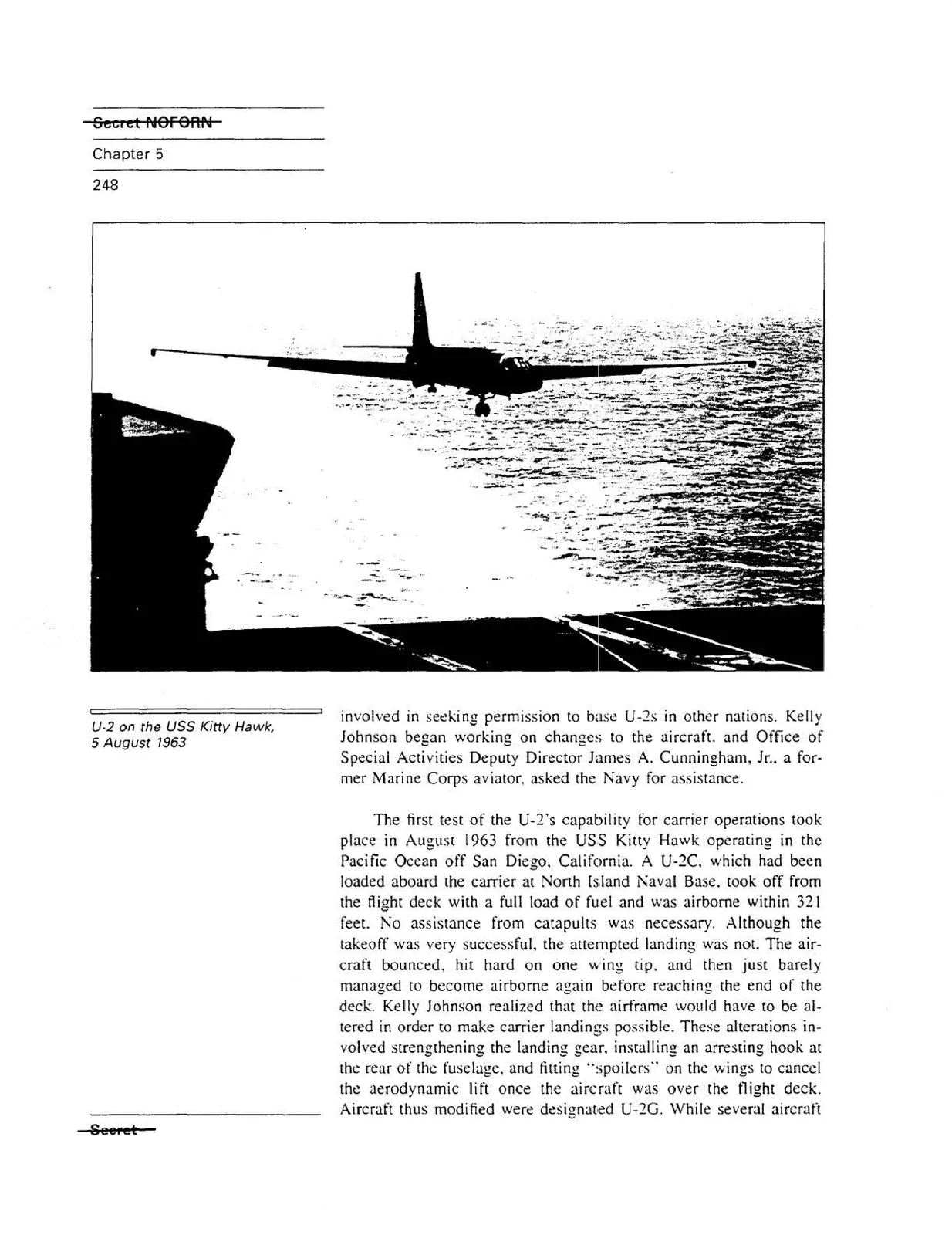
U-2 on the USS Kitty Hawk,
Johnson began working on changes to the aircraft. and Office of
5 August 1963
Special Activities Deputy Director James A. Cunningham, Jr.. a for
mer Marine Corps aviator. asked the Navy for assistance.
The first test of the U-2's capability for carrier operations took
place in August 1963 from the USS Kitty Hawk operating in the
Pacific Ocean off San Diego. California. A U-2C, which had been
loaded aboard the carrier at North ls.land Naval Base. took off from
the flight deck with a full load of fuel and was airborne within 32 1
feet. No assistance from catapults was necessary. Although the
takeoff was very successful. the attempted landing was not. The air
craft bounced, hit hard on one wing tip. and then just barely
managed to become airborne again before reaching the end of the
deck. Kelly Johnson realized that the airframe would have to be al
tered in order to make carrier landings possible. These alterations in
volved strengthening the landing gear. installing an arresting hook at
the rear of the fuselage, and fining '"spoilers" on the wings to cancel
the aerodynamic lift once the aircraft was over che tlighc deck.
Aircraft thus modified were designat,ed U-2G. While several aircraft
See.et