The Central Intelligence Agency and Overhead Reconnaissance; The U-2 and OXCART Programs, 1954-1974
CIA-UAP-003 · page 282 of 406
Text
This text came with the file. It may have mistakes. When the text and the image disagree, the image is right.
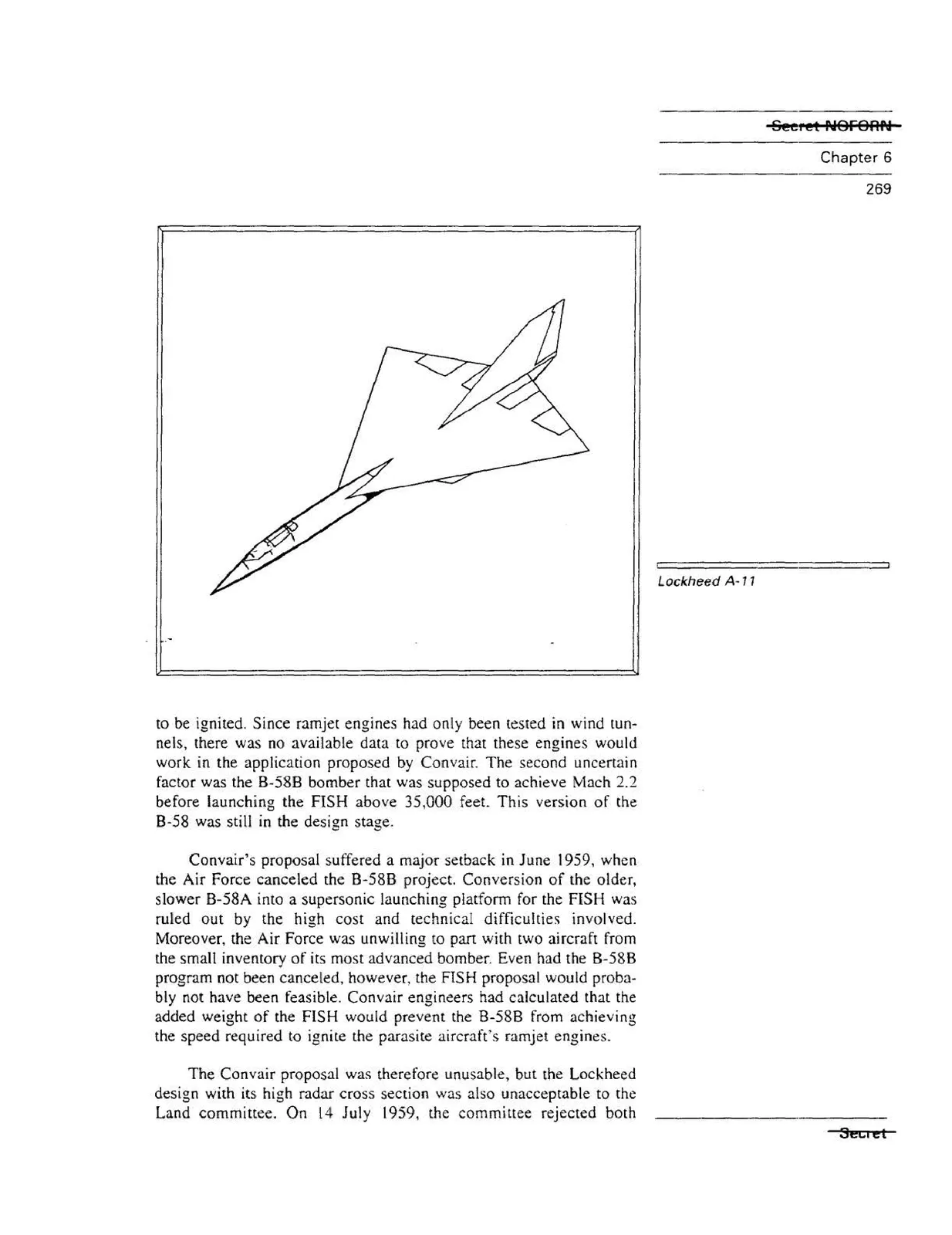
269 ~,et NOFOAN Chapter 6 to be ignited. Since ramjet engines had only been tested in wind tun nels, there was no available data to prove that these engines would work in the application proposed by Convair. The second uncertain factor was the B-58B bomber that was supposed to achieve Mach 2.2 before launching the FISH above 35,000 feet. This version of the B-58 was still in the design stage. Convair's proposal suffered a major setback in June 1959, when the Air Force canceled the 8-58B project. Conversion of the older, slower B-58A into a supersonic launching platform for the FISH was ruled out by the high cost and technical difficulties invol ved. Moreover, the Air Force was unwilling to part with two aircraft from the small inventory of its most advanced bomber. Even had the B-588 program not been canceled, however, the FISH proposal would proba bly not have been feasible. Convair engineers had calculated that the added weight of the FISH would prevent the B-588 from achieving the speed required to ignite the parasite aircraft's ramjet engines. The Convair proposal was therefore unusable, but the Lockheed design with its high radar cross section was also unacceptable to the Land committee. On 14 July 1959, the committee rejected both Lockheed A· 11 Sec,et