The Central Intelligence Agency and Overhead Reconnaissance; The U-2 and OXCART Programs, 1954-1974
CIA-UAP-003 · page 284 of 406
Text
This text came with the file. It may have mistakes. When the text and the image disagree, the image is right.
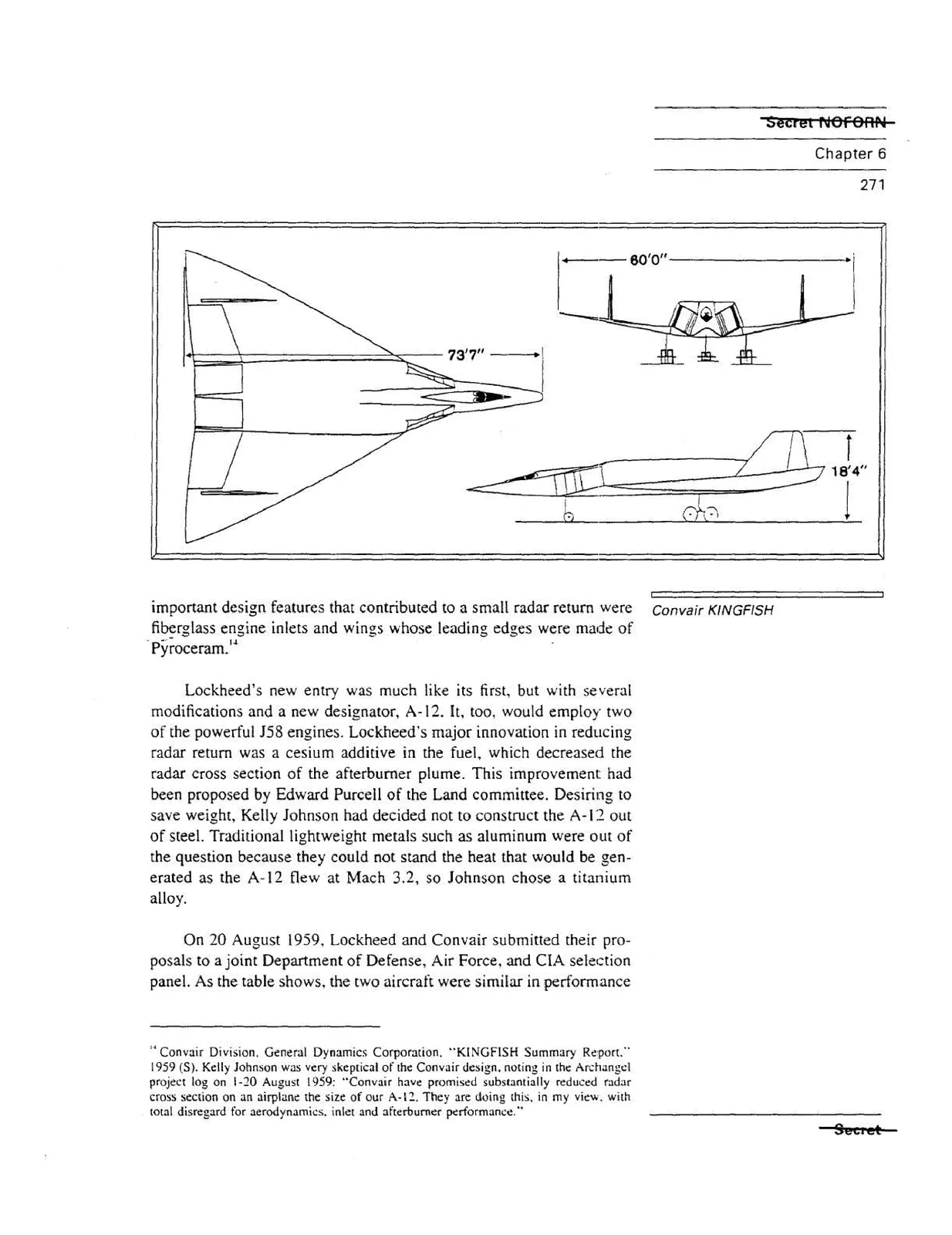
271 Sect et NOFOAN Chapter 6 --- 60'0"--------- important design features that contributed to a small radar return were Convair K!NGFISH fiberglass engine inlets and wings whose leading edges were made of . ..., - ,., Pyroceram. Lockheed's new entry was much like its first, but with several modifications and a new designator, A-12. It, too, would employ two of the powerful J58 engines. Lockheed's major innovation in reducing radar return was a cesium additive in the fuel, which decreased the radar cross section of the afterburner plume. This improvement had been proposed by Edward Purcell of the Land committee. Desiring to save weight, Kelly Johnson had decided not to construct the A- 12 out of steel. Traditional lightweight metals such as aluminum were out of the question because they could not stand the heat that would be gen erated as the A-12 flew at Mach 3.2, so Johnson chose a titanium alloy. On 20 August 1959, Lockheed and Convair submitted their pro posals to a joint Department of Defense, Air Force, and CIA selection panel. As the table shows, the two aircraft were similar in performance " Convair Division. General Dynamics Corporation. " KINGFISH Summary Re:port." 1959 (S). Kelly Johnson was very skeptical of the Convair design. noting in the Archangel project log on 1-20 August 1959: ·'Convair have promised substantially reduced radar cross seclion on an airplane the size of our A-12. They are doing this, in my view. with . lOtal disregard for aerodynamics. inlet and afterburner p,:rformance ... Secaet