The Central Intelligence Agency and Overhead Reconnaissance; The U-2 and OXCART Programs, 1954-1974
CIA-UAP-003 · page 286 of 406
Text
This text came with the file. It may have mistakes. When the text and the image disagree, the image is right.
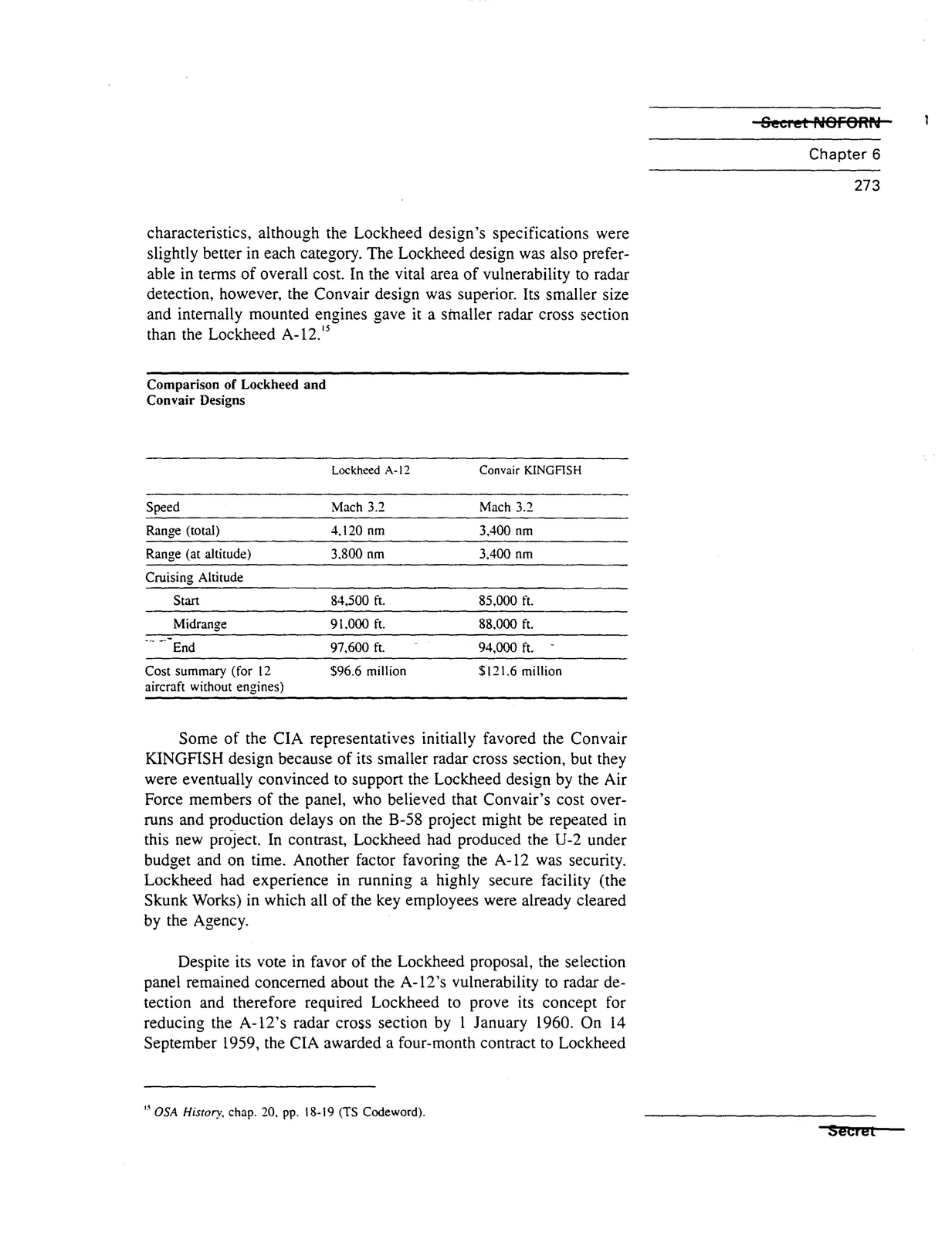
273 Secret NOFORN Chapter 6 characteristics, although the Lockheed design's specifications were slightly better in each category. The Lockheed design was also prefer able in terms of overall cost. In the vital area of vulnerability to radar detection, however, the Convair design was superior. Its smaller size and internally mounted engines gave it a smaller radar cross section than the Lockheed A-12. 15 Comparison of Lockheed and Convair Designs Lockheed A-12 Speed Range (total) Range (at altitude) Cruising Altitude Start Midrange End Cost summary (for 12 aircraft without engines) Mach 3.2 4,120 nm 3,800 nm 84,500 ft. 91.000 ft. 97,600 ft. $96.6 million Convair KINGFISH Mach 3.2 3,400 nm 3,400 nm 85.000 ft. 88.000 ft. 94,000 ft. $ I 21.6 million Some of the CIA representatives initially favored the Convair KINGFISH design because of its smaller radar cross section, but they were eventually convinced to support the Lockheed design by the Air Force members of the panel, who believed that Convair's cost over runs and production delays on the B-58 project might be repeated in this new project. In contrast, Lockheed had produced the U-2 under budget and on time. Another factor favoring the A-12 was security. Lockheed had experience in running a highly secure facility (the Skunk Works) in which all of the key employees were already cleared by the Agency. Despite its vote in favor of the Lockheed proposal, the selection panel remained concerned about the A-12 's vulnerability to radar de tection and therefore required Lockheed to prove its concept for reducing the A-l2's radar cross section by l January 1960. On 14 September 1959, the CIA awarded a four-month contract to Lockheed " OSA History, chap. 20, pp. 18-19 (TS Codeword). Secret