The Central Intelligence Agency and Overhead Reconnaissance; The U-2 and OXCART Programs, 1954-1974
CIA-UAP-003 · page 325 of 406
Text
This text came with the file. It may have mistakes. When the text and the image disagree, the image is right.
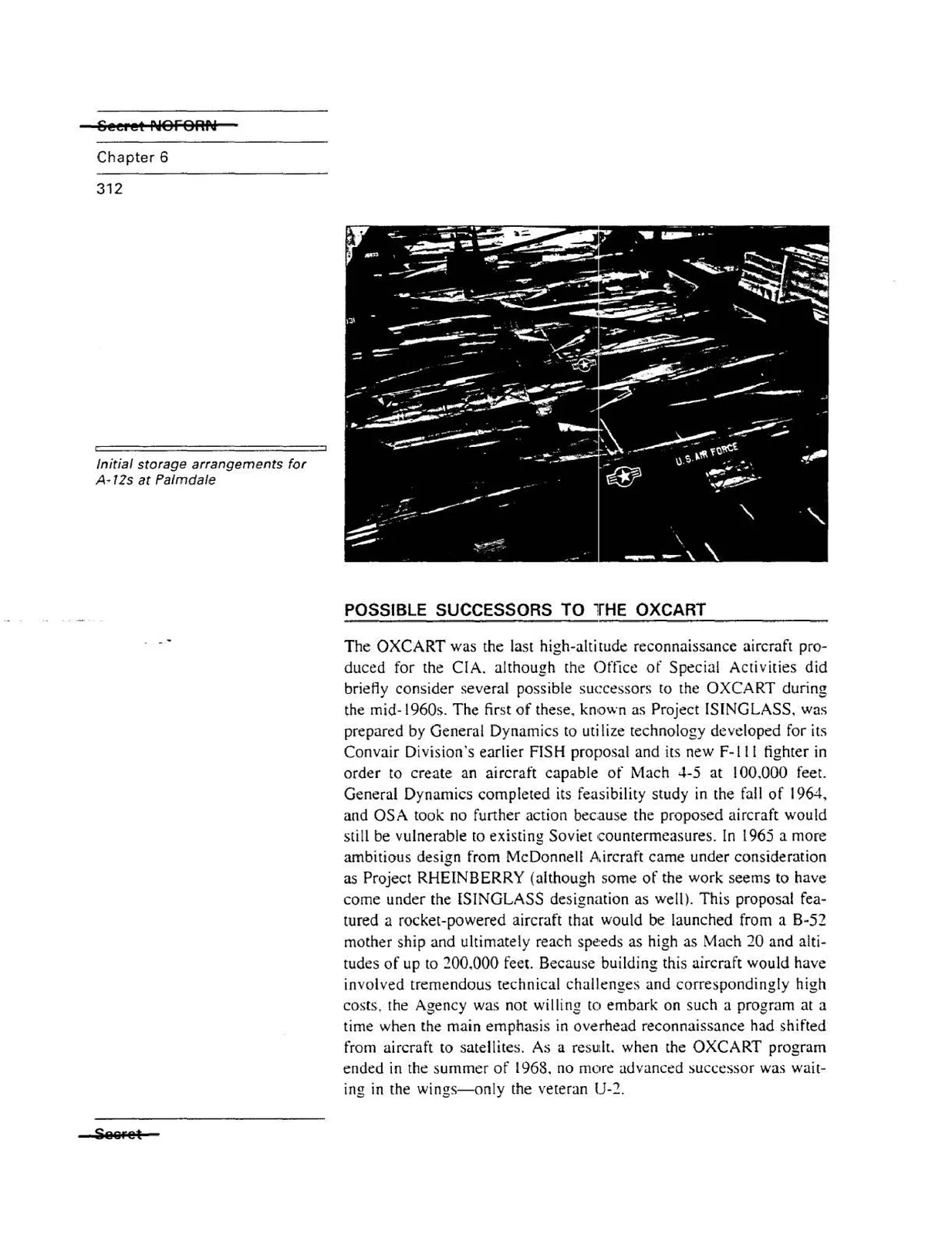
312 6eeret NOFOAN Chapter 6 Initial storage arrangements for A-12s at Palmdale POSSIBLE SUCCESSORS TO lrHE OXCART The OXCART was the last high-altitude reconnaissance aircraft pro duced for the CIA. although the Office of Special Activities did briefly consider several possible successors to the OXCART during the mid- I960s. The first of these. known as Project ISINGLASS. was prepared by General Dynamics to utilize technology developed for its Convair Division's earlier FISH proposal and its new F-I I I fighter in order to create an aircraft capable of Mach ~-5 at I 00,000 feet. General Dynamics completed its feasibility study in the fall of 1964, and OSA took no further action because the proposed aircraft would still be vulnerable to existing Soviet ,countermeasures. In l 965 a more ambitious design from McDonnell Aircraft came under consideration as Project RHEINBERRY (although some of the work seems to have come under the ISINGLASS designation as well). This proposal fea tured a rocket-powered aircraft that would be launched from a B-52 mother ship and ultimately reach spe:eds as high as Mach 20 and alti tudes of up to 200,000 feet. Because building this aircraft would have involved tremendous technical chall.enges and correspondingly high costs, the Agency was not willing to embark on such a program at a time when the main emphasis in overhead reconnaissance had shifted from aircraft to satellites. As a resuilt. when the OXCART program ended in the summer of 1968, no mcire advanced successor was wait ing in the wings-only the veteran U-2. 5iee,et