The Central Intelligence Agency and Overhead Reconnaissance; The U-2 and OXCART Programs, 1954-1974
CIA-UAP-003 · page 34 of 406
Text
This text came with the file. It may have mistakes. When the text and the image disagree, the image is right.
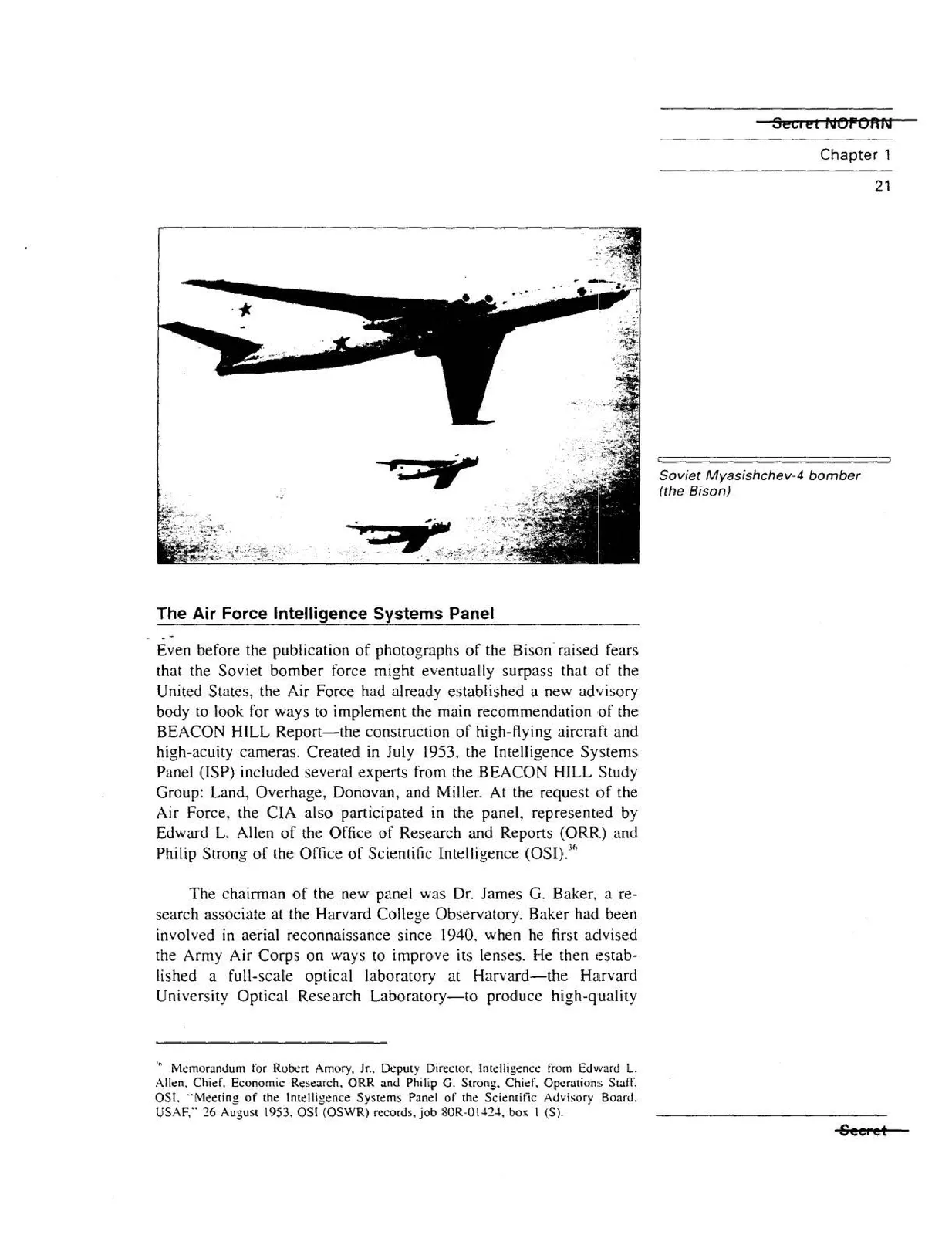
21 Sec, et NOf'Oft~ Chapter 1 .. ~: ... . . :-.·~·~ .' ~~~f':.:l-f.Je.) \': . •.. g,., au£ • Soviet Myasishchev-4 bomber (the Bison) The Air Force Intelligence Systems Panel Even before the publication of photographs of the Bison· raised fears that the Soviet bomber force might eventually surpass that o f the United States, the Air Force had already established a new advisory body to look for ways to implement the main recommendation of the BEACON HILL Report-the construction of high-flying aircraft and high-acuity cameras. Created in July 1953, the Intelligence Systems Panel (ISP) included several experts from the BEACON HILL Study Group: Land, Overhage, Donovan, and Miller. At the request of the Air Force, the CIA also participated in the panel, represent«!d by Edward L. Allen of the Office of Research and Reports (ORR) and Philip Strong of the Office of Scientific Intelligence (OSI). 31 ' The chairman of the new panel was Dr. James G. Baker. a re search associate at the Harvard College Observatory. Baker had been involved in aerial reconnaissance since 1940, when he first advised the Army Air Corps on ways to improve its lenses. He then estab lished a full-scale optical laboratory at Harvard-the Hrnrvard University Optical Research Laboratory-to produce high-quality "' Mc:moram.lum for Rolxrt Amory. Jr.. Dt::puty Direclor. lnlelligence from Edward L . Allen. Chief. Economic Research. ORR and Philip G. Strong. Chief. Operation:s Staff. OSI. "Meeling of lhe Intelligence Systems Panc:l of th.: Scientific Advisory Board. USAF:· 26 Augusl 1953. OSI (OSWR) records. job 80R-0l424. bo:< I (S). Seeret