The Central Intelligence Agency and Overhead Reconnaissance; The U-2 and OXCART Programs, 1954-1974
CIA-UAP-003 · page 346 of 406
Text
This text came with the file. It may have mistakes. When the text and the image disagree, the image is right.
333
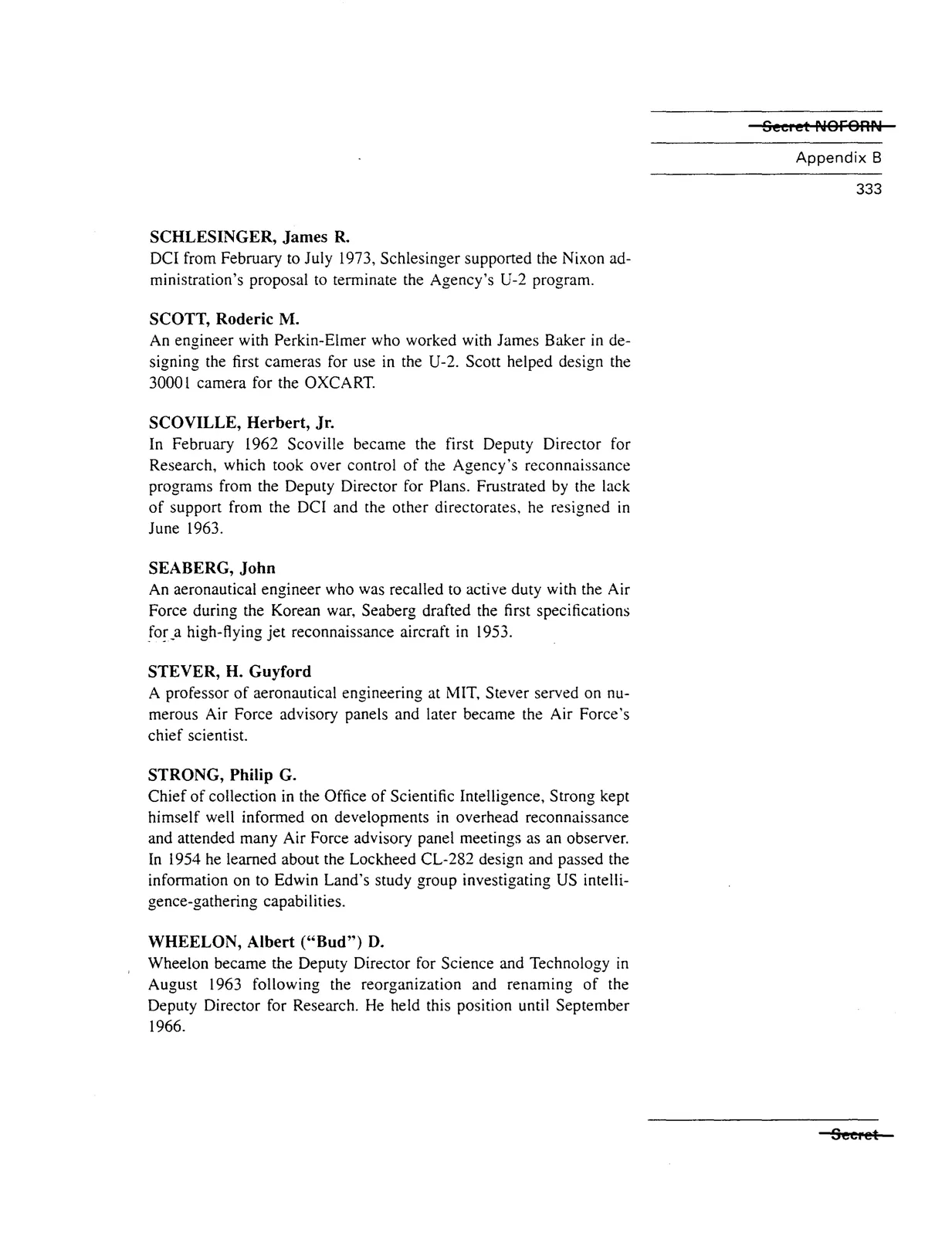
SCHLESINGER, James R.
DCI from February to July 1973, Schlesinger supported the Nixon ad
ministration's proposal to terminate the Agency's U-2 program.
SCOTT, Roderic M.
An engineer with Perkin-Elmer who worked with James Baker in de
signing the first cameras for use in the U-2. Scott helped design the
30001 camera for the OXCART.
SCOVILLE, Herbert, Jr.
In February 1962 Scoville became the first Deputy Director for
Research, which took over control of the Agency's reconnaissance
programs from the Deputy Director for Plans. Frustrated by the lack
of support from the DCI and the other directorates, he resigned in
June 1963.
SEABERG, John
An aeronautical engineer who was recalled to active duty with the Air
Force during the Korean war, Seaberg drafted the first specifications
fo~ _a high-flying jet reconnaissance aircraft in 1953.
STEVER, H. Guyf ord
A professor of aeronautical engineering at MIT, Stever served on nu
merous Air Force advisory panels and later became the Air Force's
chief scientist.
STRONG, Philip G.
Chief of collection in the Office of Scientific Intelligence, Strong kept
himself well informed on developments in overhead reconnaissance
and attended many Air Force advisory panel meetings as an observer.
In 1954 he learned about the Lockheed CL-282 design and passed the
information on to Edwin Land's study group investigating US intelli
gence-gathering capabilities.
WHEELON, Albert ("Bud") D.
, Wheelon became the Deputy Director for Science and Technology in
August 1963 following the reorganization and renaming of the
Deputy Director for Research. He held this position until September
1966.
See1 et NOFOAN
Appendix 8
5ee1et