The Central Intelligence Agency and Overhead Reconnaissance; The U-2 and OXCART Programs, 1954-1974
CIA-UAP-003 · page 37 of 406
Text
This text came with the file. It may have mistakes. When the text and the image disagree, the image is right.
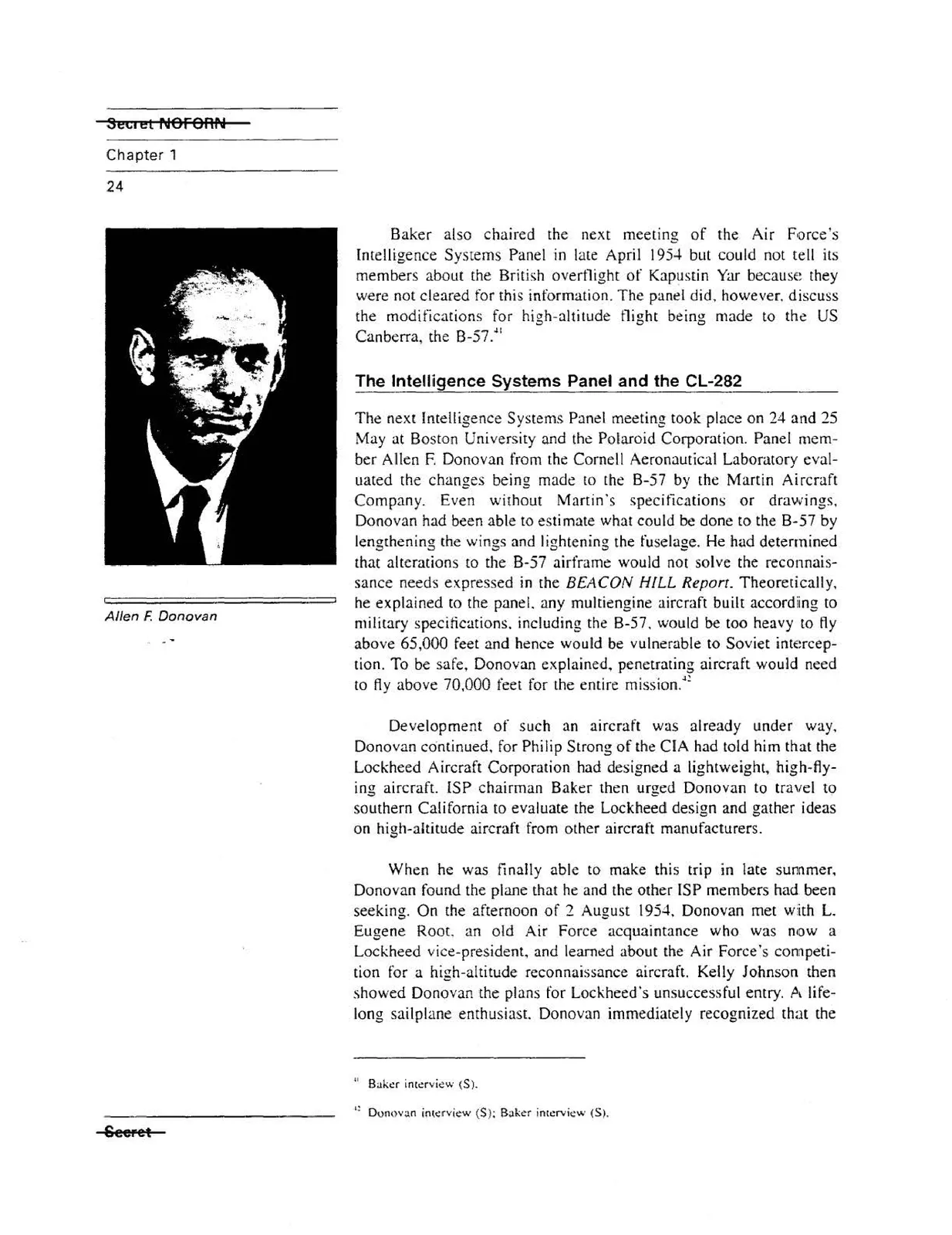
24 Sec, et NOFOAP~ Chapter 1 Allen F. Donovan Baker also chaired the next meeting of the Air Force's Intelligence Systems Panel in late April 1954 but could not tell its members about the British overflight of Kap~stin Yar because they were not cleared for this information. The panel did. however. discuss the modifications for high-alti tude flight being made to the US Canberra, the B-57." The Intelligence Systems Panel and the CL-282 The next Intelligence Systems Panel meeting took place on 24 and 25 May at Boston University and the Polaroid Corporation. Panel mem ber Allen F. Donovan from the Cornell Aeronautical Laboratory eval uated the changes bei ng made to the B-57 by the Martin Aircraft Company. Even wichout Martin's specifications or drawings, Donovan had been able to estimate what could be done to the 8-57 by lengthening the wings and lightening the fuselage. He had determined that alterations to the B-57 airframe would not sol ve the reconnais sance needs ex.pressed in the BEACON HILL Report. Theoretically, he explained to the panel. any multiengine aircraft built accordiing to military specifications. including the B-57. would be too heavy to fly above 65,000 feet and hence would be vulnerable to Soviet intercep tion. To be safe, Donovan explained, penetrating aircraft would need 10 fly above 70,000 feet for the entire mission.': Development of such an aircraft was already under way. Donovan continued. for Philip Strong of the CIA had told him that the Lockheed Aircraft Corporation had designed a lightweight, high-fly ing aircraft. ISP chairman Baker then urged Donovan to travel t9 southern California to evaluate the Lockheed design and gather ideas on high-altitude aircraft from other aircraft manufacturers. When he was finally able to make this trip in late summer, Donovan found the plane that he and the other ISP members had. been seeking. On the afternoon of 2 August 1954. Donovan met wiith L. Eugene Root. an old Air Force acquaintance who was n,ow a Lockheed vice-president. and learned about the Air Force's competi tion for a high-altitude reconnaissance aircraft. Kelly Johnson then showed Donovan the plans for Lockheed's unsuccessful entry. A life long sailplane enthusiast. Donovan immediately recognized that the .,: Donovan interview (S); Baker interview (S). Geeret