The Central Intelligence Agency and Overhead Reconnaissance; The U-2 and OXCART Programs, 1954-1974
CIA-UAP-003 · page 72 of 406
Text
This text came with the file. It may have mistakes. When the text and the image disagree, the image is right.
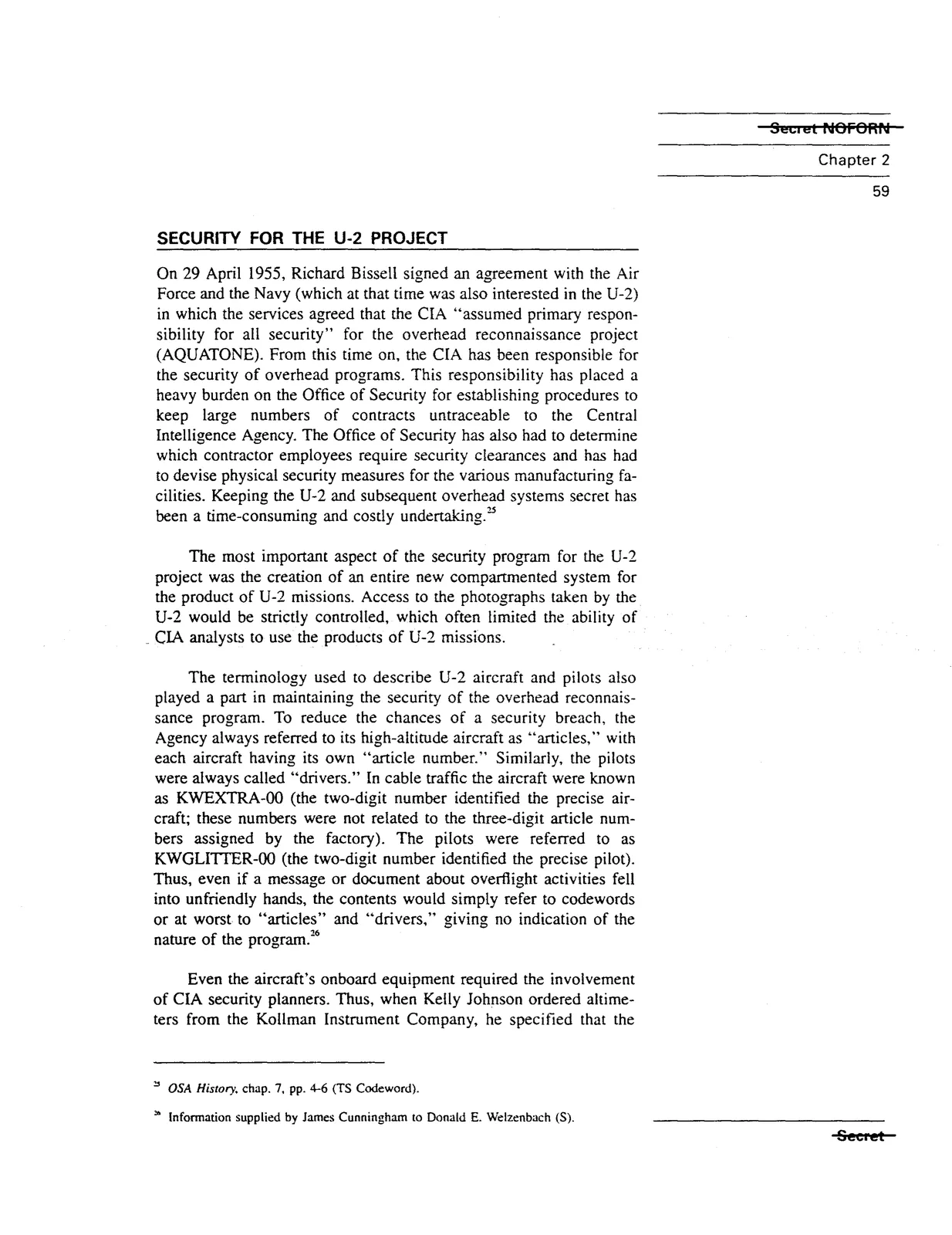
59 Sec,et NOFORN Chapter 2 SECURITY FOR THE U-2 PROJECT On 29 April 1955, Richard Bissell signed an agreement with the Air Force and the Navy (which at that time was also interested in the U-2) in which the services agreed that the CIA "assumed primary respon sibility for all security" for the overhead reconnaissance project (AQUATONE). From this time on, the CIA has been responsible for the security of overhead programs. This responsibility has placed a heavy burden on the Office of Security for establishing procedures to keep large numbers of contracts untraceable to the Central Intelligence Agency. The Office of Security has also had to determine which contractor employees require security clearances and has had to devise physical security measures for the various manufacturing fa cilities. Keeping the U-2 and subsequent overhead systems secret has been a time-consuming and costly undertaking. 25 The most important aspect of the security program for the U-2 project was the creation of an entire new compartmented system for the product of U-2 missions. Access to the photographs taken by the U-2 would be strictly controlled, which often limited the ability of _CIA analysts to use the products of U-2 missions. The terminology used to describe U-2 aircraft and pilots also played a part in maintaining the security of the overhead reconnais sance program. To reduce the chances of a security breach, the Agency always referred to its high-altitude aircraft as "articles," with each aircraft having its own "article number." Similarly, the pilots were always called "drivers." In cable traffic the aircraft were known as KWEXTRA-00 (the two-digit number identified the precise air craft; these numbers were not related to the three-digit article num bers assigned by the factory). The pilots were referred to as KWGLITTER-00 (the two-digit number identified the precise pilot). Thus, even if a message or document about overflight activities fell into unfriendly hands, the contents would simply refer to codewords or at worst to "articles" and "drivers," giving no indication of the nature of the program. -'6 Even the aircraft's onboard equipment required the involvement of CIA security planners. Thus, when Kelly Johnson ordered altime ters from the Kollman Instrument Company, he specified that the " OSA History. chap. 7, pp. 4-6 (TS Codeword). ,. lnfonnation supplied by James Cunningham to Donald E. Welzenbach (S). Secret