The Central Intelligence Agency and Overhead Reconnaissance; The U-2 and OXCART Programs, 1954-1974
CIA-UAP-003 · page 75 of 406
Text
This text came with the file. It may have mistakes. When the text and the image disagree, the image is right.
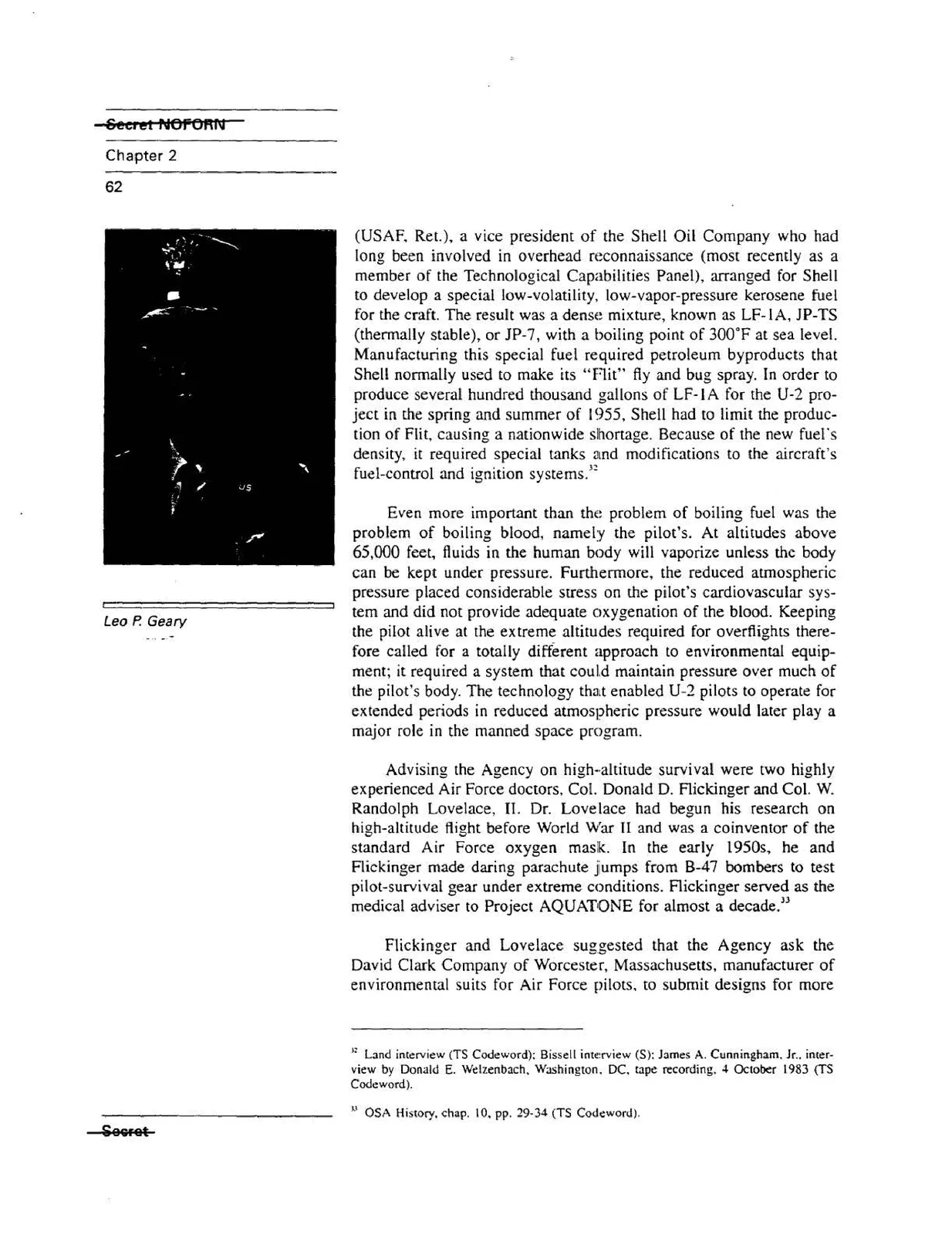
62 See, el N61'0Rl\1 Chapter 2 Leo P. Geary (USAF. Ret.), a vice president of the Shell Oil Company who had long been involved in overhead reconnaissance (most recently as a member of the Technological Capabilities Panel), arranged for Shell to develop a special low-volatility, low-vapor-pressure kerosene fuel for the craft. The result was a dense mixture, known as LF-1 A, JP-TS (thermally stable), or JP-7, with a boiling point of 300°F at sea level. Manufacturing this special fuel required petroleum byproducts that Shell normally used to make its "Flit" fly and bug spray. In order to produce several hundred thousand gallons of LF-1 A for the U-2 pro ject in the spring and summer of 1955. Shell had to limit the produc tion of Flit. causing a nationwide slhortage. Because of the new fuel's density, it required special tanks .:11nd modifications to the aircraft's fuel-control and ignition systems.)~ Even more important than the problem of boiling fuel was the problem of boiling blood, namely the pilot's. At altitudes above 65,000 feet, fluids in the human body will vaporize unless the body can be kept under pressure. Furthermore, the reduced atmospheric pressure placed considerable stress on the pilot's cardiovascular sys tem and did not provide adequate oxygenation of the blood. Keeping the pilot alive at the extreme altitudes required for overflights there fore called for a totally different approach to environmental equip ment; it required a system that coul,d maintain pressure over much of the pilot's body. The technology tha,t enabled U-2 pilots to operate for extended periods in reduced atmospheric pressure would later play a major role in the manned space program. Advising the Agency on high-•altitude survival were two highly experienced Air Force doctors, Col. Donald D. Flickinger and Col. W. Randolph Lovelace, 11. Dr. Lovelace had begun his research on high-altitude flight before World War II and was a coinventor of the standard Air Force oxygen maslk. In the early 1950s, he and Flickinger made daring parachute jiumps from B-47 bombers to test pilot-survival gear under extreme conditions. Flickinger served as the medical adviser to Project AQUATONE for almost a decade.H Flickinger and Lovelace suggested that the Agency ask the David Clark Company of Worcester, Massachusetts, manufacturer of environmental suits for Air Force pilots. to submit designs for more " Land interview (TS Codeword): Bissell inte,rview (S): James A. Cunningham. Jr.. inter view by Donald E. Welzenbach. Washington. DC. tape recording. 4 October 1983 (TS Codeword). '·' OSA History. chap. 10. pp. 29-34 (TS Codeword).