Australian Dept of Defense Scientific and Intel Aspects of the UFO Problem
CIA-UAP-019 · page 8 of 19
Text
This text came with the file. It may have mistakes. When the text and the image disagree, the image is right.
4.
4 its existe-nce.
Public disl.rihut.ion vaa !ll~de, ho,.-ev{lr, of a so
ee.lled 11 summa.ry" 1-hich in fa.ct did not Sul"lmariso, nor scarcely
&lludo to the 19·17-52 dc.ta 1 but conccntra.tcd or. 1953-55 rcportin.;
which vas cle~rly designed to reduce the residual unknowns to nn
insi{:nificant number, no matter how senseless tho identification
became.
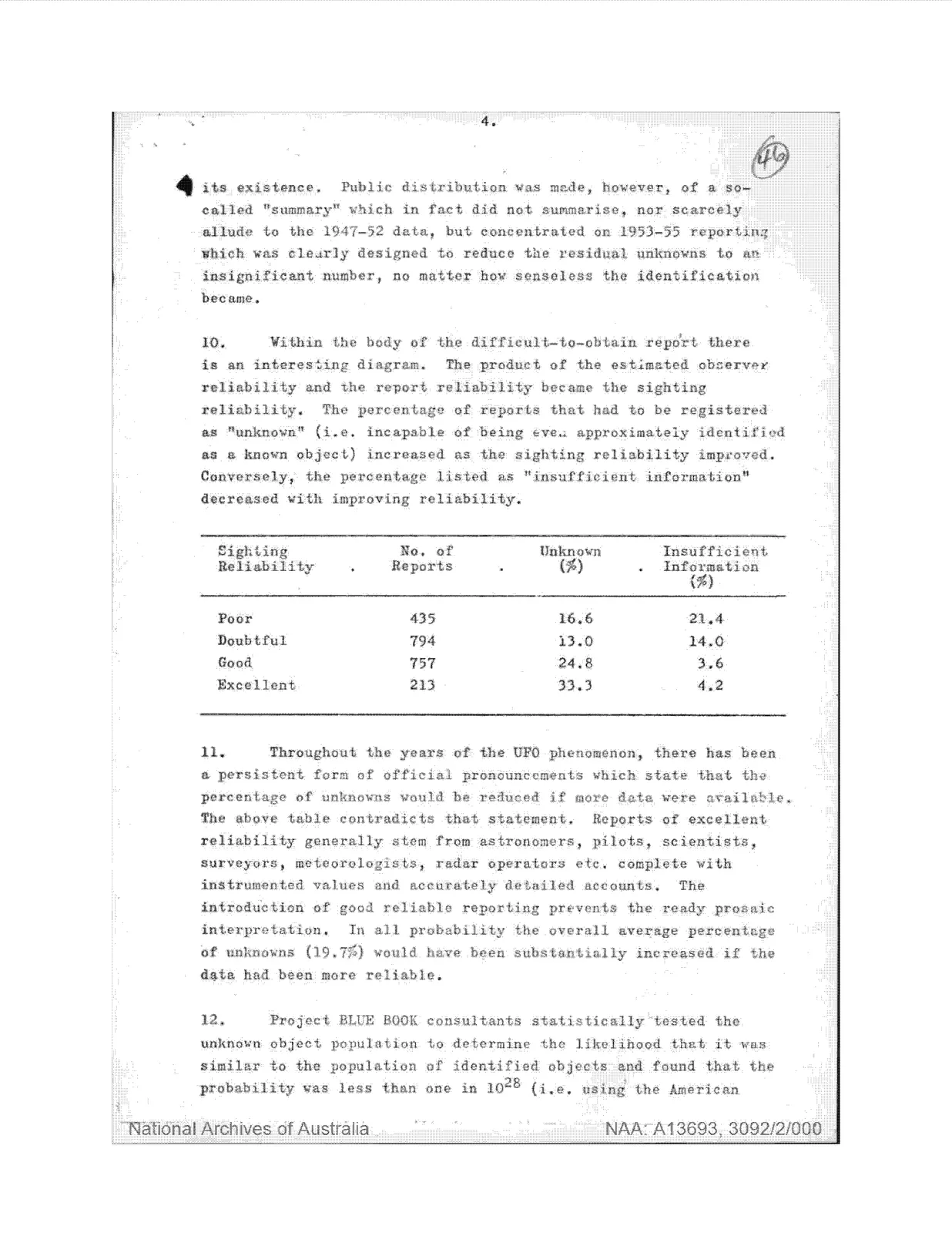
10.
Vi t.hin U1u body of the diffi cul t.-to-oh ta.in .repo'r l thei-e
il!I an intores~ing diagram.
The product of the estimated obr.erv"r
relia.bil i ty and t.be rel)ort reliability be,ame the sighting
relinllility.
Tht! ,percenlng!! of reporls that had to be register"'J
a.s t•unkno1.1n 11 (i.e. incapsble of being .,ye,. approximately identif i ,.-d
aa a. known object) increased as the sighting reliability impi.·o·:ed.
Conver5eJy, the percentage listed as "insufficient info~naLion"
d"creased with improving reliability.
~ighting
No. of
Uoknovn
Insufficie111,
Relia.bili ty
Reports
(%)
Informs.ti en
(,t;)
Poor
435
16.6
21.4
Doubtful
794
13.0
14.0
Good
757
24.8
J.6
Excellent
213
33.3
'1.2
11.
Throughout the years of the UFO phc,nomenon, there has been
e. persistent for:n of official pronouncements ',/hich state thut th-,
percentage of unknnwn5 would bA redu~ed if more data were c~ailnble.
The tshove table contradicts that statement.
Reports of excellent
reliability g1merally s tom from a.strono:nerE:, pilots, scientists,
surveyorn 1 mctcorolo;:ists, radar operators etc, complete with
instrumented valueR and Rccund,ely cllit.fdlt~d uc:counts.
The
introduction o~ good raliablo reporting pr•vnnts the roady prosaic
int.eq>ri~tation,
In all probability the overall average percentr.g!J
of llnkno..,ns ( 19. T~) would h:~.ve be ,m subs len I, ia l ly increased if thE.'
dita hnd been more reliablo.
12,
Project BLUE BOOK ccmsul tants sta.ti s t:i cal ly tos ted the
unknovn object popula~ion to determine the likelihood tbat it wn3
similar to the popult\tion of identified objects and found tha.t the
probability was less than one in 1028 (i,e. using the American
~ational Archives of Australia
NAA A 13693, 3092/2/000