Los Alamos Conference on Aerial Phenomena, 1949
DOE-UAP-D004 · page 24 of 25
Text
This text came with the file. It may have mistakes. When the text and the image disagree, the image is right.
•
:------•
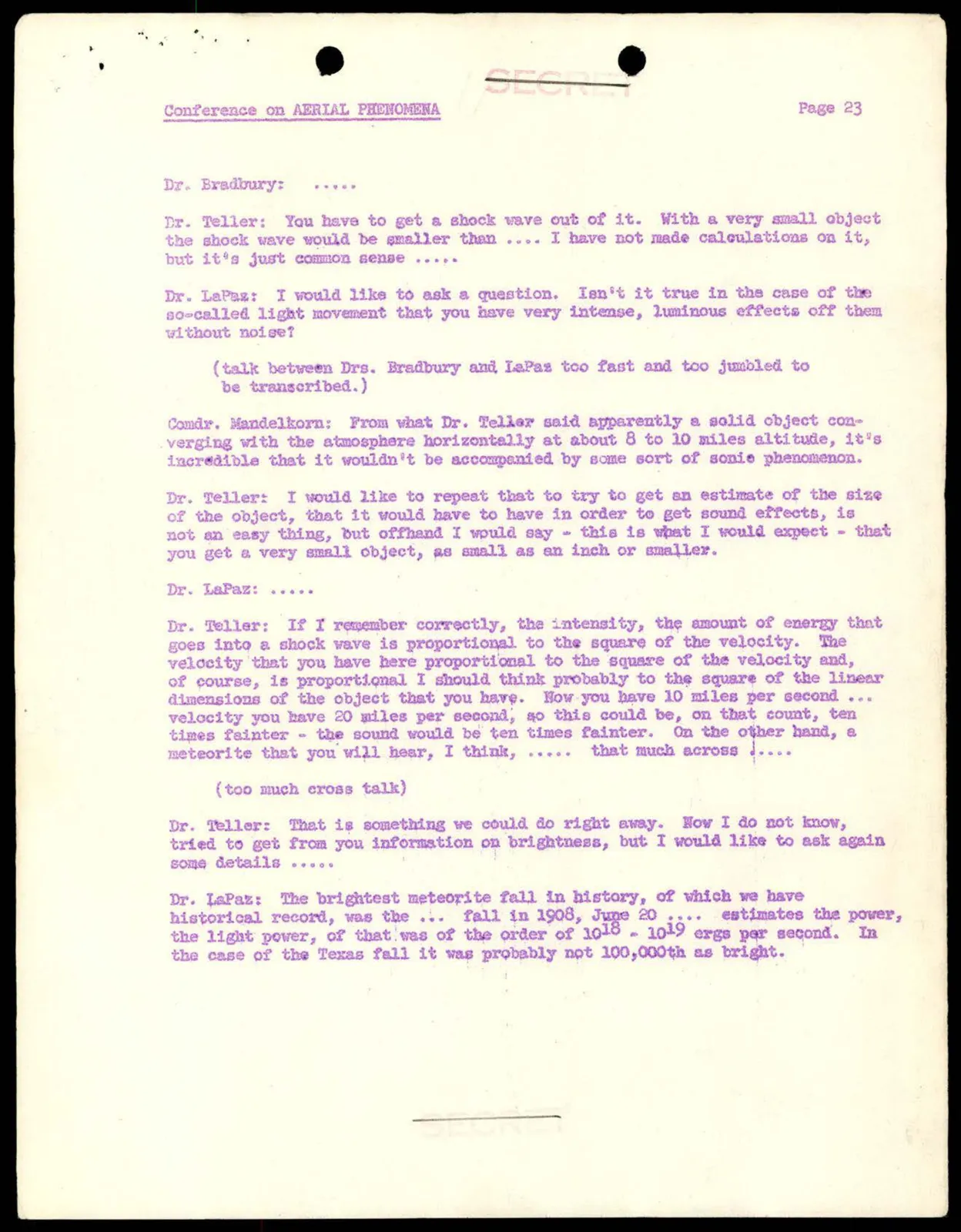
Conference on AERIAL PHENOMENA
Page 23
Dr.. l3radbury: .....
Dr . Teller :
You have to get a shock \18.Ve out ot it. W1th a very t.miaJ.l object
the shock uave Vl?uld be emaller tban .. •. I ba.ve not .made colcula.tiona on it,
but it 0 s just common sense ... . •
Dr. Le.Paz: I 1t-ould like to ask a question. Ien 8t it true in the case ot t
oo-called light movement that you have very intense, luminous effects off tbem
vithout noi~'l
( talk between Drs. Bradbury and La.Pa!. too taot and too jumbled to
be traniscribed.)
Comdr. Mandelkorn:
From what Dr. Tell r said apparently a solid object eon•
verging with the atmosphere horizon·tally at o.bout 8 to 10 miles e.ltitude, 1tvs
i ner dible that it wouldn 9t be accompanied by eome sort ot sonie phenomenon.
Dr. Teller! I w-ould like to repeat that to try to get sn estimate ot the si~~
of the object, 'that it would have to have in order to get sound effects, 1e
not an easy thing, but offhand I WPul.tl. a~ - this ie wtiat I -woulcl. e.xpoct - that
you get a very small object, ,-a small as an inch or BDla4ler.
Dr. LaPaz: . ....
Dr. Teller: If I ral}elllber correctly, the :..ntensity, th~ amount of energy thnt
goes into a ohock wave is proportio~ to th square of the velocity.
The
vel ocity tbat you have here proporti'onal to the square of the velocity and,
of QOurse, is proport1.Qnal I sbould think probably to th' square ot the linear
dimensions of the obJect tha't you bav~. Nov you hf;Lve 10 miles per eecond • ••
velocity you have 20 vdles per second~ AO this could be, on that count, ten
·t;~es fainter .. t.be sound would be ten times fainter.
OD the o\lM!r band, a
m eteor1te that you· will hear, I think, . • • • .
that much across J •• ••
•
l
( too much cross ta.lk)
Dr. Teller: That i~ something we c0uld do right away. 1'ov I do not know,
tried to get from you information on brightness, but I would like to ask again
some details ..• o •
Dr. l,aPaz: The brightest meteo;-1te tall 1n bistory, of Vhich ve have
historioal. record, vae tbe .~. fall 1n 19()8, ~
20 •••• est'-2na.tes the power,
the light power, of' that .was ot the order of 101 • 1019 ergs w aecOlld. In
the case of the Texas fall it wao prQbably not 100,0001;h as bright.