UAP Reported at Sandia Base, 1948-1950
DOW-UAP-D017 · page 5 of 116
Text
This text came with the file. It may have mistakes. When the text and the image disagree, the image is right.
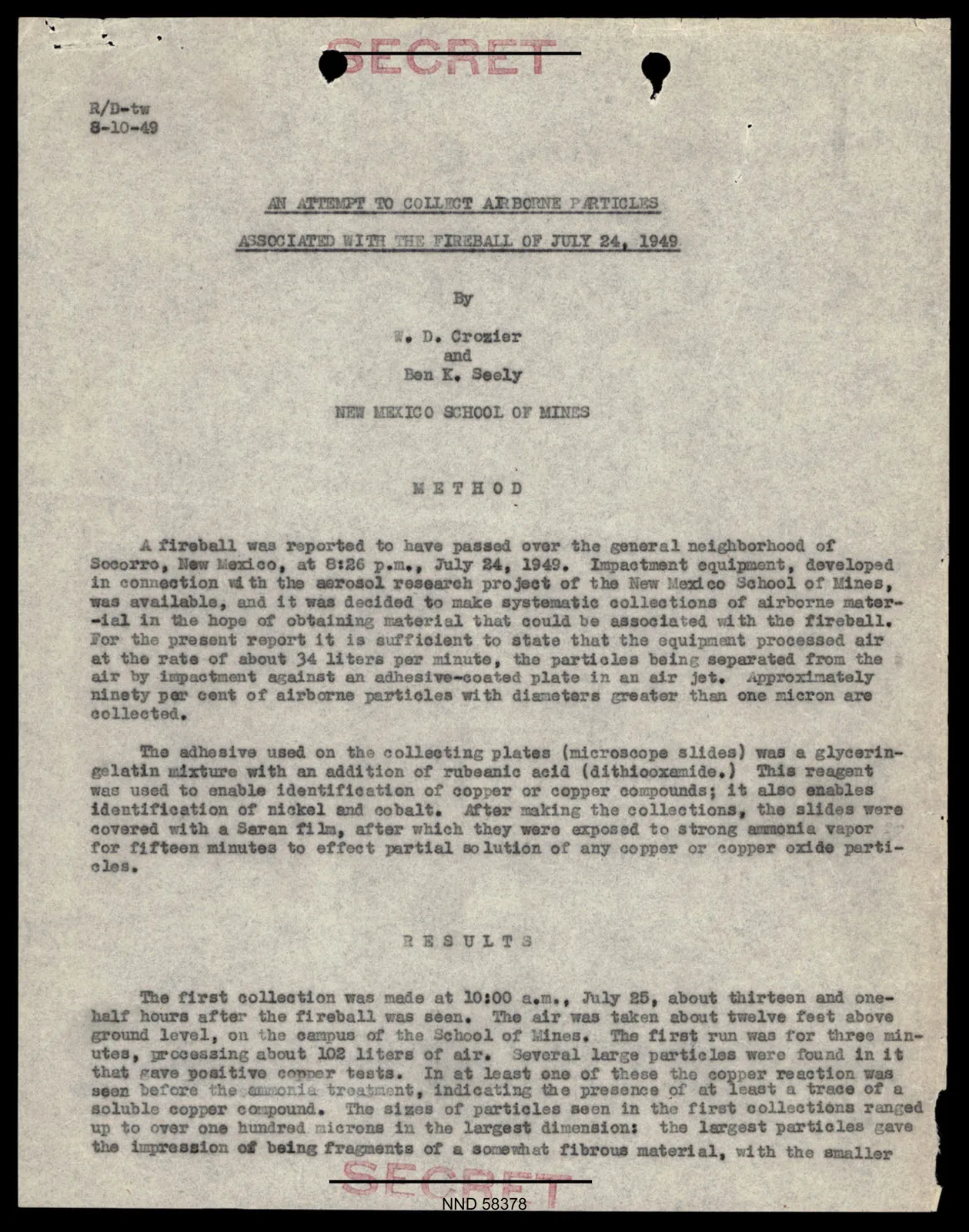
M ' R/D- tw 8-10-49 AN AT'l!EMP? 'ro coU.roT AnBCP.NE PAU'ICLES A'3SOOIA'l'ED fJI'l'iJ THE FIREBALL OF JULY 241 1949 By • n. Oroztor and Ben x. Seely HBTHOD A 'fireball was raportad to have pasaod ovor the general noighborhood of Socorro, Uew Uexi.00 1 at 8:26 p.m. 1 J'uly 241 1949. Impaotment equipment, develop9d in conneation 1a th the sarosol research proJect ot the New Mex1 co School of !lines, was available, and it was decided to make systematic collections ot airborne me.ter - iel. in the hope ot obta1nill8 material that could be associated .-1th the t1reball. For the present report it is suftio1ent to state that the equipnant processed air at the rate ot about J4 11tera per minute, the particles being separated f'rom the air by -impactment against en adhesi'f9-coate~ plate in an air jet. Appro:d!natel.y ninety per cent of airborne particlee with dianeters greater than one micron are collected. Tho adheeive used. on the collecting plates (mcroscope slides) waa a glycerin gelatin tlixture w1th an a.dd1tion or rubeanic aeid (dithiooxamide. ) 'l'lus reagent was used to enable identifioation of copper or copper compounds; it also enables identification of nickel and cobalt. After ?C:lking the eollaotions, the slides were covered with e. Saran til::l, after which thoy were exposed to strong aomonia vapor for r1:tteon Jninutes to effect partial ao lution or any copp_er or copper oxide parti el.Gs. R ESULT S '?he first oolleotion was made at 10:00 a . m., .ruly 25, about thirteen and one he.lf houra after the fireball was seen. The air wan te.lcen about twelve teet above ground lovel, on t he Ol!!'.IJ>UO ar the School ot Uines. Tho first run was i'or three min- , utes , ll['COosaing cbout 102 liters of air. Sevoro.l large particles wero :round in it that gave J)ositiva co pe.r teats. In at least ono or these the copper reaction was aeen petore the cn::mx>ni c tro~ont, indicating the presence 9f at least a trace of a aoluble copper co~pound. The sizes of particles aoon in tho first oollections ranged up to over one hundred microns in the largest dimension: the largest particles gave tho impression o~ bein.g f'r8gl:lents or a so:i:ievm.at f'ibrous material, llith the smaller ~~ NND 58378