UAP Reported at Sandia Base, 1948-1950
DOW-UAP-D017 · page 76 of 116
Text
A machine read this text from the scan. When the text and the image disagree, the image is right.
SECRET

December 20, 1948

TO: Colonel Doyle Rees

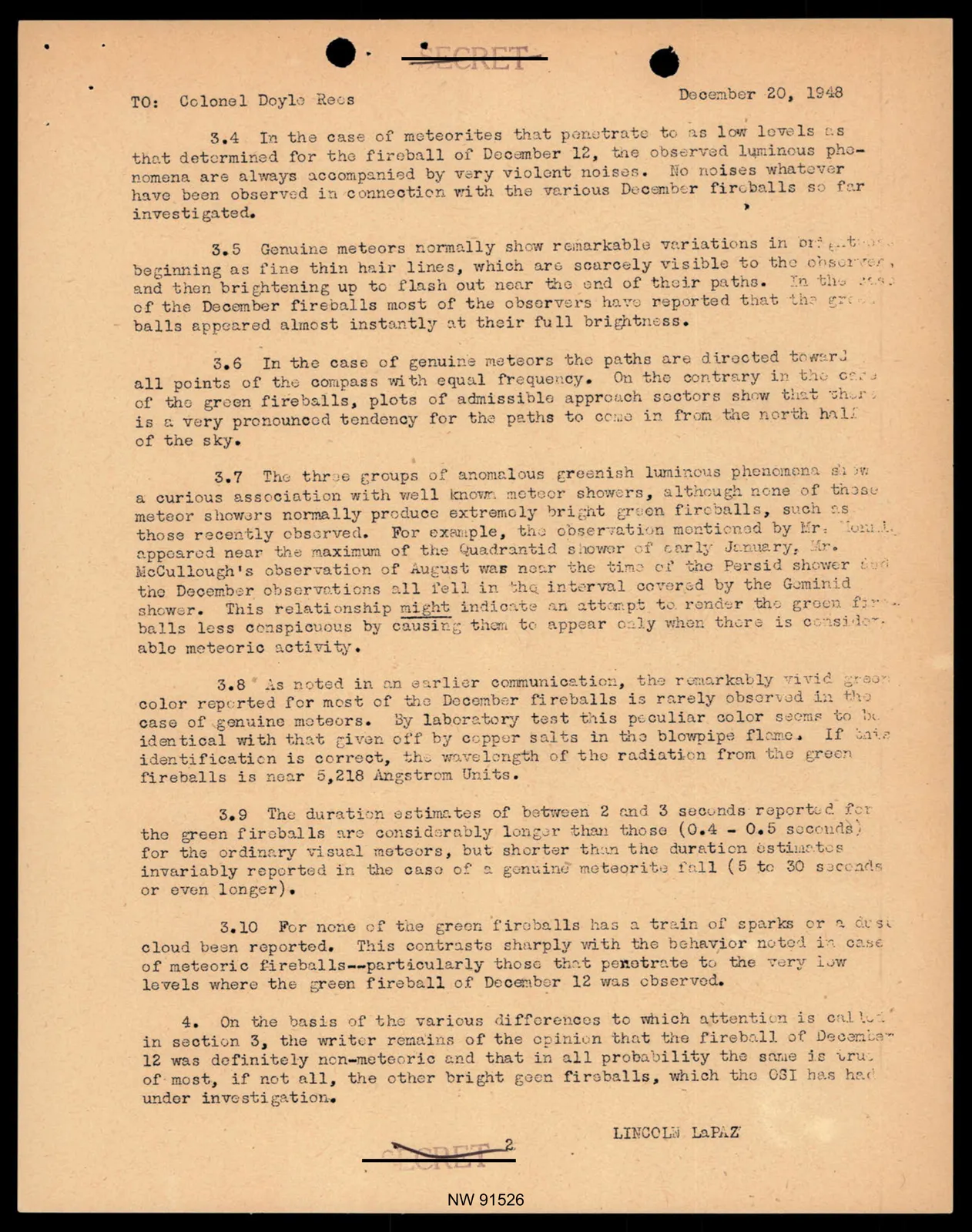
3.4 In the case of meteorites that penetrate to as low levels as that determined for the fireball of December 12, the observed luminous phenomena are always accompanied by very violent noises. No noises whatever have been observed in connection with the various December fireballs so far investigated.

3.5 Genuine meteors normally show remarkable variations in brightness, beginning as fine thin hair lines, which are scarcely visible to the observer, and then brightening up to flash out near the end of their paths. In the case of the December fireballs most of the observers have reported that the green balls appeared almost instantly at their full brightness.

3.6 In the case of genuine meteors the paths are directed toward all points of the compass with equal frequency. On the contrary in the case of the green fireballs, plots of admissible approach sectors show that there is a very pronounced tendency for the paths to come in from the north half of the sky.

3.7 The three groups of anomalous greenish luminous phenomena show a curious association with well known meteor showers, although none of these meteor showers normally produce extremely bright green fireballs, such as those recently observed. For example, the observation mentioned by Mr. McCullough appeared near the maximum of the Quadrantid shower of early January. Mr. McCullough's observation of August was near the time of the Persid shower and the December observations all fell in the interval covered by the Geminid shower. This relationship might indicate an attempt to render the green fireballs less conspicuous by causing them to appear only when there is considerable meteoric activity.

3.8 As noted in an earlier communication, the remarkably vivid green color reported for most of the December fireballs is rarely observed in the case of genuine meteors. By laboratory test this peculiar color seems to be identical with that given off by copper salts in the blowpipe flame. If this identification is correct, the wavelength of the radiation from the green fireballs is near 5,218 Angstrom Units.

3.9 The duration estimates of between 2 and 3 seconds reported for the green fireballs are considerably longer than those (0.4 - 0.5 seconds) for the ordinary visual meteors, but shorter than the duration estimates invariably reported in the case of a genuine meteorite fall (5 to 30 seconds or even longer).

3.10 For none of the green fireballs has a train of sparks or a dust cloud been reported. This contrasts sharply with the behavior noted in case of meteoric fireballs--particularly those that penetrate to the very low levels where the green fireball of December 12 was observed.

4. On the basis of the various differences to which attention is called in section 3, the writer remains of the opinion that the fireball of December 12 was definitely non-meteoric and that in all probability the same is true of most, if not all, the other bright green fireballs, which the OSI has had under investigation.

LINCOLN LaPAZ

SECRET

NW 91526