Film Analysis of Unidentified Objects, 1953
DOW-UAP-D098 · page 7 of 23
Text
This text came with the file. It may have mistakes. When the text and the image disagree, the image is right.
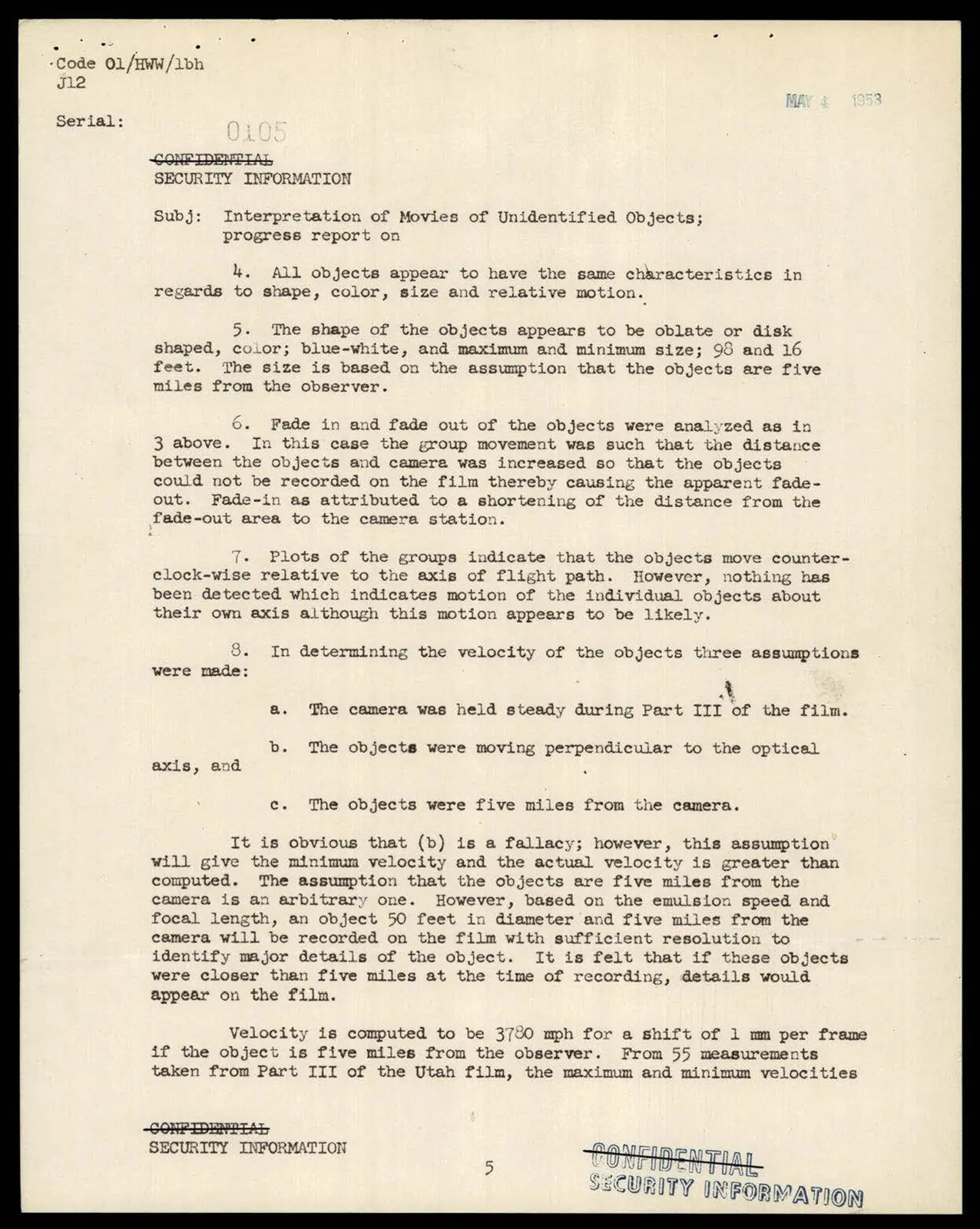
. ·Code 01/HWW/lbh Jl2 Serial: fl • r • -'' QQNFB}ENTIAL SECURITY Th1FORMATION Subj: Interpretation of Movies of Unidentified Objects; progress report on 4. All objects appear to have the same characteristics in regards to shape, color, size and relative motion. 5. The shape of the objects appears to be oblate or disk shaped, co~or; blue-white, and maximum and minimum size; 98 and 16 f eet. The size is based on the assumption that the objects are five miles from the observer. 6. Fade i n and fade out of the objects were analyzed ae in 3 above. I n this case the group movement vas such that the distance between the ob jects and camera was increased so that the objects could not be recorded on the film thereby causing the apparent fade out. Fade-in as attributed to a shortening of the distance from the fade-out area to the camera station . . I 7. Plots of the groups indicate that the objects move counter clock-wise relative to t he axis of flight path. However, nothing has been detected which indicates motion of the individual objects about their own axis al though this motion appears to be likely. 8. In determining the velocity of the objects three assumptions were ma.de: a. The camera was held s tea.dy during Part III of the film. b. The objects were moving perpendicular to the opticeJ. aY..is, and c. The objects were five miles from the camera. It is obvious that (b) is a fallacy ; however, this assumption vill give the minimum velocity and the actual velocity is greater than computed. The assumption that the objects are five miles from the camera i s a n arbitrary oue. However , based on the emulsion speed and focal length, an object 50 feet in diameter a nd five miles from the camera will be recorded on the film with sufficient resolution to identify major detail s of the object. It is felt that if these objects were closer than five miles at the time of recording, details would appear on the film. Velocity is computed to be 3780 mph for a shift of l mm per :t'rame 1:f the object is five miles from the observer. From 55 measurements taken from Part III of the Utah film, the maxi mum and minimum velocities COUFIB-Em?IAL SECURITY INFORMATION 5 ' U ~:E~Mooavw Da-f;rF@oowr£1'ifa@oo