Project Blue Book File on Tremonton Film, Utah, 1952
DOW-UAP-D102 · page 140 of 156
Text
This text came with the file. It may have mistakes. When the text and the image disagree, the image is right.
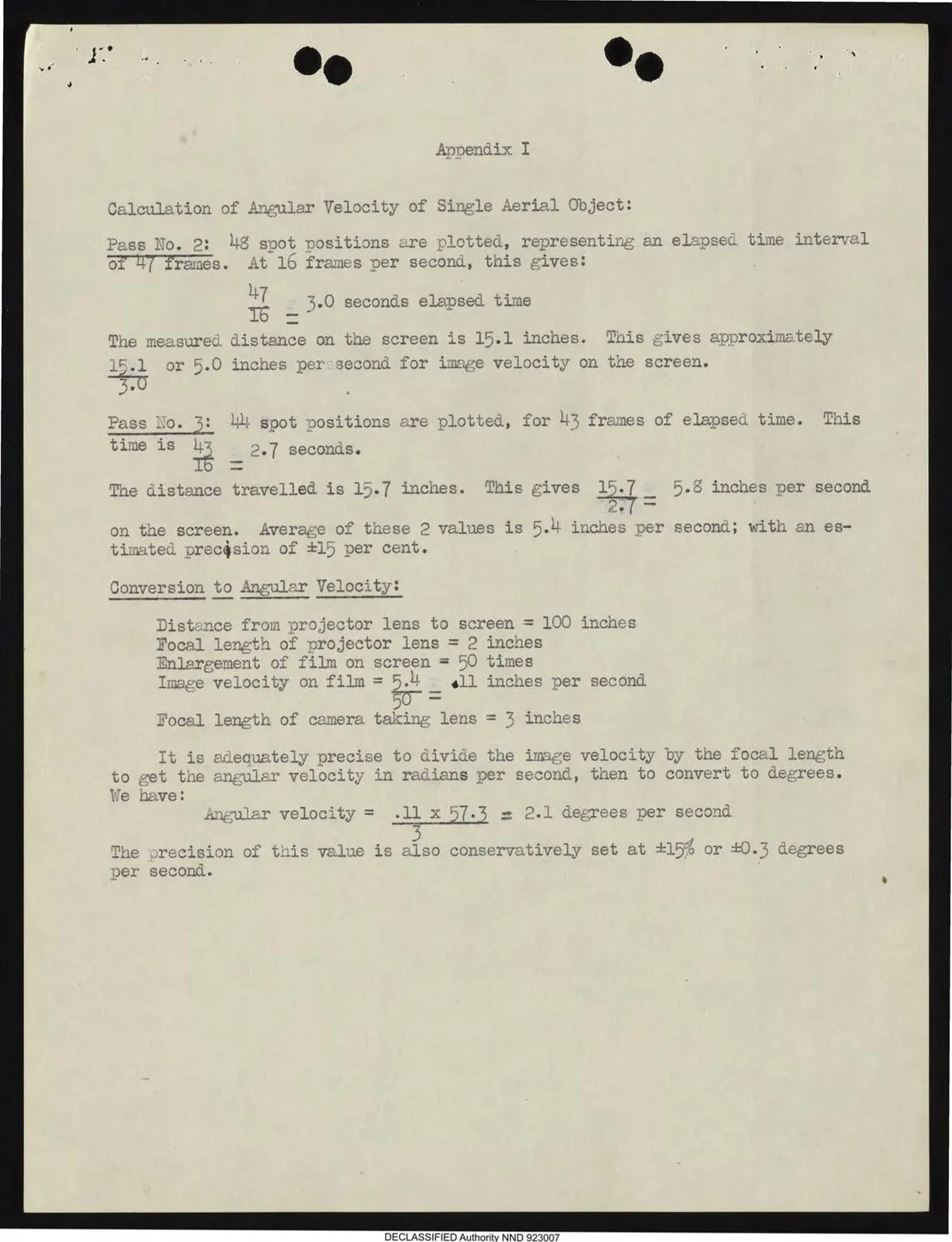
Appendix I Calculation of Angular Velocity of Single Aerial Object: Pass o. 2: 48 spot positions c..re plotted, representing an elapsed time interval of 47 frames. At 16 frames per second, this gives: 3.0 seconds elapsed time The measure distance on the screen is 15.1 inches. Ta.is gives approximately 15.1 or 5.0 inches per second for image velocity on the screen. ~ . Pass Ho . 44 spot nositions are plotted, for 43 frames of elapsed time. This time is 2.7 seconds. The distance travelled is 15.7 inches. This gives 15.t_ 5.8 inches -oer second '°l I': . on the screen. Average of these 2 values is 5.4 inches per second; with an es timated prec4sion of ±15 per cent. Conversion to Angular Velocity: Distance from projector lens to screen= 100 inches Focal length of projector lens= 2 inches EnJ.areement of film on screen= 50 times Image velocity on film=~= ,11 inches per second Focal length of camera taking lens= 3 inches It is adequately precise to divide the in:age velocity by the focal length to get the angular velocity in radians per second, then to convert to degrees. 1•re ba.ve: Angular velocity= .11 x 57.3 = 2.1 degrees per second 3 The ~recision of this value is also conservatively set at ±151 or ±0.3 degrees per second.