Project Blue Book File on Tremonton Film, Utah, 1952
DOW-UAP-D102 · page 86 of 156
Text
This text came with the file. It may have mistakes. When the text and the image disagree, the image is right.
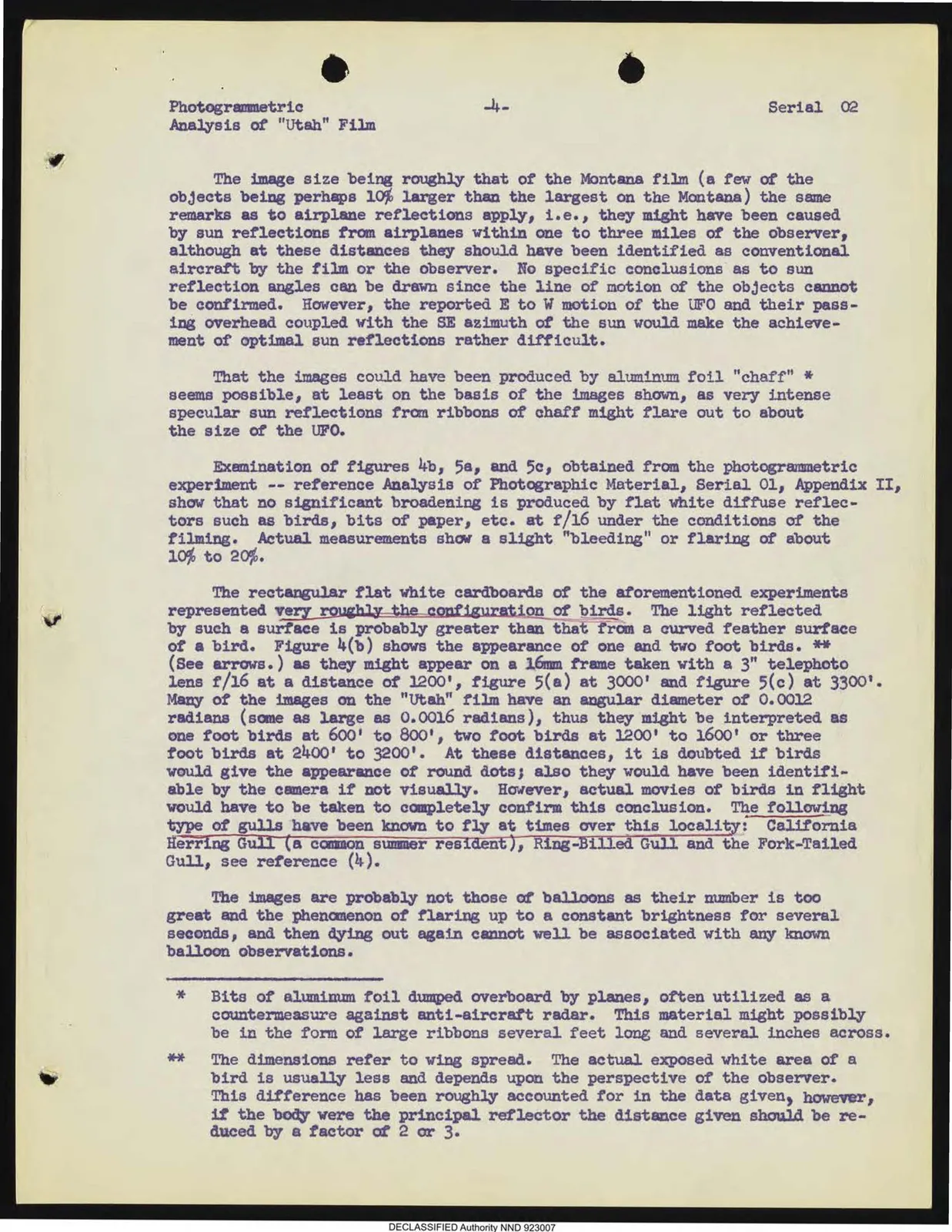
• • Photogrammetrio -4- Serial 02 Analysis ot "utah" Film The image size being roughly that of the ?oontana film (a tew at the objects being perhaps 1~ larger than the largest on the Montana) the eame remarks as to airplane reflections apply, i.e., they might haVe been caused by sun reflections tram airplanes Within one to three miles at the observer, although at these distances they should have been identif"ied as conventiOZJ.al aircraft by the til.m or the observer. No specific conclusions as to sun reflection angles oan be drawn since the line of motion of the objects cannot be confirmed. However, the reported E to 'W motion of the UFO and their pass ing overhead coupled with the SE azimuth of the sun would make the achieve ment of optimal sun reflections rather di.:f'tioult. That the images coul.d have been produced by aluminum foil "chaff"* seems possible, et least on the basis of the images shown, as very intense specular sun ref'leotions from ribbons of ahaft might flare out to about the size ot the UFO. Examination ot figures 4b, 5a, and 5c, obtained f"rom the pbotogrammetric experiment-· reference Analysis of Photographic Mater1a1, Serial 011 Appendix II, show that no significant broadening is produced by flat white di.tf'use reflec tors such as birds, bits of paper, etc. at f/16 under the conditions of the filming. Actual measurements shOW' a slight "bleeding" or flar1.Ilg ate.bout 1~ to 2()%. The rectangular flat Vhite cardboards ot the aforementioned experiments represented verz !"9'1&),Jy the cont:tsurati ot l>irds. The light reflected by such a surtace is probably greater than that fran a curved f'eather surface ot • bird. Figure 4(b) shows the appearance of one and two foot birds. ff (Se arrows.) as they might appear on a 16mm trame taken With a 3" telephoto lens f/16 at a distance ot 1200', tigure 5(a) at 3000' and figure 5(c) at 3300•. Maey of the images on the "Utah" t'ilm have an angular diameter ot 0.0012 radians (acme as large as 0.0016 radians), thus they might be interpreted as mie foot birds at 600 1 to 8oo 1 , two toot birds at 1200' to 1600 1 or three :toot birds at 2400 1 to 3200'. At these distances, it is doubted it birds would give the appearance or round dotsJ also they would have been identifi able by the c era if' not visually. H011ever, actual movies of birds in flight would have to be taken to completely confirm this conclusion. The toll.owing type ot gulls have been known to fly at times over th1e locali : California rr G a CCl!DOn summer res n , R ng- ed. Gull and the Fork-Tailed Gull, see reference (4). The images are probably not those ar balloons as their number is too great aud the phenanenon ot tlaricg up to a constant brightness for several seconds, and then dying out again cannot well be associated with au:, known balloon observations. * Bita of a1nm1 mm toil dumped overboard by planes, often utilized as a. countermeasure against ant1-a1rcratt radar. This material might possibly be in the form ot large ribbons several feet lODg and several inches across. H The dimensions refer to ving spread. The actual exposed white area of a bird is usua1ly less and depends upon the perspective of the observer. This dif'terence has been roug~ accounted tor 1n the data given, bowe'Yer, ~the~ were the principal. reflector the distance given show.d be re duced by tactor ~ 2 c,r 3. DECLASSIFIED Authority NND 923007