AAWSAP DIRD, Metallic Glasses for Aerospace Applications, December 2009
DOW-UAP-D117 · page 10 of 30
Text
This text came with the file. It may have mistakes. When the text and the image disagree, the image is right.
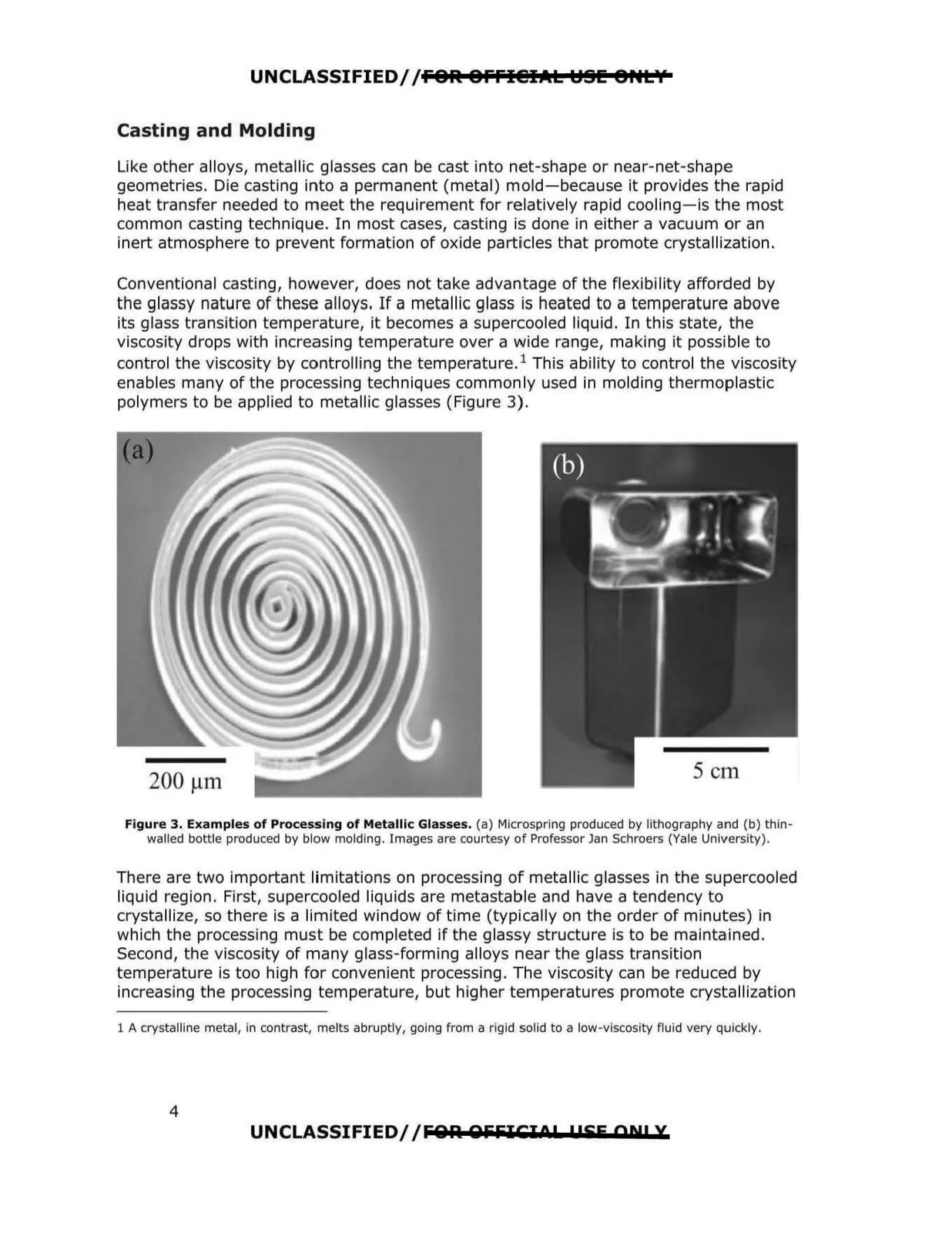
UNCLASSIFIED//FOR OFFl@IAL ~SI! 8HLY Casting and Molding Like other alloys, metallic glasses can be cast into net-shape or near-net-shape geometries. Die casting into a permanent (metal) mold-because it provides the rapid heat transfer needed to meet the requirement for relatively rapid cooling- ls the most common casting technique. In most cases, casting is done in either a vacuum or an inert atmosphere to prevent formation of oxide particles that promote crystallization. Conventional casting, however, does not take advantage of the flexibility afforded by the glassy nature of these alloys. If a metallic glass is heated to a temperature above its glass transition temperature, it becomes a supercooled liquid. In this state, the viscosity drops with increasing temperature over a wide range, making it possible to control the viscosity by controlling the temperature. 1 This ability to control the viscosity enables many of the processing techniques commonly used in molding thermoplastic polymers to be applied to metallic glasses (Figure 3). 200 µm Figure 3. Examples of Processing of Metallic Glasses. (a) Microsprlng produced by lithography and (b) thin walled bottle produced by blow molding. Images are courtesy of Professor Jan Schroers (Yale University). There are two important limitations on processing of metallic glasses in the supercooled liquid region. First, supercooled liquids are metastable and have a tendency to crystallize, so there is a limited window of time (typically on the order of minutes) in which the processing must be completed if the glassy structure is to be maintained. Second, the viscosity of many glass-forming alloys near the glass transition temperature is too high for convenient processing. The viscosity can be reduced by increasing the processing temperature, but higher temperatures promote crystallization 1 A crystalline metal, In contrast, melts abruptly, going from a rigid solid to a low-viscosity fluid very quickly. 4 UNCLASSIFIED//FOA OJifilCIOP 1155 ON! X