AAWSAP DIRD, Metallic Glasses for Aerospace Applications, December 2009
DOW-UAP-D117 · page 19 of 30
Text
This text came with the file. It may have mistakes. When the text and the image disagree, the image is right.
UNCLASSIFIED//POI\ OPPl@IAL WS& 0,u.v
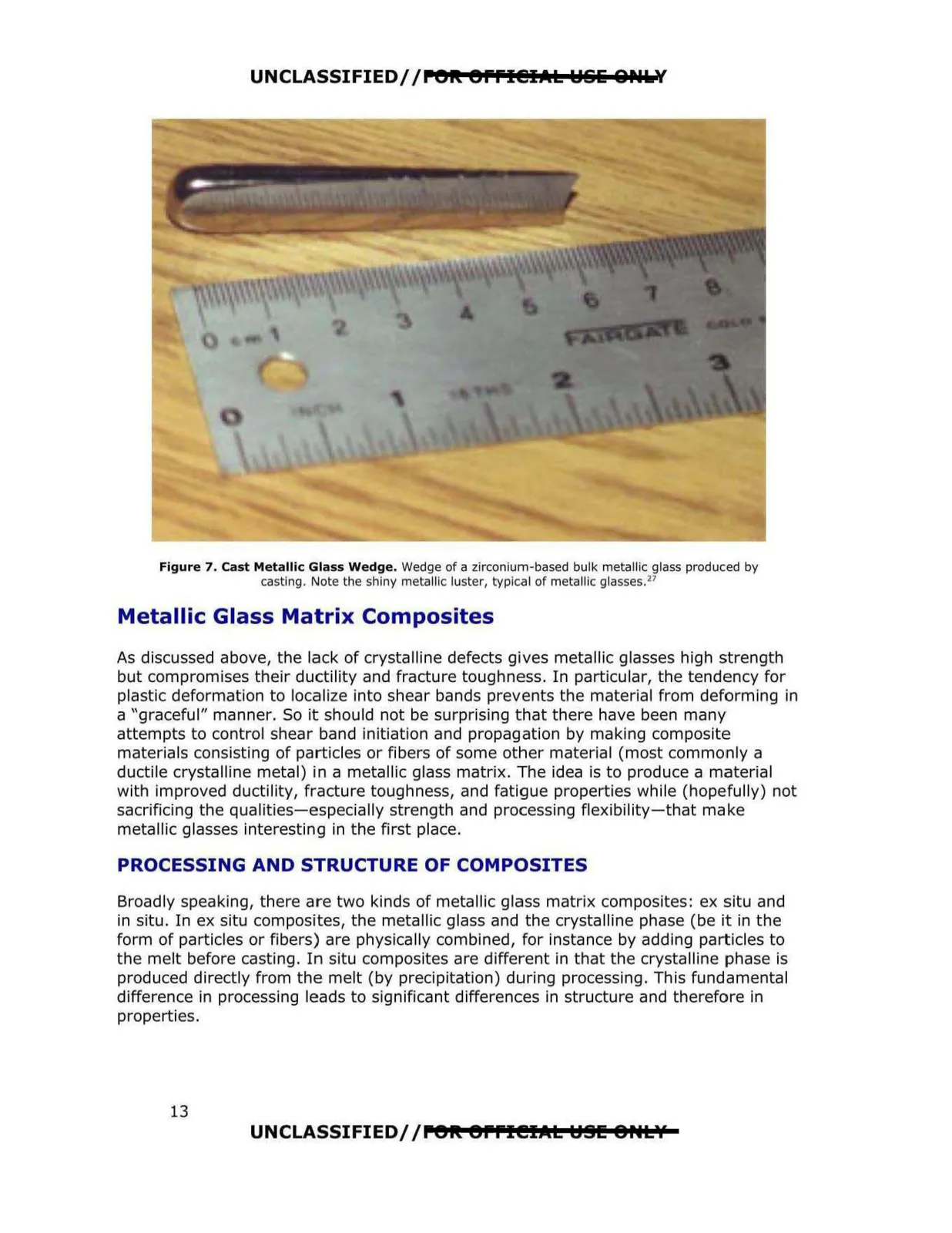
Figure 7. Cast Metallic Glass Wedge. Wedge of a zirconium-based bulk metallic glass produced by
casting. Note the shiny metallic luster, typical of metallic glasses. 27
Metallic Glass Matrix Composites
As discussed above, the lack of crystalline defects gives metallic glasses high strength
but compromises their ductility and fracture toughness. In particular, the tendency for
plastic deformation to localize into shear bands prevents the material from deforming in
a "graceful" manner. So it should not be surprising that there have been many
attempts to control shear band initiation and propagation by making composite
materials consisting of particles or fibers of some other material (most commonly a
ductile crystalline metal) in a metallic glass matrix. The idea is to produce a material
with improved ductility, fracture toughness, and fatigue properties while (hopefully) not
sacrificing the qualities- especially strength and processing flexibility- that make
metallic glasses interesting in the first place.
PROCESSING AND STRUCTURE OF COMPOSITES
Broadly speaking, there are two kinds of metallic glass matrix composites: ex situ and
in situ. In ex situ composites, the metallic glass and the crystalline phase (be it in the
form of particles or fibers) are physically combined, for instance by adding particles to
the melt before casting. In situ composites are different in that the crystalline phase is
produced directly from the melt (by precipitation) during processing. This fundamental
difference in processing leads to significant differences in structure and therefore in
properties.
13
UNCLASSIFIED//POI\ OPPlelAL liS! 8HLV