AAWSAP DIRD, Metallic Glasses for Aerospace Applications, December 2009
DOW-UAP-D117 · page 21 of 30
Text
This text came with the file. It may have mistakes. When the text and the image disagree, the image is right.
UNCLASSIFIED//P'OR OP'P'l@IAL WS& &Nia¥
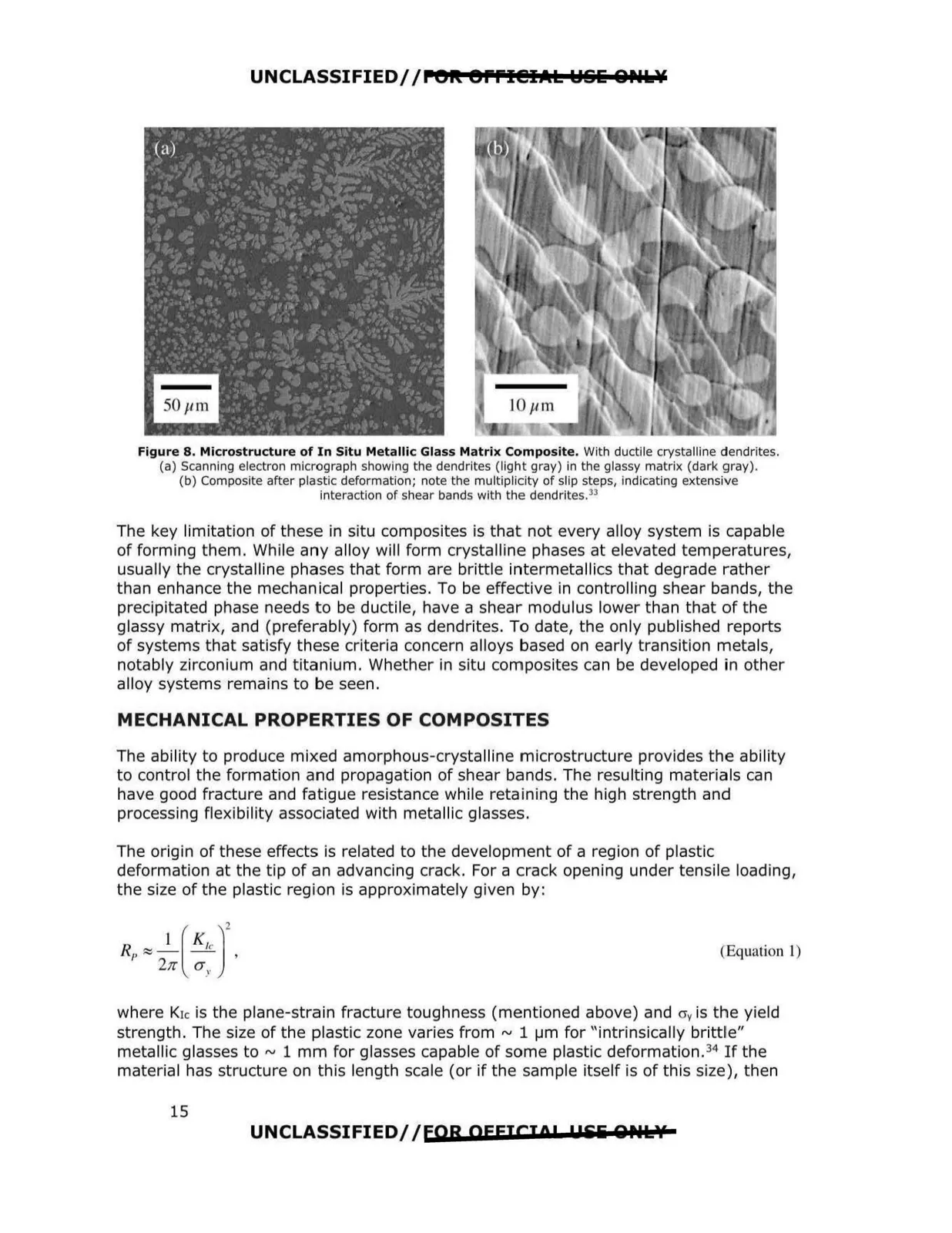
Figure 8. Microstructure of In Situ Metallic Glass Matrix Composite. With ductile crystalline dendrites.
(a) Scanning electron micrograph showing the dendrites (light gray) in the glassy matrix (dark gray).
(b) Composite after plastic deformation; note the multiplicity of slip steps, indicating extensive
interaction of shear bands with the dendrltes.33
The key limitation of these in situ composites is that not every alloy system is capable
of forming them. While any alloy will form crystalline phases at elevated temperatures,
usually the crystalline phases that form are brittle intermetallics that degrade rather
than enhance the mechanical properties. To be effective in controlling shear bands, the
precipitated phase needs to be ductile, have a shear modulus lower than that of the
glassy matrix, and (preferably) form as dendrites. To date, the only published reports
of systems that satisfy these criteria concern alloys based on early transition metals,
notably zirconium and titanium. Whether in situ composites can be developed in other
alloy systems remains to be seen.
MECHANICAL PROPERTIES OF COMPOSITES
The ability to produce mixed amorphous-crystalline microstructure provides the ability
to control the formation and propagation of shear bands. The resulting materials can
have good fracture and fatigue resistance while retaining the high strength and
processing flexibility associated with metallic glasses.
The origin of these effects is related to the development of a region of plastic
deformation at the tip of an advancing crack. For a crack opening under tensile loading,
the size of the plastic region is approximately given by:
(Equation 1)
where Kie is the plane-strain fracture toughness (mentioned above) and crv is the yield
strength. The size of the plastic zone varies from ~ 1 µm for "intrinsically brittlle"
metallic glasses to ,.., 1 mm for glasses capable of some plastic deformation. 34 If the
material has structure on this length scale (or if the sample itself is of this size), then
15
UNCLASSIFIED//FQB OFFICIO! 1!&'Ii QNLY