AAWSAP DIRD, Metallic Glasses for Aerospace Applications, December 2009
DOW-UAP-D117 · page 8 of 30
Text
This text came with the file. It may have mistakes. When the text and the image disagree, the image is right.
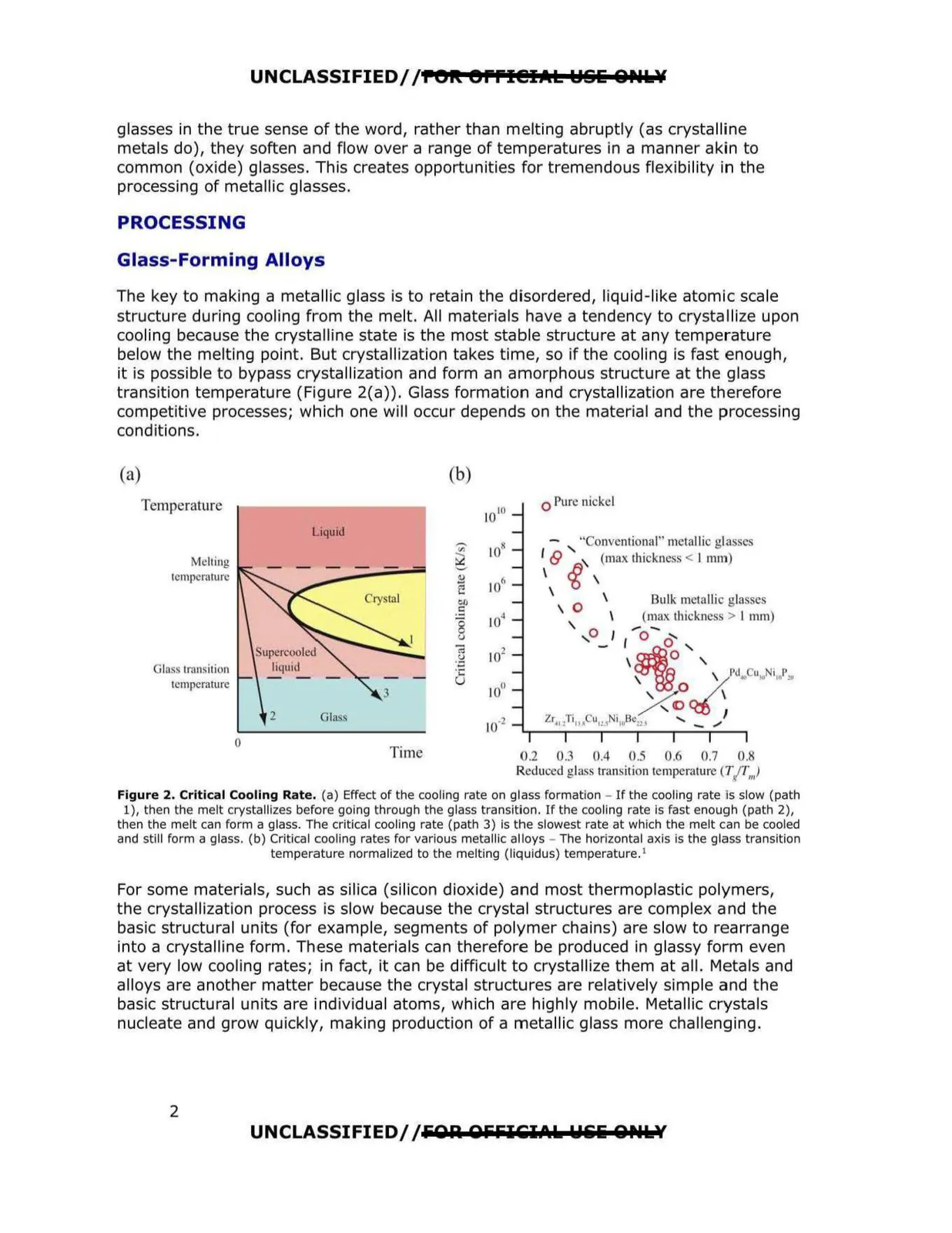
UNCLASSIFIED//POI\ OFPl@IAL WS& &Nia¥ glasses in the true sense of the word, rather than melting abruptly (as crysta lline metals do), they soften and flow over a range of temperatures in a manner akin to common (oxide) glasses. This creates opportunities for tremendous flexibi lity in the processing of metallic glasses. PROCESSING Glass-Forming Alloys The key to making a metallic glass is to retain the disordered, liquid-like atomic scale structure during cooling from the melt. All materials have a tendency to crystal lize upon cooling because the crystalline state is the most stable structure at any temperature below the melting point. But crystallization takes time, so if the cooling is fast enough, it is possible to bypass crysta llization and form an amorphous structure at the glass transition temperature (Figure 2(a)). Glass formation and crystallization are therefore competitive processes; which one will occur depends on the material and the processing conditions. (a) (b) Temperature 101(1 Liquid ~ g_ "' 10~ Me llii1g ,., 1ompcrarurc i§ 10<• "'1) I: 8 10" u el u 102 lass lr:msition ··o c: temperatu.re u 1011 I0.2 0 Purt: nickel - , " onventional' metallic gla scs I 0 , (max Lh1clme < I mm) \ cg \ \ O \ Bulk metallic glasses \ (max lb icknes > l mm) ' 0 -- '_I I O o' ' \ ~ ' 'x,o~ \ \ Pd., u.,N11,P,, . . 0 I Zr,.,T1 1,.Cu,,,N1"Bc,.,, ...._ _,, 0 Time 01 OJ OA 05 Oh 0~ OB Reduced glass tran ition temperature (T ,IT,,.) Figure 2. Critical Cooling Rate. (a) Effect of the cooling rate on glass formation - If the cooling rate ls slow (path 1), then the melt crystallizes before going through the glass transition. If the cooling rate is fast enough (path 2), then the melt can form a glass. The critical cooling rate (path 3) is the slowest rate at which the melt can be cooled and still form a glass. (b) Critical cooling rates for various metallic alloys - The horizontal axis is the glass transition temperature normalized to the melting (liquidus) temperature. 1 For some materials, such as silica (silicon dioxide) and most thermoplastic polymers, the crystallization process is slow because the crystal structures are complex and the basic structural units (for example, segments of polymer chains) are slow to rearrange into a crystalline form. These materials can therefore be produced in glassy form even at very low cooling rates; in fact, it can be difficult to crystallize them at all. Metals and alloys are another matter because the crystal structures are relatively simple and the basic structural units are individual atoms, which are highly mobile. Metallic crystals nucleate and grow quickly, making production of a metallic glass more challenging. 2 UNCLASSIFI ED/ /FOA OFFICI.li.la Wili 8PU11¥