AAWSAP DIRD, Biomaterials, January 2010
DOW-UAP-D119 · page 19 of 32
Text
This text came with the file. It may have mistakes. When the text and the image disagree, the image is right.
UNCLASSIFIED/ /FOR OFFl&IAl l:ISE 8HlY
Two common ceramics used in
dentistry and hip prostheses are
alumina and hydroxyapatite (HA). HA
is a major component of the inorganic
compartment of bone. Commercially
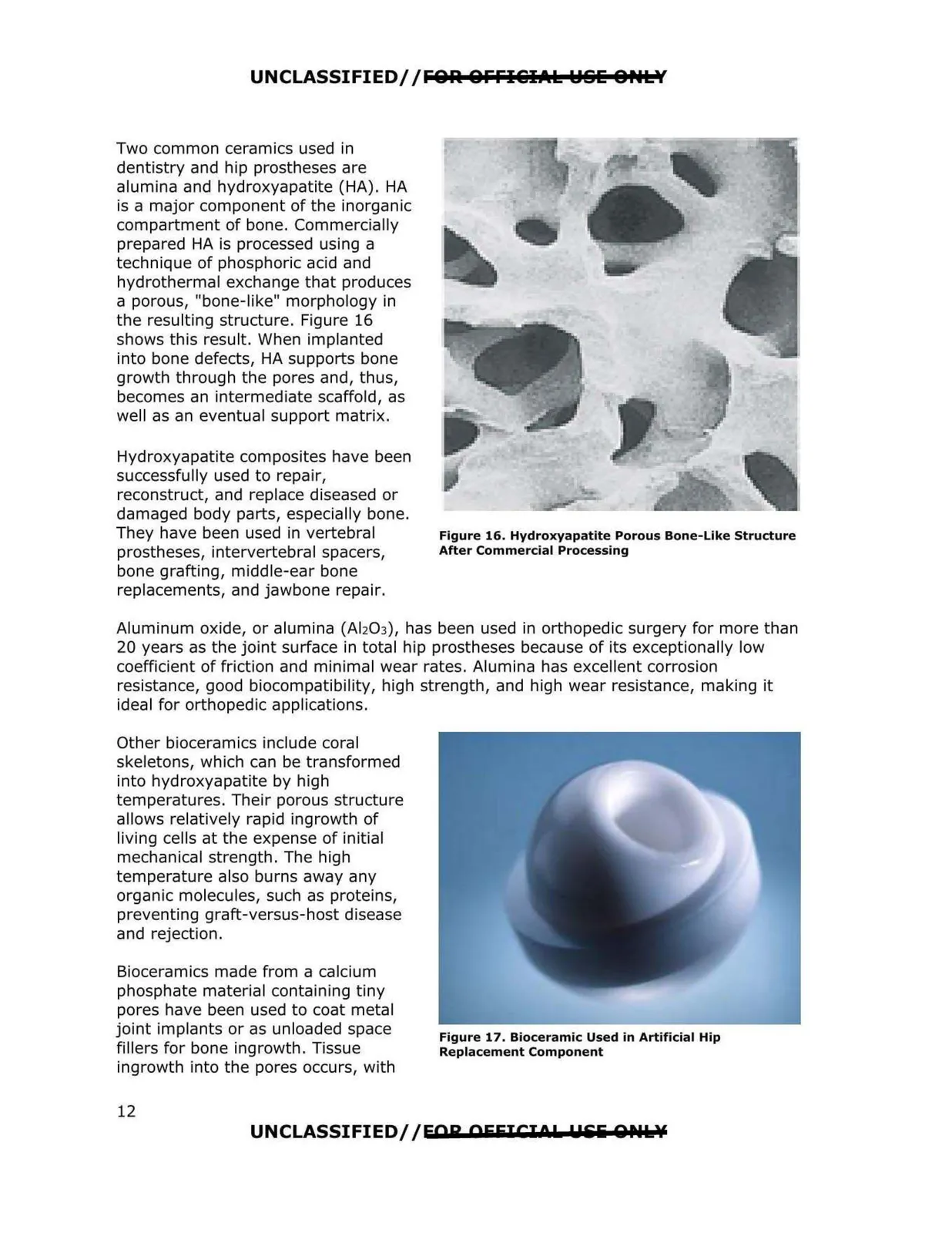
prepared HA is processed using a
technique of phosphoric acid and
hydrothermal exchange that produces
a porous, "bone-like" morphology in
the resulting structure. Figure 16
shows this result. When implanted
into bone defects, HA supports bone
growth through the pores and, thus,
becomes an intermediate scaffold, as
well as an eventual support matrix.
Hydroxyapatite composites have been
successfully used to repair,
reconstruct, and replace diseased or
damaged body parts, especially bone.
They have been used in vertebral
Figure 16. Hydroxyapatite Porous Bone-Like Structure
prostheses, intervertebral spacers,
After Commercial Processing
bone grafting, middle-ear bone
replacements, and jawbone repair.
Aluminum oxide, or alumina (Al2O3), has been used in orthopedic surgery for more than
20 years as the joint surface in total hip prostheses because of its exceptionally low
coefficient of friction and minimal wear rates. Alumina has excellent corrosion
resistance, good biocompatibility, high strength, and high wear resistance, making it
ideal for orthopedic applications.
Other bioceramics include coral
skeletons, which can be transformed
into hydroxyapatite by high
temperatures. Their porous structure
allows relatively rapid ingrowth of
living cells at the expense of initial
mechanical strength. The high
temperature also burns away any
organic molecules, such as proteins,
preventing graft-versus-host disease
and rejection.
Bioceramics made from a calcium
phosphate material containing tiny
pores have been used to coat metal
joint implants or as unloaded space
fillers for bone ingrowth. Tissue
ingrowth into the pores occurs, with
UNCLASSIFIED//FOR AFFICIOla l'ili QNkY
Figure 17. Bioceramic Used in Artificial Hip
Replacement Component
12