AAWSAP DIRD, Biomaterials, January 2010
DOW-UAP-D119 · page 5 of 32
Text
This text came with the file. It may have mistakes. When the text and the image disagree, the image is right.
UNCLASSIFIED/ /POR. orr1e1J1tt tl.!I!!! OHLY
Biomaterials
Introduction
Biomaterials are metals, ceramics, polymers, glasses, carbons, and composite
materials intended to interface with biological systems. They are often used to
treat, augment, or replace bodily tissues, organs, or functions. Such materials
are used in various forms, including molded or machined parts, coatings,
fibers, films, foams, and fabrics. Biomaterials are usually nonliving, but recent
definitions also include living skin and tissues produced in culture.
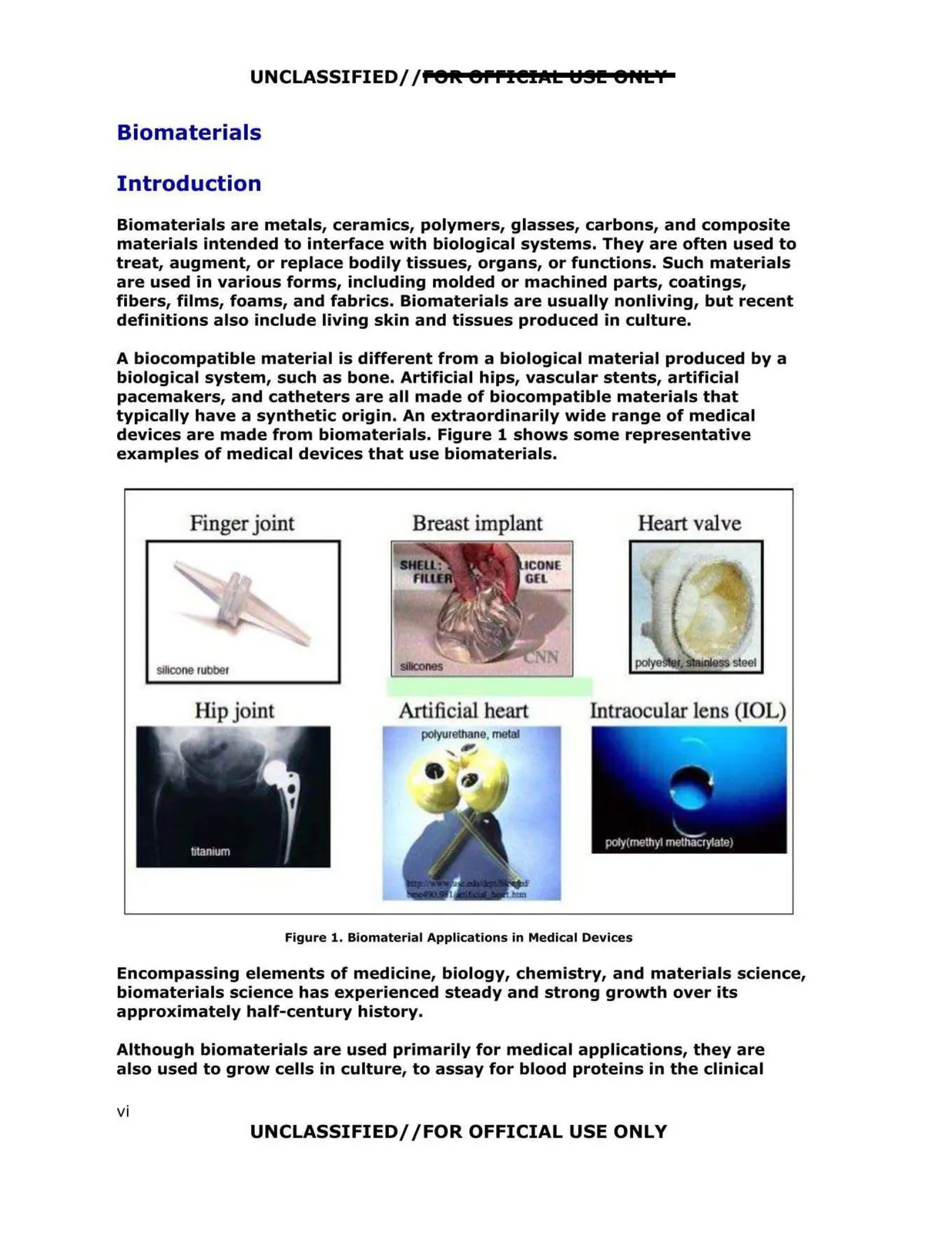
A biocompatible material is different from a biological material produced by a
biological system, such as bone. Artificial hips, vascular stents, artificial
pacemakers, and catheters are all made of biocompatible materials that
typically have a synthetic origin. An extraordinarily wide range of medical
devices are made from biomaterials. Figure 1 shows some representative
examples of medical devices that use biomaterials.
Finger joint
Breast implant
Heart valve
.lloooe rubber
Hip j int
tifi ial heart
poly\lr
Figure 1. Biomaterial Applications in Medical Devices
Encompassing elements of medicine, biology, chemistry, and materials science,
biomaterials science has experienced steady and strong growth over its
approximately half-century history.
Although biomaterials are used primarily for medical applications, they are
also used to grow cells in culture, to assay for blood proteins in the clinical
UNCLASSIFIED//FOR OFFICIAL USE ONLY
vi