AAWSAP DIRD, Biomaterials, January 2010
DOW-UAP-D119 · page 7 of 32
Text
This text came with the file. It may have mistakes. When the text and the image disagree, the image is right.
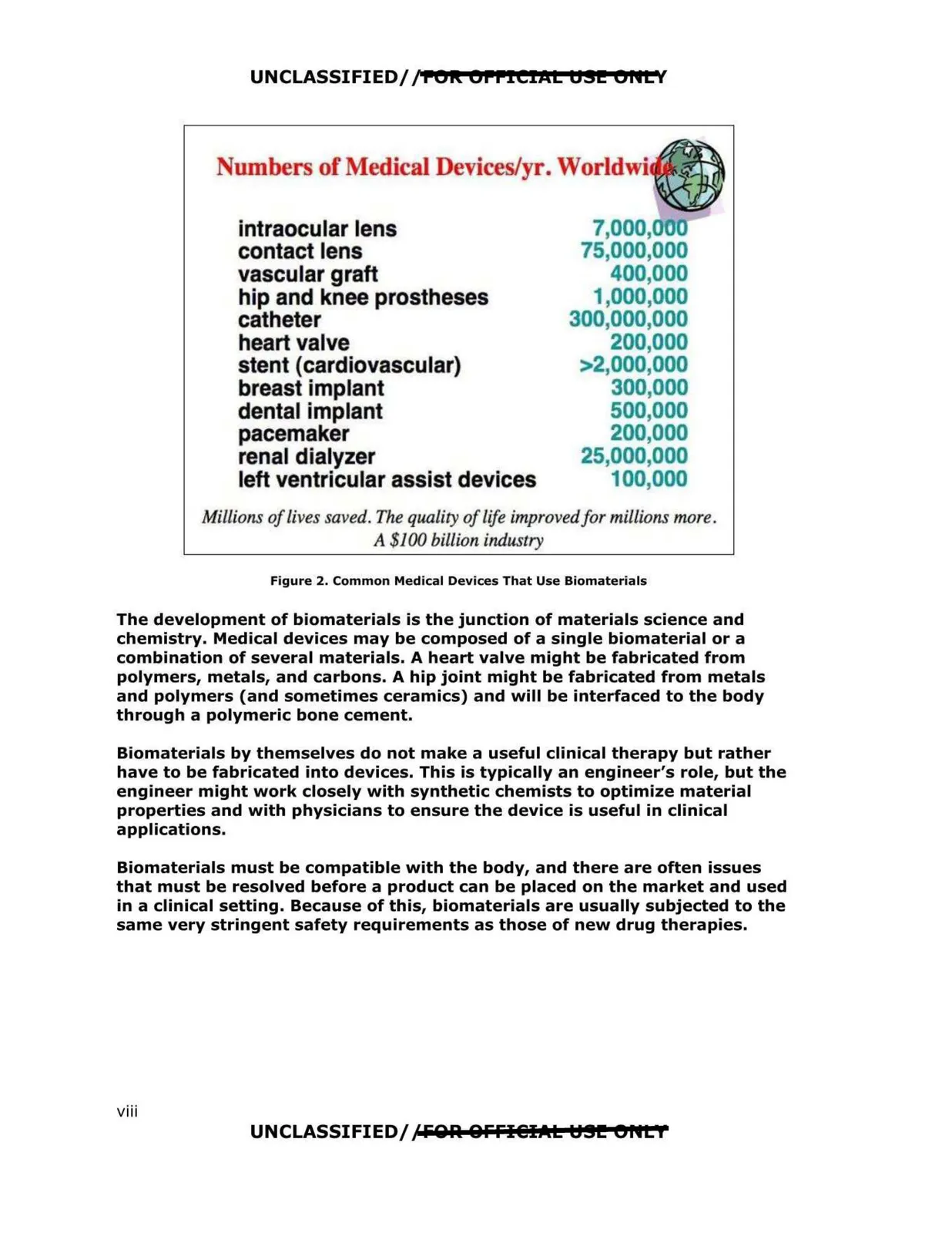
UNCLASSIFIED// POI\ OPPICl"L U.!E! Oflt ( Numbers of Medical Devices/yr. Worldwi,.,......- intraocular lens 7,000, contact lens 75,000,000 vascular graft 400,000 hip and knee prostheses 1,000,000 catheter 300,000,000 heart valve 200,000 stent (cardiovascular) >2,000,000 breast implant 300,000 dental implant 500,000 pacemaker 200,000 renal d ialyzer 25,000,000 left ventricular assist devices 100,000 Millions oflives saved. The quality ofLife improved for millions more. A $100 billion industry Figure 2. Common Medical Devices That Use Biomaterials The development of biomaterials is the junction of materials science and chemistry. Medical devices may be composed of a single biomaterial or a combination of several materials. A heart valve might be fabricated from polymers, metals, and carbons. A hip joint might be fabricated from metals and polymers (and sometimes ceramics) and will be interfaced to the body through a polymeric bone cement. Biomaterials by themselves do not make a useful clinical therapy but rather have to be fabricated into devices. This is typically an engineer's role, but the engineer might work closely with synthetic chemists to optimize material properties and with physicians to ensure the device is useful in clinical applications. Biomaterials must be compatible with the body, and there are often issues that must be resolved before a product can be placed on the market and used in a clinical setting. Because of this, biomaterials are usually subjected to the same very stringent safety requirements as those of new drug therapies. UNCLASSIFIED/,,roA &FFI@IAL U:!E: Oflt I viii