AAWSAP DIRD, Materials for Advanced Aerospace Platforms, January 2010
DOW-UAP-D120 · page 7 of 27
Text
This text came with the file. It may have mistakes. When the text and the image disagree, the image is right.
UNCLASSIFIED/} FOR OFFICil<L l:191!!! 8HL1/
The newer Al alloys also can be specially processed to render them superplastically
formable. This capability opens a realm of possibilities to replace structures that, in the
absence of this capability, are machined from thick plate. Very large structures are
produced in sections that must be joined. Conventional fusion welding techniques do
not work for high-strength Al alloys such as 7075, 7050, 2024, or 2050 because either
the welds lead to cracks or the welds made under conditions that avoid cracking have
greatly reduced tensile properties. Because these alloys are not amenable to welding,
heavier, fatigue-prone mechanically fastened joints must be used. Recently, scientists
developed a joining process that permits joining of Al alloys such as 7050. This process,
called friction stir welding (FSW), allows joint designs in a variety of configurations that
were not considered possible when fusion welding was the only alternative.
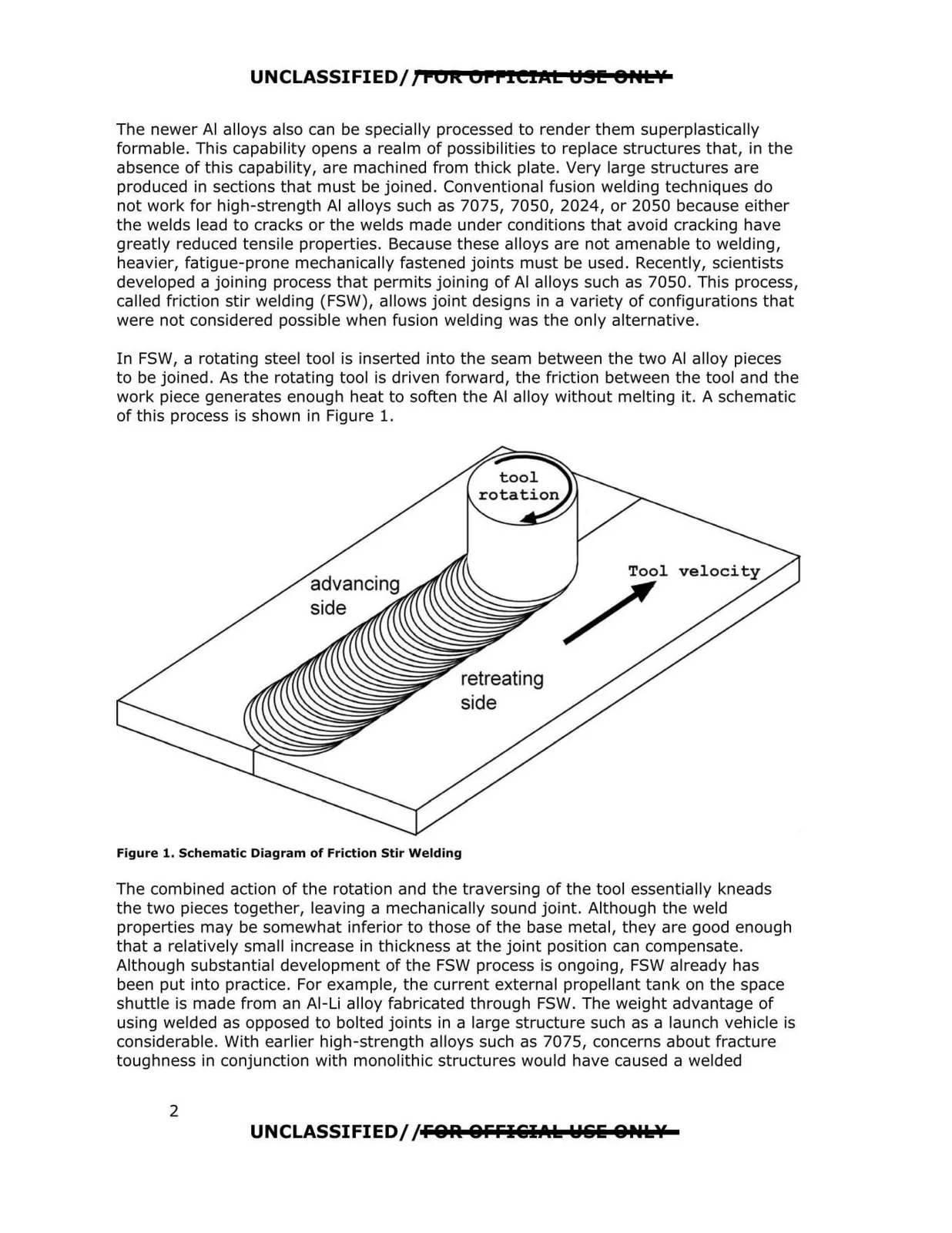
In FSW, a rotating steel tool is inserted into the seam between the two Al alloy pieces
to be joined. As the rotating tool is driven forward, the friction between the tool and the
work piece generates enough heat to soften the Al alloy without melting it. A schematic
of this process is shown in Figure 1.
retreating
side
Tool
/
Figure 1. Schematic Diagram of Friction Stir Welding
The combined action of the rotation and the traversing of the tool essentially kneads
the two pieces together, leaving a mechanically sound joint. Although the weld
properties may be somewhat inferior to those of the base metal, they are good enough
that a relatively small increase in thickness at the joint position can compensate.
Although substantial development of the FSW process is ongoing, FSW already has
been put into practice. For example, the current external propellant tank on the space
shuttle is made from an Al-Li alloy fabricated through FSW. The weight advantage of
using welded as opposed to bolted joints in a large structure such as a launch vehicle is
considerable. With earlier high-strength alloys such as 7075, concerns about fracture
toughness in conjunction with monolithic structures would have caused a welded
2
UNCLASSIFIED/ /FOR. OFFl&IAI:: W&li &Ptl::lf