AAWSAP DIRD, Materials for Advanced Aerospace Platforms, January 2010
DOW-UAP-D120 · page 9 of 27
Text
This text came with the file. It may have mistakes. When the text and the image disagree, the image is right.
UNCLASSIFIED// FOR OFFICll<L l:l!H!! 8PtLY
material is not suitable for the reasons stated earlier. Clearly, the time required for
layup places practical limitations on component size.
•
In automated tow placement, thin ribbons of a pre-preg are fed off a drum or rolled
into a computer numerically controlled machine that places them in the desired
position. In principle, this process trades recurring labor cost for up-front capital
investment (the tow placement machine) and programming time. If the anticipated
volume of identical parts is high enough to amortize the capital investment and,
particularly, the programming cost, this can be an attractive means of reducing
manufacturing costs. For axisymmetric shapes, such as cylinders, this essentially
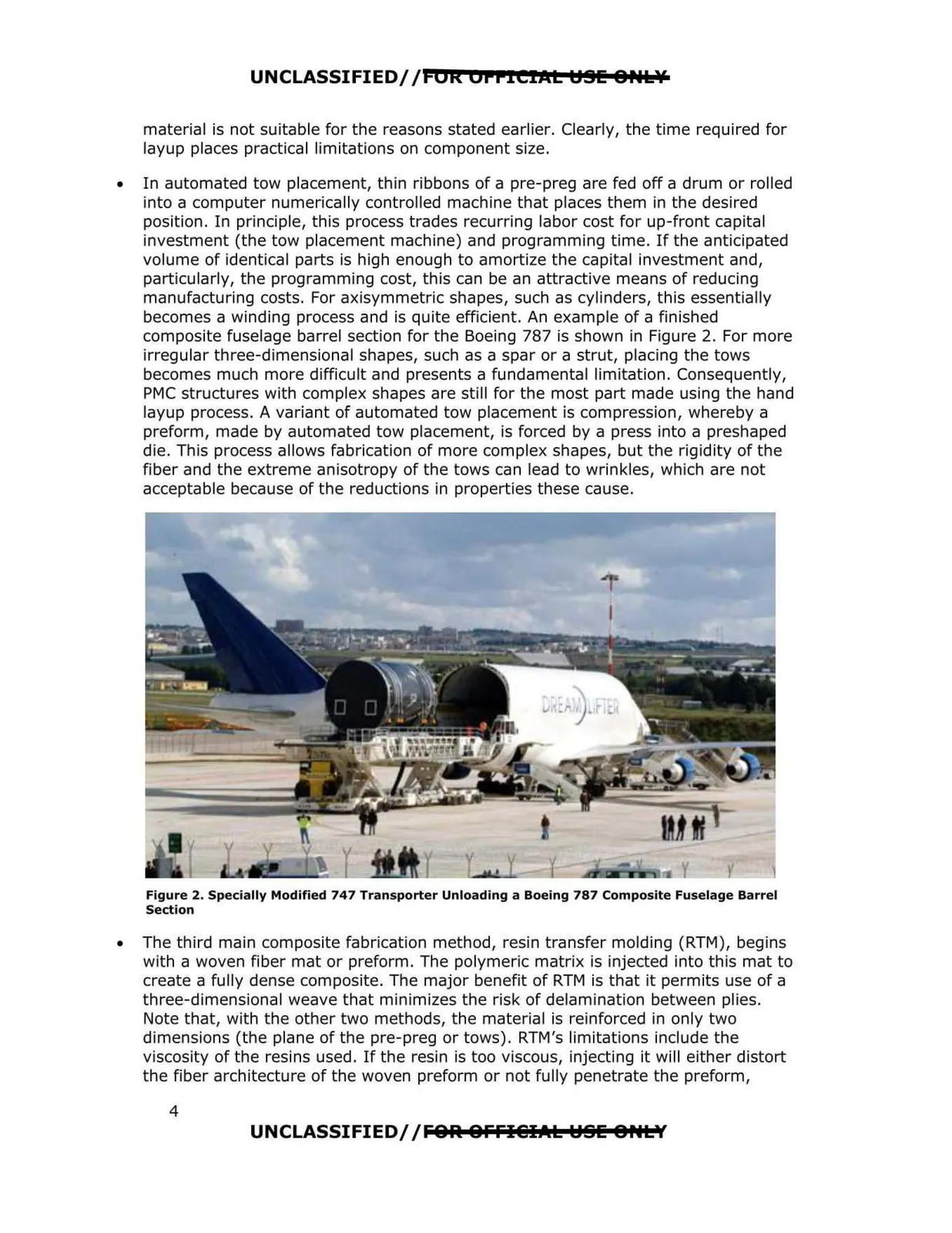
becomes a winding process and is quite efficient. An example of a finished
composite fuselage barrel section for the Boeing 787 is shown in Figure 2. For more
irregular three-dimensional shapes, such as a spar or a strut, placing the tows
becomes much more difficult and presents a fundamental limitation. Consequently,
PMC structures with complex shapes are still for the most part made using the hand
layup process. A variant of automated tow placement is compression, whereby a
preform, made by automated tow placement, is forced by a press into a preshaped
die. This process allows fabrication of more complex shapes, but the rigidity of the
fiber and the extreme anisotropy of the tows can lead to wrinkles, which are not
acceptable because of the reductions in properties these cause.
Figure 2. Specially Modified 747 Transporter Unloading a Boeing 787 Composite Fuselage Barrel
Section
•
The third main composite fabrication method, resin transfer molding (RTM), begins
with a woven fiber mat or preform. The polymeric matrix is injected into this mat to
create a fully dense composite. The major benefit of RTM is that it permits use of a
three-dimensional weave that minimizes the risk of delamination between plies.
Note that, with the other two methods, the material is reinforced in only two
dimensions (the plane of the pre-preg or tows). RTM's limitations include the
viscosity of the resins used. If the resin is too viscous, injecting it will either distort
the fiber architecture of the woven preform or not fully penetrate the preform,
4
UNCLASSIFIED//FOR 8FFI@IAL YSE erttl/