AAWSAP DIRD, Pulsed High-Power Microwave Source Technology, January 2010
DOW-UAP-D121 · page 11 of 37
Text
This text came with the file. It may have mistakes. When the text and the image disagree, the image is right.
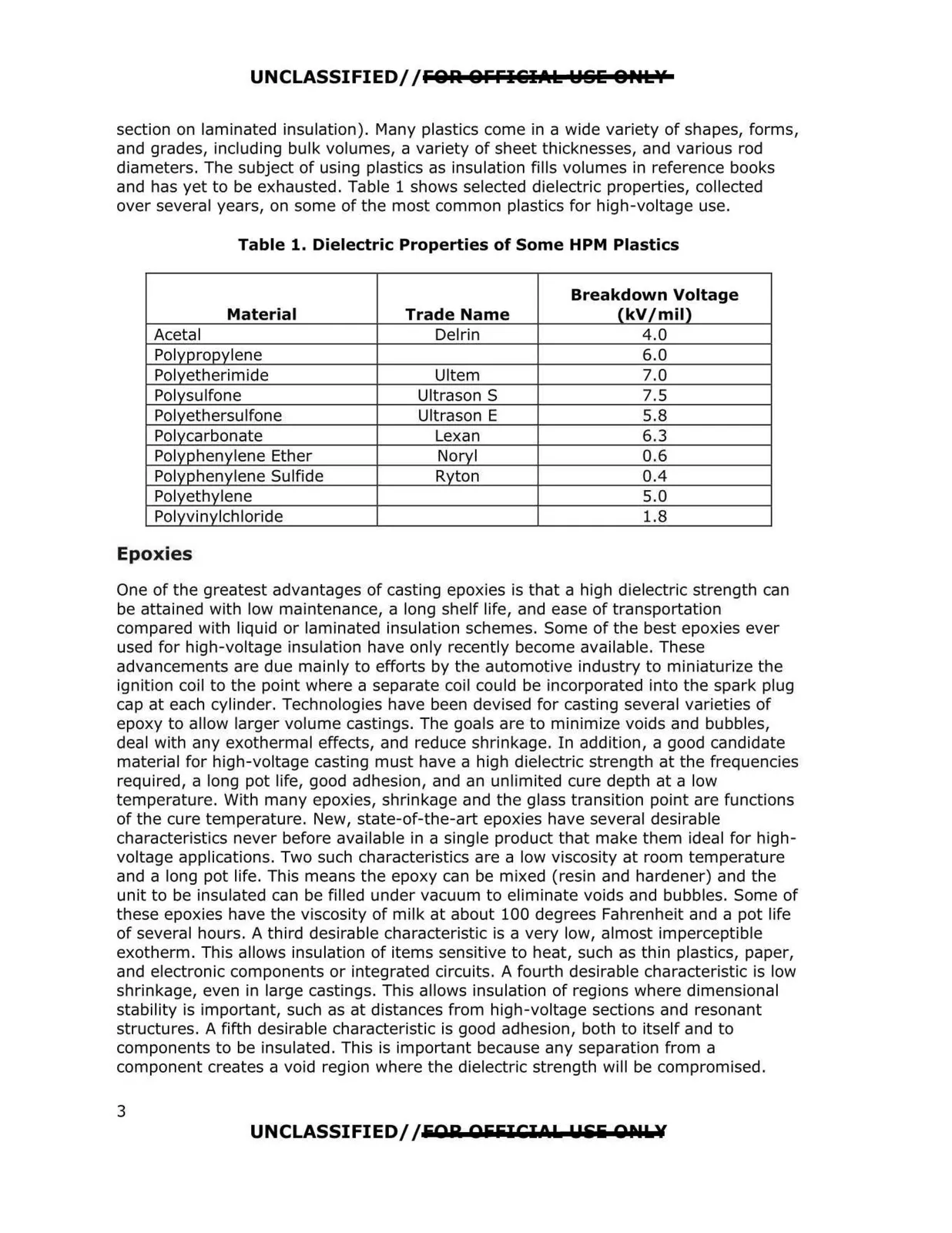
UNCLASSIFIED/ /FOlil OFFl&IAl WSE 8,.lV section on laminated insulation). Many plastics come in a wide variety of shapes, forms, and grades, including bulk volumes, a variety of sheet thicknesses, and various rod diameters. The subject of using plastics as insulation fills volumes in reference books and has yet to be exhausted . Table 1 shows selected dielectric properties, collected over several years, on some of the most common plastics for high-voltage use. Table 1. Dielectric Properties of Some HPM Plastics Material Trade Name Breakdown Voltage (kV/mil) Acetal Delrin 4.0 Polypropylene 6.0 Polyetherim ide Ultem 7.0 Polysulfone Ultrason S 7.5 Polyethersulfone Ultrason E 5.8 Polycarbonate Lexan 6.3 Polvohenylene Ether Noryl 0.6 Polyphenylene Sulfide Ryton 0.4 Polyethylene 5.0 Polyvinylch loride 1.8 Epoxies One of the greatest advantages of casting epoxies is that a high dielectric strength can be attained with low maintenance, a long shelf life, and ease of transportation compared with liquid or laminated insulation schemes. Some of the best epoxies ever used for high-voltage insulation have only recently become available. These advancements are due mainly to efforts by the automotive industry to miniaturize the ignition coil to the point where a separate coil could be incorporated into the spark plug cap at each cylinder. Technologies have been devised for casting several varieties of epoxy to allow larger volume castings. The goals are to minimize voids and bubbles, deal with any exothermal effects, and reduce shrinkage. In addition, a good candidate material for high-voltage casting must have a high dielectric strength at the frequencies required, a long pot life, good adhesion, and an unlimited cure depth at a low temperature. With many epoxies, shrinkage and the glass transition point are functions of the cure temperature. New, state-of-the-art epoxies have several desirable characteristics never before available in a single product that make them ideal for high voltage applications. Two such characteristics are a low viscosity at room temperature and a long pot life. This means the epoxy can be mixed (resin and hardener) and the unit to be insulated can be filled under vacuum to eliminate voids and bubbles. Some of these epoxies have the viscosity of milk at about 100 degrees Fahrenheit and a pot life of several hours. A third desirable characteristic is a very low, almost imperceptible exotherm. This allows insulation of items sensitive to heat, such as thin plastics, paper, and electronic components or integrated circuits. A fourth desirable characteristic is low shrinkage, even in large castings. This allows insulation of regions where dimensional stability is important, such as at distances from high-voltage sections and resonant structures. A fifth desirable characteristic is good adhesion, both to itself and to components to be insulated. This is important because any separation from a component creates a void region where the dielectric strength will be compromised. UNCLASSIFIED//5OB OFFICIO ls. U&'li QPlls.¥ 3