AAWSAP DIRD, Pulsed High-Power Microwave Source Technology, January 2010
DOW-UAP-D121 · page 13 of 37
Text
This text came with the file. It may have mistakes. When the text and the image disagree, the image is right.
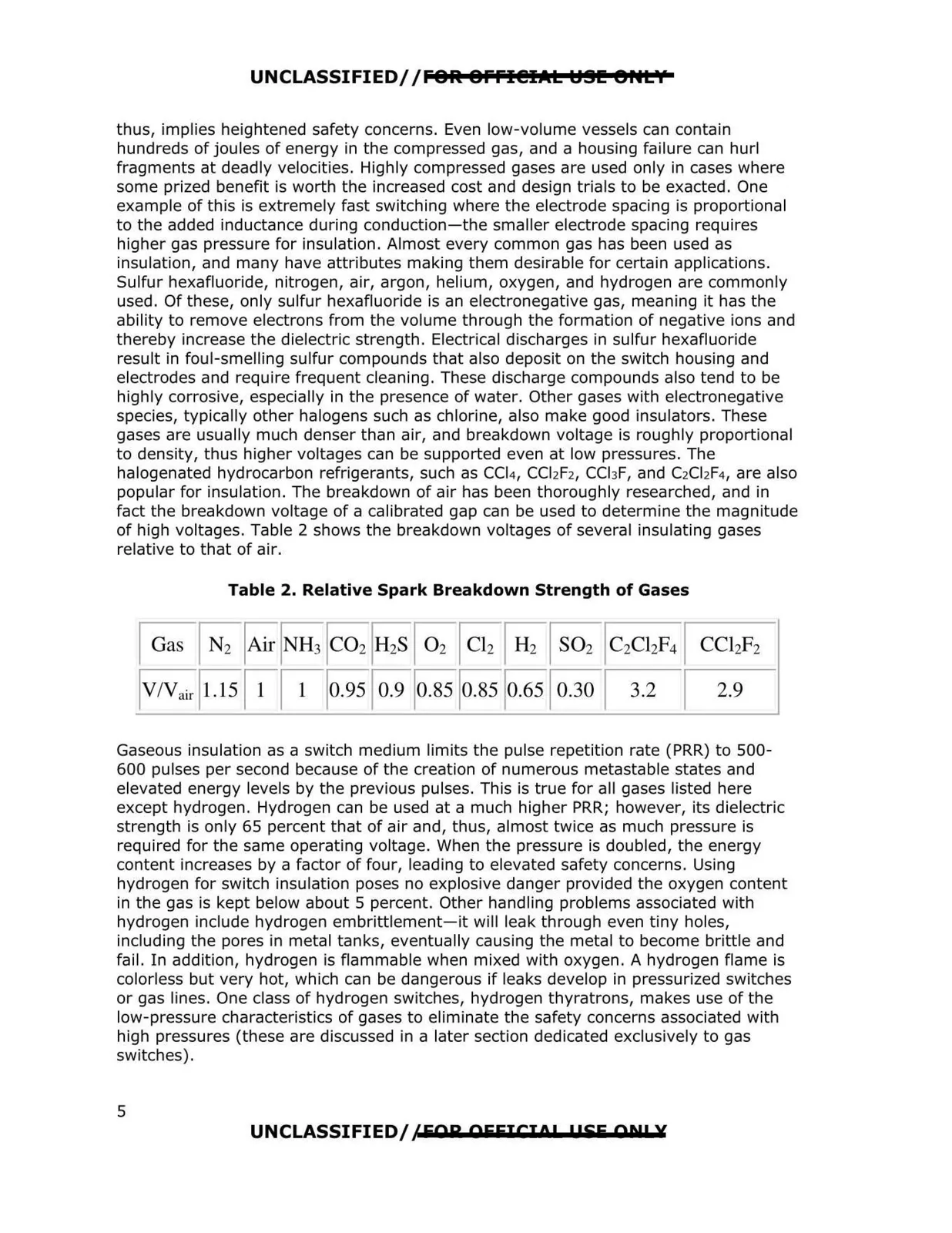
UNCLASSIFIED//FOR OFFl@IAL l!ISl!!! 9Ht5i" thus, implies heightened safety concerns. Even low-volume vessels can contain hundreds of joules of energy in the compressed gas, and a housing failure can hurl fragments at deadly velocities. Highly compressed gases are used only in cases where some prized benefit is worth the increased cost and design trials to be exacted. One example of this is extremely fast switching where the electrode spacing is proportional to the added inductance during conduction-the smaller electrode spacing requires higher gas pressure for insulation. Almost every common gas has been used as insulation, and many have attributes making them desirable for certain applications. Sulfur hexafluoride, nitrogen, air, argon, helium, oxygen, and hydrogen are commonly used. Of these, only sulfur hexafluoride is an electronegative gas, meaning it has the ability to remove electrons from the volume through the formation of negative ions and thereby increase the dielectric strength. Electrical discharges in sulfur hexafluoride result in foul-smelling sulfur compounds that also deposit on the switch housing and electrodes and require frequent cleaning. These discharge compounds also tend to be highly corrosive, especially in the presence of water. Other gases with electronegative species, typically other halogens such as chlorine, also make good insulators. These gases are usually much denser than air, and breakdown voltage is roughly proportional to density, thus higher voltages can be supported even at low pressures. The halogenated hydrocarbon refrigerants, such as CCl4, CCl2F2, CCbF, and C2Cl2f4, are also popular for insulation. The breakdown of air has been thoroughly researched, and in fact the breakdown voltage of a calibrated gap can be used to determine the magnitude of high voltages. Table 2 shows the breakdown voltages of several insulating gases relative to that of air. Table 2. Relative Spark Breakdown Strength of Gases Gaseous insulation as a switch medium limits the pulse repetition rate (PRR) to 500 600 pulses per second because of the creation of numerous metastable states and elevated energy levels by the previous pulses. This is true for all gases listed here except hydrogen. Hydrogen can be used at a much higher PRR; however, its dielectric strength is only 65 percent that of air and, thus, almost twice as much pressure is required for the same operating voltage. When the pressure is doubled, the energy content increases by a factor of four, leading to elevated safety concerns. Using hydrogen for switch insulation poses no explosive danger provided the oxygen content in the gas is kept below about 5 percent. Other handling problems associated with hydrogen include hydrogen embrittlement-it will leak through even tiny holes, including the pores in metal tanks, eventually causing the metal to become brittle and fail. In addition, hydrogen is flammable when mixed with oxygen. A hydrogen flame is colorless but very hot, which can be dangerous if leaks develop in pressurized switches or gas lines. One class of hydrogen switches, hydrogen thyratrons, makes use of the low-pressure characteristics of gases to eliminate the safety concerns associated with high pressures (these are discussed in a later section dedicated exclusively to gas switches). UNCLASSIFIED//FOR OFFICIO! 1 !SE ON! X 5