AAWSAP DIRD, Invisibility Cloaking Theory and Experiments, March 2010
DOW-UAP-D122 · page 12 of 29
Text
This text came with the file. It may have mistakes. When the text and the image disagree, the image is right.
UNCLASSIFIED//FOlt 8PPl@IAL YSI: 8,.LY
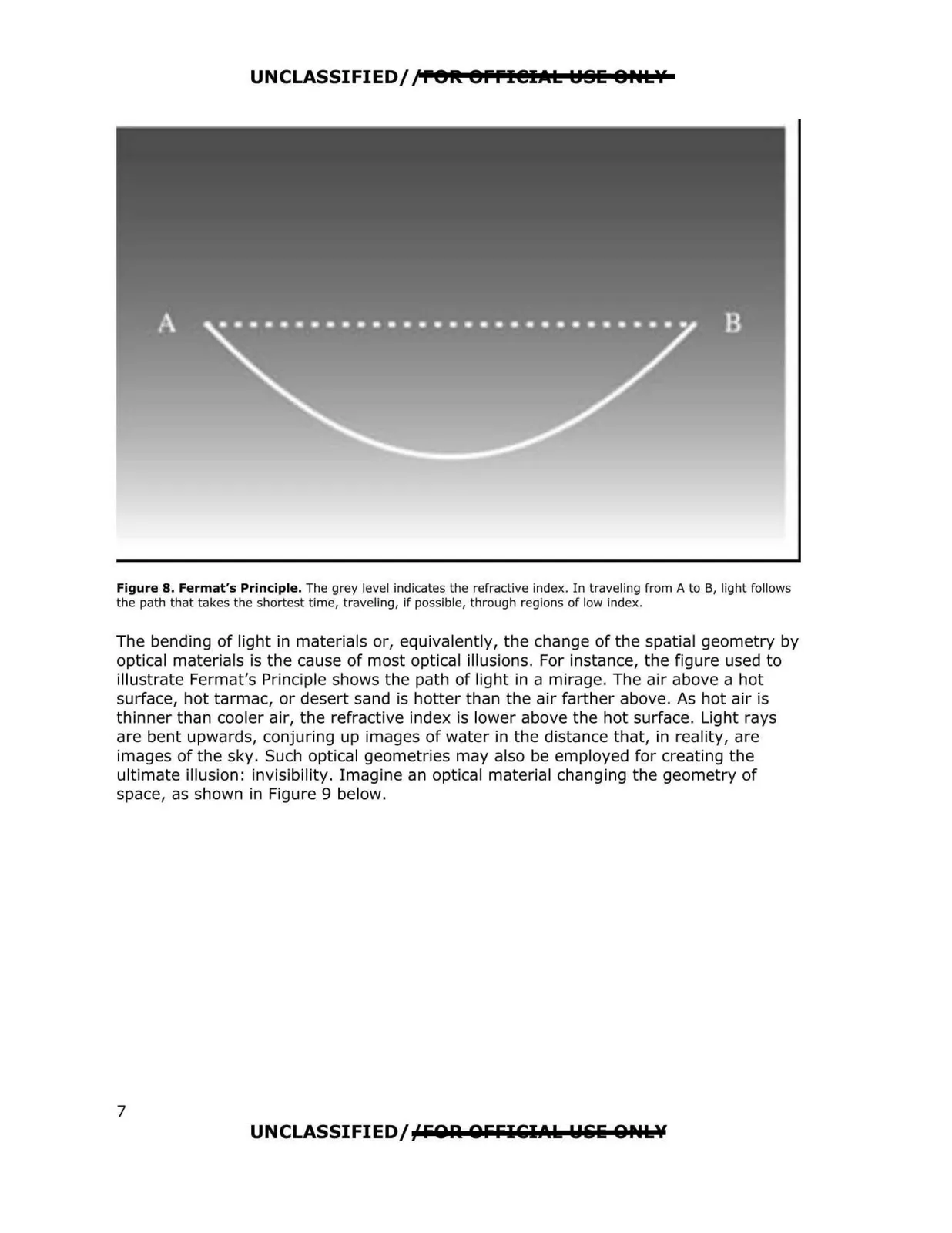
Figure 8. Fermat's Principle. The grey level indicates the refractive index. In traveling from A to B, light follows
the path that takes the shortest time, traveling, if possible, through regions of low index.
The bending of light in materials or, equivalently, the change of the spatial geometry by
optical materials is the cause of most optical illusions. For instance, the figure used to
illustrate Fermat's Principle shows the path of light in a mirage. The air above a hot
surface, hot tarmac, or desert sand is hotter than the air farther above. As hot air is
thinner than cooler air, the refractive index is lower above the hot surface. Light rays
are bent upwards, conjuring up images of water in the distance that, in reality, are
images of the sky. Such optical geometries may also be employed for creating the
ultimate illusion: invisibility. Imagine an optical material changing the geometry of
space, as shown in Figure 9 below.
UNCLASSIFIED/;CFOA OFFitl.t.k W&lii 0PUslf
7