AAWSAP DIRD, Invisibility Cloaking Theory and Experiments, March 2010
DOW-UAP-D122 · page 14 of 29
Text
This text came with the file. It may have mistakes. When the text and the image disagree, the image is right.
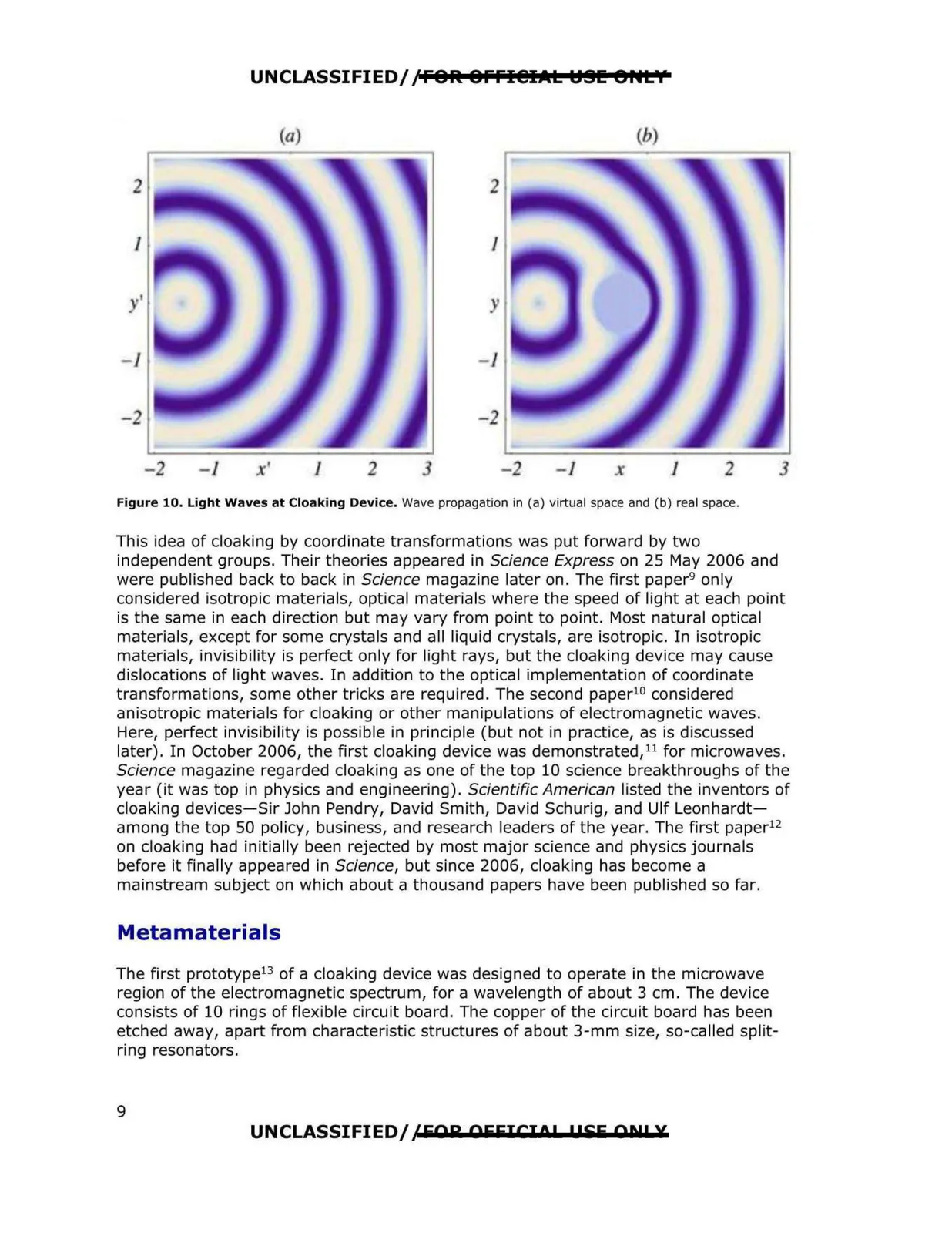
UNCLASSIFIED/,'FOR: OFFl@IAL l!ISI!!! 9HLY Figure 10. Light Waves at Cloaking Device. Wave propagation in (a) virtual space and (b) real space. This idea of cloaking by coordinate transformations was put forward by two independent groups. Their theories appeared in Science Express on 25 May 2006 and were published back to back in Science magazine later on. The first paper9 only considered isotropic materials, optical materials where the speed of light at each point is the same in each direction but may vary from point to point. Most natural optical materials, except for some crystals and all liquid crystals, are isotropic. In isotropic materials, invisibility is perfect only for light rays, but the cloaking device may cause dislocations of light waves. In addition to the optical implementation of coordinate transformations, some other tricks are required. The second paper10 considered anisotropic materials for cloaking or other manipulations of electromagnetic waves. Here, perfect invisibility is possible in principle (but not in practice, as is discussed later). In October 2006, the first cloaking device was demonstrated, 11 for microwaves. Science magazine regarded cloaking as one of the top 10 science breakthroughs of the year (it was top in physics and engineering) . Scientific American listed the inventors of cloaking devices-Sir John Pendry, David Smith, David Schurig, and Ulf Leonhardt among the top 50 policy, business, and research leaders of the year. The first paper12 on cloaking had initially been rejected by most major science and physics journals before it finally appeared in Science, but since 2006, cloaking has become a mainstream subject on which about a thousand papers have been published so far. Metamaterials The first prototype13 of a cloaking device was designed to operate in the microwave region of the electromagnetic spectrum, for a wavelength of about 3 cm. The device consists of 10 rings of flexible circuit board. The copper of the circuit board has been etched away, apart from characteristic structures of about 3-mm size, so-called split ring resonators. UNCLASSIFIED//509 OFFICIOP 1!55 ODtf PX 9