AAWSAP DIRD, Invisibility Cloaking Theory and Experiments, March 2010
DOW-UAP-D122 · page 25 of 29
Text
This text came with the file. It may have mistakes. When the text and the image disagree, the image is right.
UNCLASSIFIED/ /FOR: errl@IAL YSI: e ..tv
hemisphere invisible and creating the same illusion as shown in A. Alternatively (D), one could expand the red line
that light never crosses to create a hidden space.
Why are such curved optical spaces of any practical advantage? They seem more
complicated, but the distortion of space in such spaces is always finite, never infinite as
in the conventional Euclidean cloaking devices. As the spatial distortions directly
correspond to the required refractive indices, the required optical properties are never
infinite, and hence such devices can, in principle, operate in a broad band of the
spectrum. Curved space is more practical than flat space, although the theory is more
complicated. These ideas can be extended from the two-dimensional toy model to the
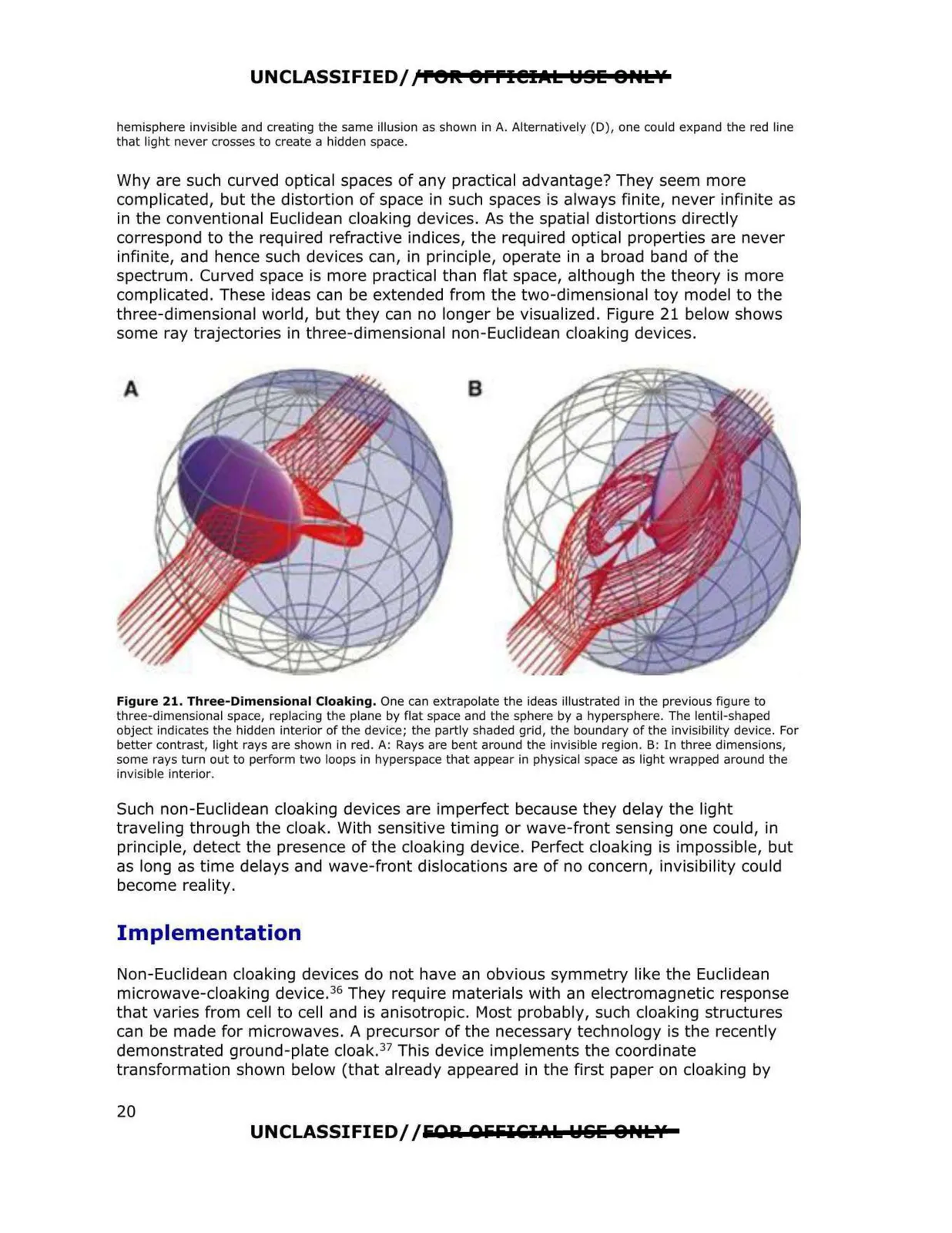
three-dimensional world, but they can no longer be visualized. Figure 21 below shows
some ray trajectories in three-dimensional non-Euclidean cloaking devices.
Figure 21. Three-Dimensional Cloaking. One can extrapolate the ideas illustrated in the previous figure to
three-dimensional space, replacing the plane by flat space and the sphere by a hypersphere. The lentil-shaped
object indicates the hidden interior of the device; the partly shaded grid, the boundary of the invisibility device. For
better contrast, light rays are shown in red. A: Rays are bent around the invisible region. B: In three dimensions,
some rays turn out to perform two loops in hyperspace that appear in physical space as light wrapped around the
invisible interior.
Such non-Euclidean cloaking devices are imperfect because they delay the light
traveling through the cloak. With sensitive timing or wave-front sensing one could, in
principle, detect the presence of the cloaking device. Perfect cloaking is impossible, but
as long as time delays and wave-front dislocations are of no concern, invisibility could
become reality.
Implementation
Non-Euclidean cloaking devices do not have an obvious symmetry like the Euclidean
microwave-cloaking device. 36 They require materials with an electromagnetic response
that varies from cell to cell and is anisotropic. Most probably, such cloaking structures
can be made for microwaves. A precursor of the necessary technology is the recently
demonstrated ground-plate cloak. 37 This device implements the coordinate
transformation shown below (that already appeared in the first paper on cloaking by
UNCLASSIFIED//&OR OFFICI.t.k WS& 8,.LY
20