AAWSAP DIRD, Positron Aerospace Propulsion, March 2010
DOW-UAP-D123 · page 6 of 35
Text
This text came with the file. It may have mistakes. When the text and the image disagree, the image is right.
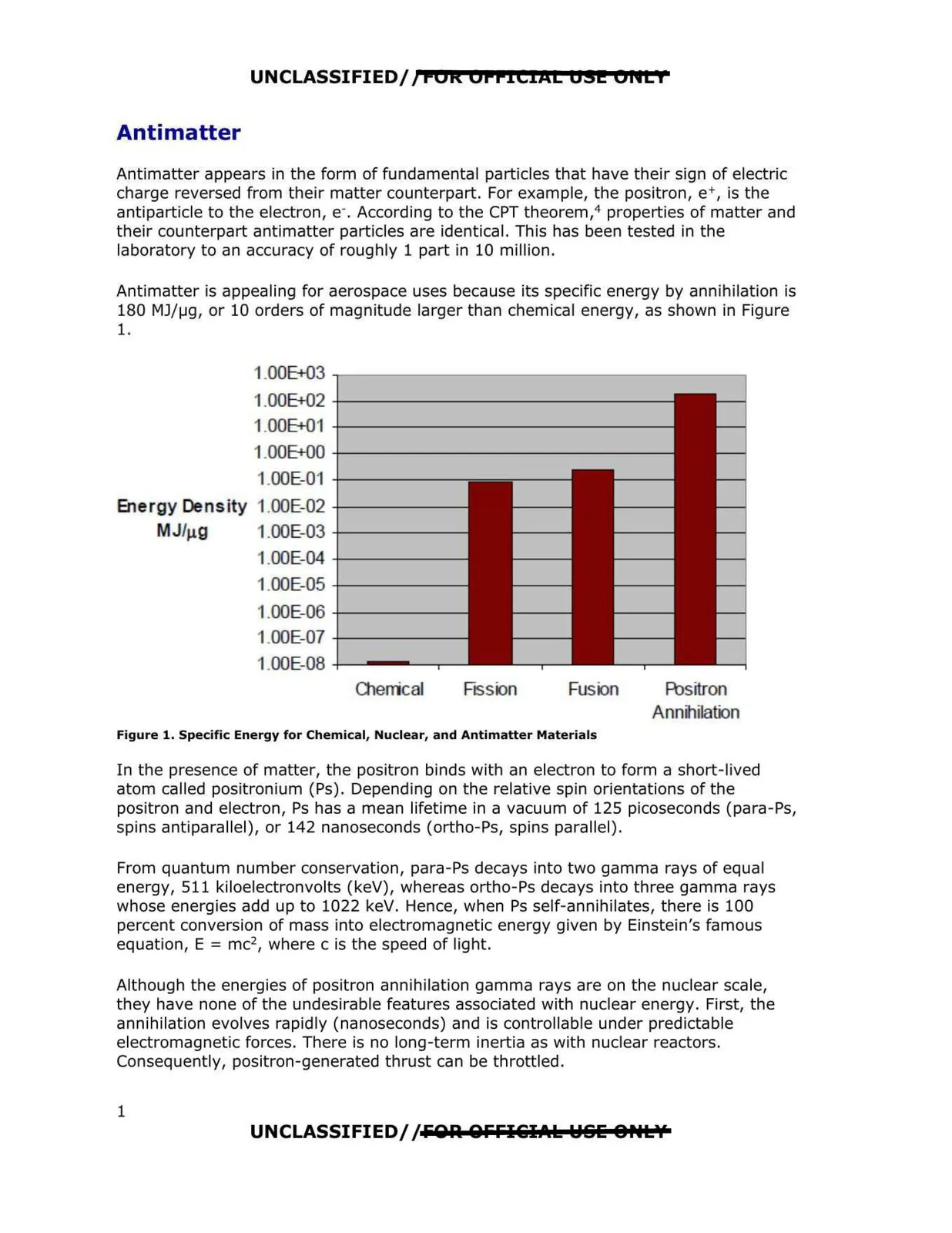
UNCLASSIFIED/JFOR OFFICIAL USE 014[ I Antimatter Antimatter appears in the form of fundamental particles that have their sign of electric charge reversed from their matter counterpart. For example, the positron, e+, is the antiparticle to the electron, e·. According to the CPT theorem,4 properties of matter and their counterpart antimatter particles are identical. This has been tested in the laboratory to an accuracy of roughly 1 part in 10 million. Antimatter is appealing for aerospace uses because its specific energy by annihilation is 180 MJ/µg, or 10 orders of magnitude larger than chemical energy, as shown in Figure 1. 1.00E+03 ~-------------- 1.00E+02 +------------- 1.00E+01 +------------- 1.00E+O0 -+------------- 1.00E-01 -+----- Energy Density _OOE-02 ---- MJ/µg 1.00E-03 ---- _OOE-04 +------ 1.00E-05 +----- 1.00E-06 -+----- 1.00E-07 -+----- 1.00E-08 -1-----.,---- Olerrical Fission Fusion Fbsitron Annihilation Figure 1. Specific Energy for Chemical, Nuclear, and Antimatter Materials In the presence of matter, the positron binds with an electron to form a short-lived atom called positronium (Ps). Depending on the relative spin orientations of the positron and electron, Ps has a mean lifetime in a vacuum of 125 picoseconds (para-Ps, spins antiparallel), or 142 nanoseconds (ortho-Ps, spins parallel). From quantum number conservation, para-Ps decays into two gamma rays of equal energy, 511 kiloelectronvolts (keV), whereas ortho-Ps decays into three gamma rays whose energies add up to 1022 keV. Hence, when Ps self-annihilates, there is 100 percent conversion of mass into electromagnetic energy given by Einstein's famous equation, E = mc2, where c is the speed of light. Although the energies of positron annihilation gamma rays are on the nuclear scale, they have none of the undesirable features associated with nuclear energy. First, the annihilation evolves rapidly (nanoseconds) and is controllable under predictable electromagnetic forces. There is no long-term inertia as with nuclear reactors. Consequently, positron-generated thrust can be throttled. UNCLASSIFIED/ /570A OFFl&IAk W&E 8HLY 1