AAWSAP DIRD, Space Access: Where We’ve Been and Where We Could Go, March 2010
DOW-UAP-D124 · page 34 of 56
Text
This text came with the file. It may have mistakes. When the text and the image disagree, the image is right.
UNCLASSIFIED/}FOR: 8FFI@IAL l::191!! er•t I
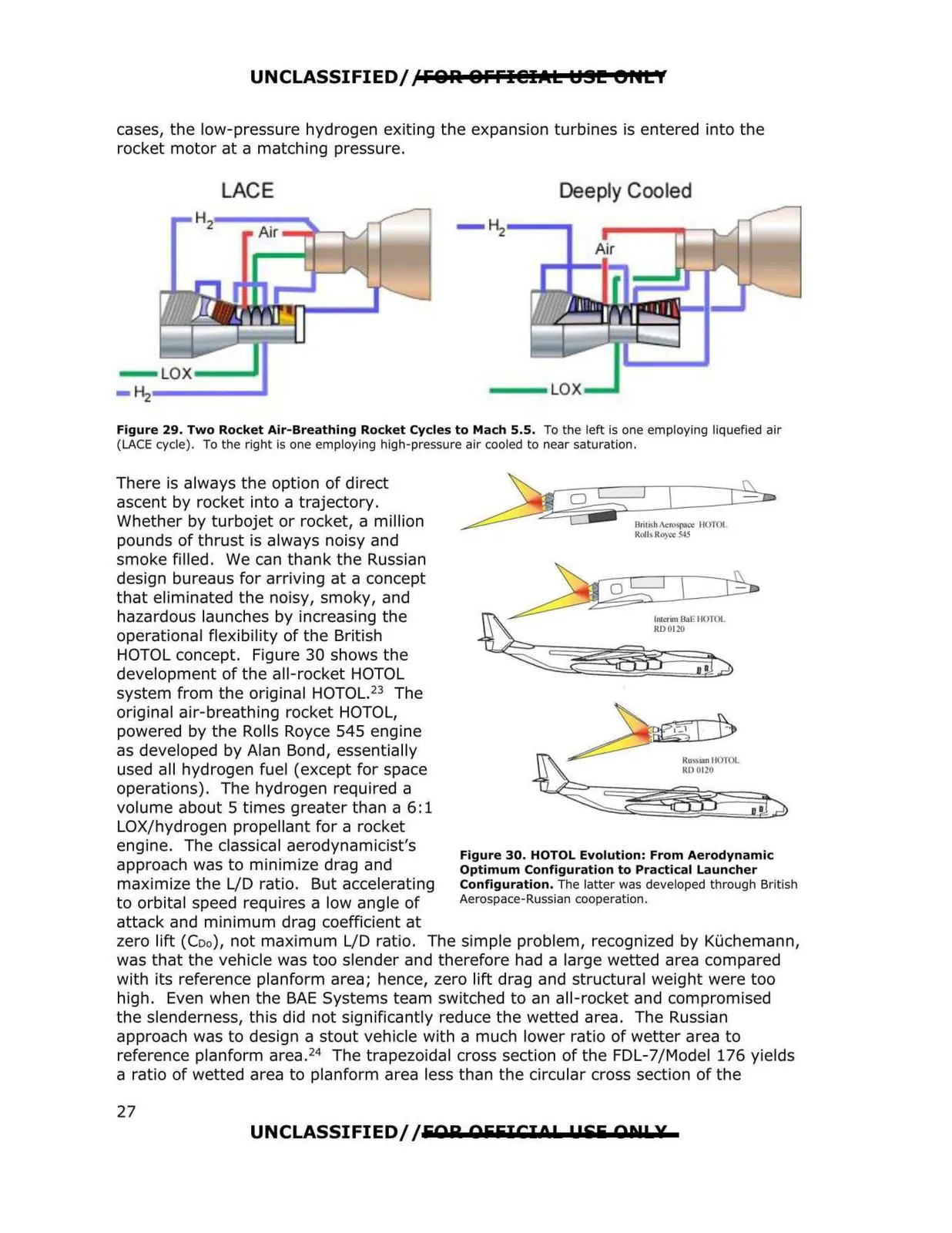
cases, the low-pressure hydrogen exiting the expansion turbines is entered into the
rocket motor at a matching pressure.
LACE
Deeply Cooled
--• LOX
Figure 29. Two Rocket Air-Breathing Rocket Cycles to Mach S.S. To the lelt is one employing liquefied air
(LACE cycle). To the right is one employing high-pressure air cooled to near saturation.
There is always the option of direct
ascent by rocket into a trajectory.
Whether by turbojet or rocket, a million
pounds of thrust is always noisy and
smoke filled . We can thank the Russian
design bureaus for arriving at a concept
that eliminated the noisy, smoky, and
hazardous launches by increasing the
operational flexibility of the British
HOTOL concept. Figure 30 shows the
development of the all-rocket HOTOL
system from the original HOTOL.23 The
original air-breathing rocket HOTOL,
powered by the Rolls Royce 545 engine
as developed by Alan Bond, essentially
used all hydrogen fuel (except for space
operations). The hydrogen required a
volume about 5 times greater than a 6: 1
LOX/hydrogen propellant for a rocket
engine. The classical aerodynamicist's
approach was to minimize drag and
maximize the L/D ratio. But accelerating
to orbital speed requires a low angle of
attack and minimum drag coefficient at
!ln1~h Aemsp,1cc flOTOI
Rolls Roya! 545
lruerun Ba E I IOTOL.
RD0l20
~ gt%'.\ =.b
~
RU5Sumll0TOL
RU 0120
Figure 30. HOTOL Evolution: From Aerodynamic
Optimum Configuration to Practical Launcher
Configuration. The latter was developed through British
Aerospace-Russian cooperation.
zero lift (Coo), not maximum L/D ratio. The simple problem, recognized by Kuchemann,
was that the vehicle was too slender and therefore had a large wetted area compared
with its reference planform area; hence, zero lift drag and structural weight were too
high. Even when the BAE Systems team switched to an all-rocket and compromised
the slenderness, this did not significantly reduce the wetted area. The Russian
approach was to design a stout vehicle with a much lower ratio of wetter area to
reference planform area. 24 The trapezoidal cross section of the FOL-7 /Model 176 yields
a ratio of wetted area to planform area less than the circular cross section of the
UNCLASSIFIED//EAR AEFICIOP 1!55 All! X
27