AAWSAP DIRD, Space Access: Where We’ve Been and Where We Could Go, March 2010
DOW-UAP-D124 · page 6 of 56
Text
This text came with the file. It may have mistakes. When the text and the image disagree, the image is right.
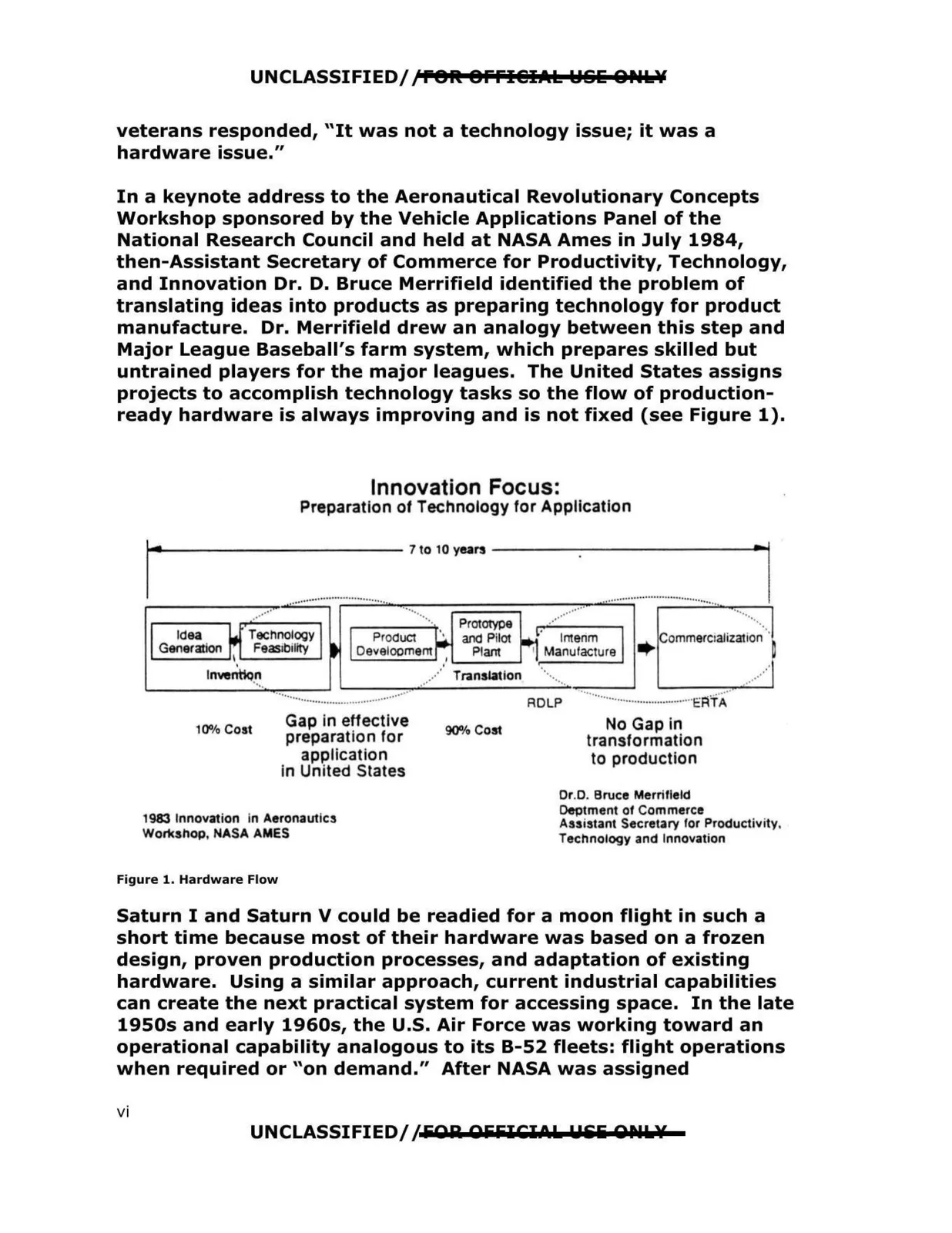
UNCLASSIFIED/,«POil Offl@IAL YSli QPU,¥ veterans responded, "It was not a technology issue; it was a hardware issue." In a keynote address to the Aeronautical Revolutionary Concepts Workshop sponsored by the Vehicle Applications Panel of the National Research Council and held at NASA Ames in July 1984, then-Assistant Secretary of Commerce for Productivity, Technology, and Innovation Dr. D. Bruce Merrifield identified the problem of translating ideas into products as preparing technology for product manufacture. Dr. Merrifield drew an analogy between this step and Major League Baseball's farm system, which prepares skilled but untrained players for the major leagues. The United States assigns projects to accomplish technology tasks so the flow of production ready hardware is always improving and is not fixed (see Figure 1). Innovation Focus: Preparation of Technology for Application ---r-----7to10years-----~1 ------~--""••"_, ,__...;;.;.:, ----,....-=----_-_-_,---...,.._ ".........., •"- _ .....:.., .. --"'"'--... ............. ·····•.. ,••· ' •, .. Prototype .... Idea Generation .______., .______, PrOCluct and Pilot lntenm + Commercialization ·. Develooment Plant I Manufacture lnve~n Translation ··•.... ··•. ••······· ...•••· •.................. ................•1:i:t· fA•• ·····••..................... ROLP Gap in effective No Gap in 100/o Cost 900/o Cost preparation for transformation application to production in United States Or.O. Bruce Merrifield Oeptment of Commerce 1983 Innovation In Aeronautics Assistant Secretary for Productivity, Wortcshop, NASA AMES Technology and Innovation Figure 1. Hardware Flow Saturn I and Saturn V could be readied for a moon flight in such a short time because most of their hardware was based on a frozen design, proven production processes, and adaptation of existing hardware. Using a similar approach, current industrial capabilities can create the next practical system for accessing space. In the late 1950s and early 1960s, the U.S. Air Force was working toward an operational capability analogous to its B-52 fleets: flight operations when required or "on demand." After NASA was assigned UNCLASSIFIED//iOA: OiilCIOls. n&li Qfslls.¥ vi