AAWSAP DIRD, Space Access: Where We’ve Been and Where We Could Go, March 2010
DOW-UAP-D124 · page 8 of 56
Text
This text came with the file. It may have mistakes. When the text and the image disagree, the image is right.
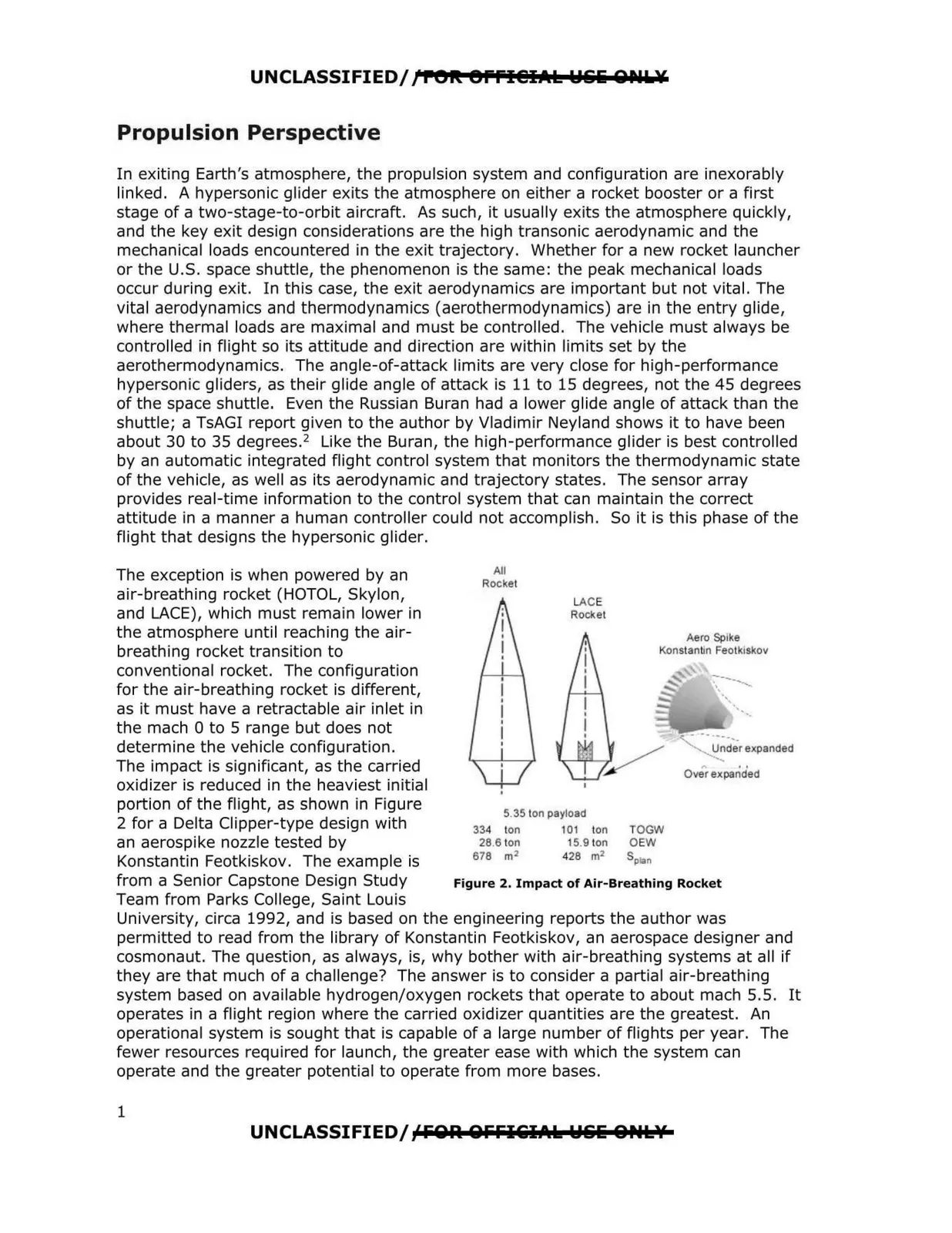
UNCLASSIFIED/ /FOR: 9FFl@IAL WIiii QPIL¥ Propulsion Perspective In exiting Earth's atmosphere, the propulsion system and configuration are inexorably linked. A hypersonic glider exits the atmosphere on either a rocket booster or a first stage of a two-stage-to-orbit aircraft. As such, it usually exits the atmosphere quickly, and the key exit design considerations are the high transonic aerodynamic and the mechanical loads encountered in the exit trajectory. Whether for a new rocket launcher or the U.S. space shuttle, the phenomenon is the same: the peak mechanical loads occur during exit. In this case, the exit aerodynamics are important but not vital. The vital aerodynamics and thermodynamics (aerothermodynamics) are in the entry glide, where thermal loads are maximal and must be controlled. The vehicle must always be controlled in flight so its attitude and direction are within limits set by the aerothermodynamics. The angle-of-attack limits are very close for high-performance hypersonic gliders, as their glide angle of attack is 11 to 15 degrees, not the 45 degrees of the space shuttle. Even the Russian Buran had a lower glide angle of attack than the shuttle; a TsAGI report given to the author by Vladimir Neyland shows it to have been about 30 to 35 degrees. 2 Like the Buran, the high-performance glider is best controlled by an automatic integrated flight control system that monitors the thermodynamic state of the vehicle, as well as its aerodynamic and trajectory states. The sensor array provides real-time information to the control system that can maintain the correct attitude in a manner a human controller could not accomplish. So it is this phase of the flight that designs the hypersonic glider. The exception is when powered by an All Rocket air-breathing rocket (HOTOL, Skylon, and LACE), which must remain lower in the atmosphere until reaching the air breathing rocket transition to conventional rocket. The configuration for the air-breathing rocket is different, as it must have a retractable air inlet in the mach O to 5 range but does not determine the vehicle configuration. The impact is significant, as the carried oxidizer is reduced in the heaviest initial portion of the flight, as shown in Figure 5. 35 ton payload 2 for a Delta Clipper-type design with 334 ton 101 ton TOGW an aerospike nozzle tested by 28.6 ton 15.9 ton DEW 678 m2 428 m2 Konstantin Feotkiskov. The example is from a Senior Capstone Design Study Figure 2. Impact of Air-Breathing Rocket Team from Parks College, Saint Louis University, circa 1992, and is based on the engineering reports the author was permitted to read from the library of Konstantin Feotkiskov, an aerospace designer and cosmonaut. The question, as always, is, why bother with air-breathing systems at all if they are that much of a challenge? The answer is to consider a partial air-breathing system based on available hydrogen/oxygen rockets that operate to about mach S.S. It operates in a flight region where the carried oxidizer quantities are the greatest. An operational system is sought that is capable of a large number of flights per year. The fewer resources required for launch, the greater ease with which the system can operate and the greater potential to operate from more bases. LACE Rooket Aero Spike Konstanbn FeotkIskov ..._Under expanded ·, Over expand'e<I UNCLASSIFIED/,erQA QFFI&il.t.k WIiii &Ptllf 1