AAWSAP DIRD, Inertial Electrostatic Confinement Fusion, March 2010
DOW-UAP-D125 · page 29 of 72
Text
This text came with the file. It may have mistakes. When the text and the image disagree, the image is right.
UNCLASSIFIED/ /FOR OFFl@IAL ~81: 8HLY
a)
b)
~
I
Reflector
/
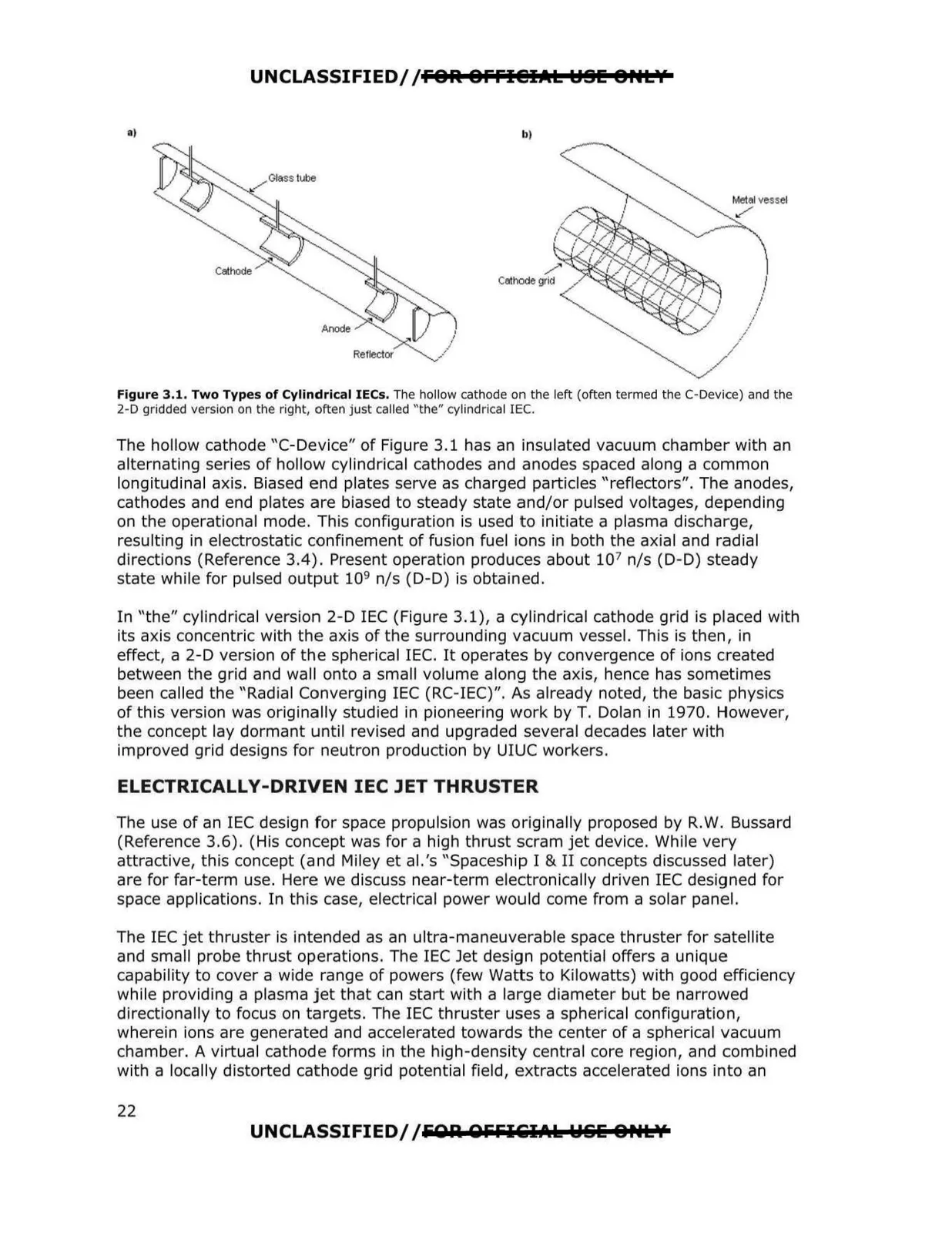
Figure 3.1. Two Types of Cylindrical IECs. The hollow cathode on the left (often termed the C-Device) and the
2-D gridded version on the right, often just called "the" cylindrical IEC.
The hollow cathode "C-Device" of Figure 3.1 has an insulated vacuum chamber with an
alternating series of hollow cylindrical cathodes and anodes spaced along a common
longitudinal axis. Biased end plates serve as charged particles "reflectors". The anodes,
cathodes and end plates are biased to steady state and/or pulsed voltages, depending
on the operational mode. This configuration is used to initiate a plasma discharge,
resulting in electrostatic confinement of fusion fuel ions in both the axial and radial
directions (Reference 3.4). Present operation produces about 107 n/s (D-D) steady
state while for pulsed output 109 n/s (D-D) is obtained.
In "the" cylindrical version 2-D IEC (Figure 3.1), a cylindrical cathode grid is placed with
its axis concentric with the axis of the surrounding vacuum vessel. This is then, in
effect, a 2-D version of the spherical IEC. It operates by convergence of ions created
between the grid and wall onto a small volume along the axis, hence has sometimes
been called the "Radial Converging IEC (RC-IEC)". As already noted, the basic physics
of this version was originally studied in pioneering work by T. Dolan in 1970. However,
the concept lay dormant until revised and upgraded several decades later with
improved grid designs for neutron production by UIUC workers .
ELECTRICALLY- DRIVEN IEC JET THRUSTER
The use of an !EC design for space propulsion was originally proposed by R.W. Bussard
(Reference 3.6) . (His concept was for a high thrust scram jet device. While very
attractive, this concept (and Miley et al.'s "Spaceship I & II concepts discussed later)
are for far-term use. Here we discuss near-term electronically driven IEC designed for
space applications. In this case, electrical power would come from a solar panel.
The IEC jet thruster is intended as an ultra-maneuverable space thruster for satellite
and small probe thrust operations. The IEC Jet design potential offers a unique
capability to cover a wide range of powers (few Watts to Kilowatts) with good efficiency
while providing a plasma jet that can start with a large diameter but be narrowed
directionally to focus on targets. The IEC thruster uses a spherical configuration,
wherein ions are generated and accelerated towards the center of a spherical vacuum
chamber. A virtual cathode forms in the high-density central core region, and combined
with a locally distorted cathode grid potential field, extracts accelerated ions into an
UNCLASSIFIED//5i0A OFFIQlal.k W&E or•tY
22