AAWSAP DIRD, Inertial Electrostatic Confinement Fusion, March 2010
DOW-UAP-D125 · page 42 of 72
Text
This text came with the file. It may have mistakes. When the text and the image disagree, the image is right.
UNCLASSIFIED/ /FOA OFFI&ilAk W&& 8rtk\f
events take place. Accordingly, he predicted that the Q-value (defined the ratio of
fusion power out to ion input power) of an IEC device operating with a 50/50 percent
deuterium- tritium (D-T) mixture would be "'0.21 for a 50-kV square well. This
conclusion would rule out the possibility of a fusion reactor, but would leave open the
development of driven neutron sources. However, this analysis contains several
questionable assumptions. For example, a tightly focused monoenergetic ion beam is in
fact a pessimistic scenario, because different co-moving ion species (such as D and T
with the same energy) result in a finite speed difference, thus fostering ion -ion
collisions and the degradation of the ion distribution function. It would be more realistic
to consider that, in a square well, friction between species would homogenize the speed
within the ion beam after some time, making the speed difference infinitesimal. This
line of argument was pursued earlier by Barnes et al., (Reference 4.3) who found Q"'
1. 3 for the same system.
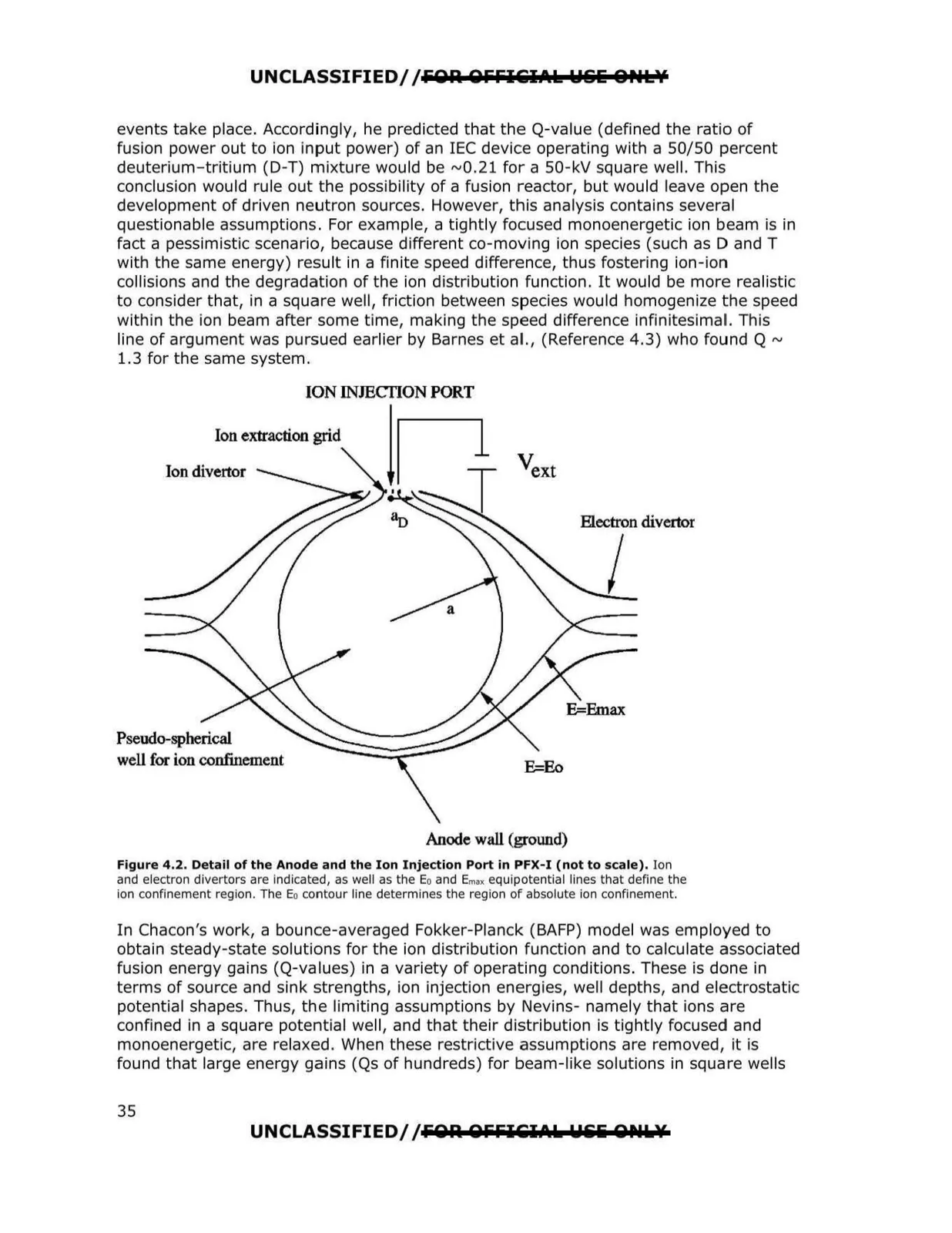
ION INJECTION PORT
Ion extraction grid
Ion divertor
Electron divcrtor
I
Pseudo-spherical
well for ion confinement
Anode wall (ground)
Figure 4.2. Detail of the Anode and the Ion Injection Port in PFX-I (not to scale). Ion
and electron divertors are indicated, as well as the Eo and Emax equipotential lines that define the
ion confinement region. The Eo contour line determines the region of absolute ion confinement.
In Chacon's work, a bounce-averaged Fokker-Planck (BAFP) model was employed to
obtain steady-state solutions for the ion distribution function and to calculate associated
fusion energy gains (Q-values) in a variety of operating conditions. These is done in
terms of source and sink strengths, ion injection energies, well depths, and electrostatic
potential shapes. Thus, the limiting assumptions by Nevins- namely that ions are
confined in a square potential well, and that their distribution is tightly focused and
monoenergetic, are relaxed. When these restrictive assumptions are removed, it is
found that large energy gains (Qs of hundreds) for beam-like solutions in square wells
UNCLASSIFIED/ /FOA OFFI&iIAk Wliii 01\lk¥
35