AAWSAP DIRD, Inertial Electrostatic Confinement Fusion, March 2010
DOW-UAP-D125 · page 52 of 72
Text
This text came with the file. It may have mistakes. When the text and the image disagree, the image is right.
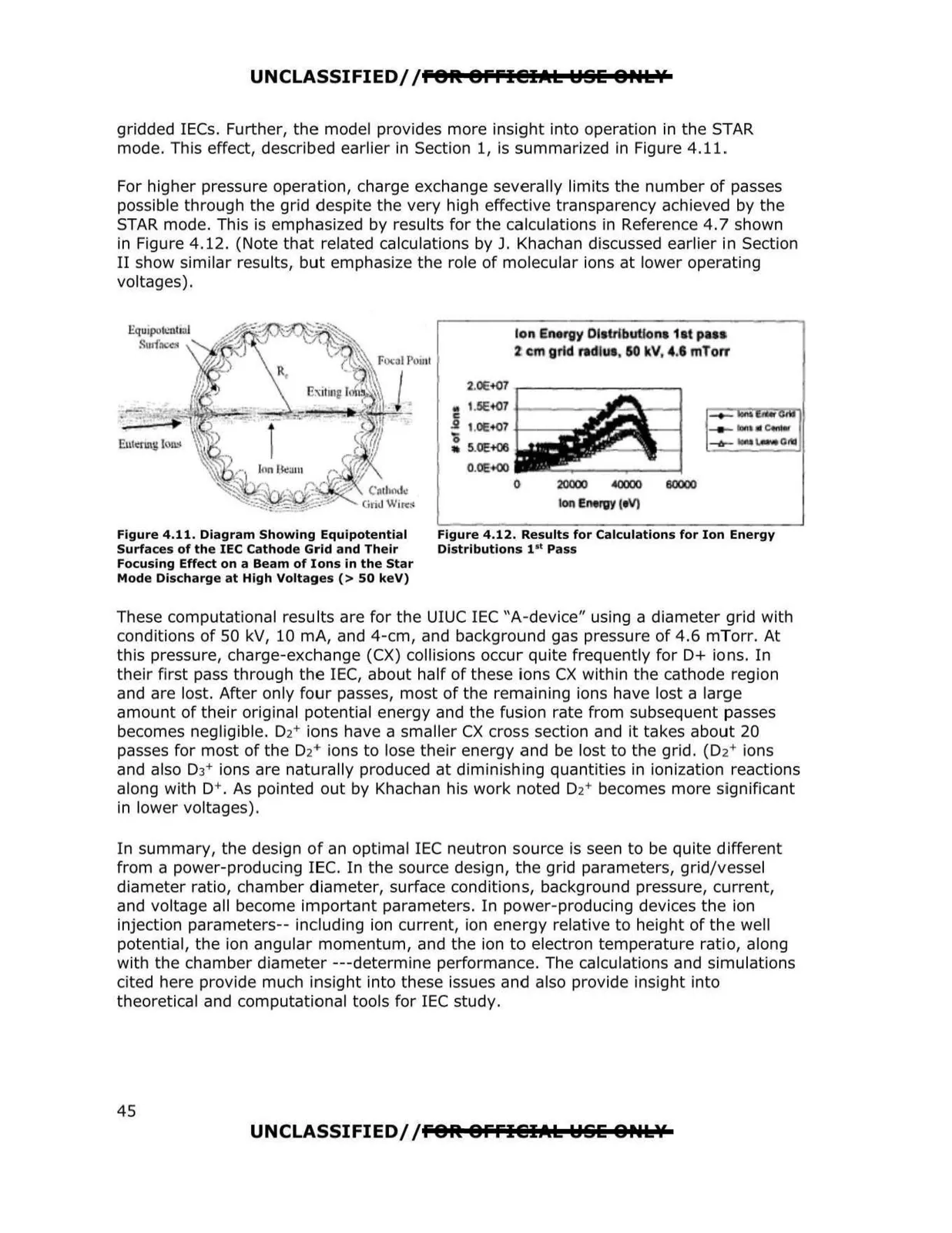
UNCLASSIFIED/ /fOR Offl@IAL WSE 8,.Llf gridded IECs. Further, the model provides more insight into operation in the STAR mode. This effect, described earlier in Section 1, is summarized in Figure 4.11. For higher pressure operation, charge exchange severally limits the number of passes possible through the grid despite the very high effective transparency achieved by the STAR mode. This is emphasized by results for the calculations in Reference 4. 7 shown in Figure 4.12. (Note that related calculations by J. Khachan discussed earlier in Section II show similar results, but emphasize the role of molecular ions at lower operating voltages). Equ1pobtnbaI Surf~ •lllffl!IJl I n,i Ion En•'VY Ol,tnbutton11at pH 2: cm grid radlua, 50 kV, 4. mTorr 2.0E+07 .---------,, 11 UiE+o7 : 5.0800 o.c,e..oo 0 20000 4'0000 80000 ton Energy (eV) I 1.oe+o1 t-- Figure 4.11. Diagram Showing Equipotential Figure 4.12. Results for Calculations for Ion Energy Surfaces of the IEC Cathode Grid and Their Distributions pt Pass Focusing Effect on a Beam of Ions in the Star Mode Discharge at High Voltages ( > 50 keV) These computational resu Its are for the UIUC IEC "A-device" using a diameter grid with conditions of 50 kV, 10 mA, and 4-cm, and background gas pressure of 4.6 mTorr. At this pressure, charge-exchange (CX) collisions occur quite frequently for D+ ions. In their first pass through the IEC, about half of these ions CX within the cathode region and are lost. After only four passes, most of the remaining ions have lost a large amount of their original potential energy and the fusion rate from subsequent passes becomes negligible. D2+ ions have a smaller CX cross section and it takes about 20 passes for most of the D2+ ions to lose their energy and be lost to the grid. (D2+ ions and also D3+ ions are naturally produced at diminishing quantities in ionization reactions along with o +. As pointed out by Khachan his work noted D2+ becomes more significant in lower voltages) . In summary, the design of an optimal IEC neutron source is seen to be quite different from a power-producing IEC. In the source design, the grid parameters, grid/vessel diameter ratio, chamber diameter, surface conditions, background pressure, current, and voltage all become important parameters. In power-producing devices the ion injection parameters-- including ion current, ion energy relative to height of the well potential, the ion angular momentum, and the ion to electron temperature ratio, along with the chamber diameter ---determine performance. The calculations and simulations cited here provide much insight into these issues and also provide insight into theoretical and computational tools for IEC study. UNCLASSIFIED/ /FOR 8fflOIAL WSE 8NLY 45