AAWSAP DIRD, Inertial Electrostatic Confinement Fusion, March 2010
DOW-UAP-D125 · page 55 of 72
Text
This text came with the file. It may have mistakes. When the text and the image disagree, the image is right.
UNCLASSIFIED/ /POI\ OPPICllct tt!I!! 9HLY
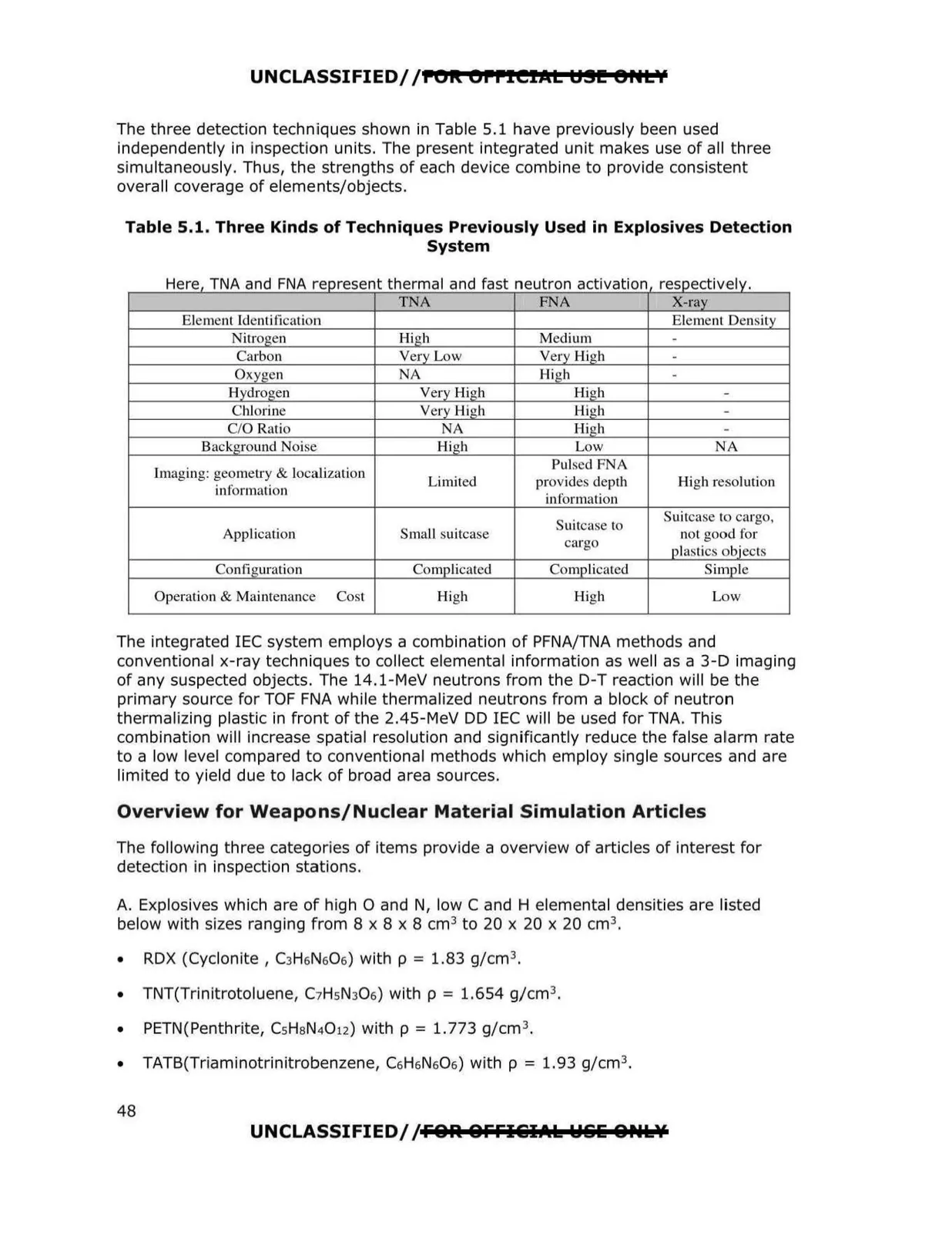
The three detection techniques shown in Table 5.1 have previously been used
independently in inspection units. The present integrated unit makes use of all three
simultaneously. Thus, the strengths of each device combine to provide consistent
overall coverage of elements/objects.
Table 5.1. Three Kinds of Techniques Previously Used in Explosives Detection
System
Here,, TNA and FNA represent thermal and fast neutron activation respectiv,elv
X-ray
Element Identification
TNA
FNA
Element Density
Nitrogen
High
Mediu m
-
Very High
Very Low
Carbon
-
Oxygen
1-ligh
NA
-
Hydrogen
Very High
High
-
Very High
High
Chlorine
-
C/0 Ratio
High
NA
-
Background Noise
Hi gh
Low
NA
Pul sed FNA
Imaging: geometry & localization
Limited
provides depth
High resolution
inti rmali n
information
Suitca
I carg ,
uitca et
Application
Small suitcase
not good for
cargo
plastics objects
Configuratio n
Simple
Complicated
Complicated
Operation & Maintenance
Cost
Hi gh
High
Low
The integrated IEC system employs a combination of PFNA/TNA methods and
conventional x-ray techniques to collect elemental information as wel l as a 3-D imaging
of any suspected objects. The 14.1-MeV neutrons from the D-T reaction will be the
primary source for TOF FNA wh ile thermalized neutrons from a block of neutron
thermalizing plastic in front of the 2.45-MeV DD IEC will be used for TNA. This
combination will increase spatial resolution and significantly reduce the false allarm rate
to a low level compared to conventional methods which employ single sources and are
limited to yield due to lack of broad area sources.
Overview for Weapons/Nuclear Material Simulation Articles
The following three categories of items provide a overview of articles of interest for
detection in inspection stations.
A. Explosives which are of high O and N, low C and H elemental densities are listed
below with sizes ranging from 8 x 8 x 8 cm3 to 20 x 20 x 20 cm 3.
•
RDX (Cyclonite , C3HGNGO6) with p = 1.83 g/cm3.
•
TNT(Trinitrotoluene, C7HsNJO6) with p = 1.654 g/cm 3 .
•
PETN(Penthrite, CsHsN4O1 2) with p = 1.773 g/cm3.
•
TATB(Triaminotrinitrobenzene, CGHGNGOG) with p = 1.93 g/cm 3•
UNCLASSIFIED/ /FOR 8FFl€i1Ak W&lii 0NkY
48