AAWSAP DIRD, Inertial Electrostatic Confinement Fusion, March 2010
DOW-UAP-D125 · page 70 of 72
Text
This text came with the file. It may have mistakes. When the text and the image disagree, the image is right.
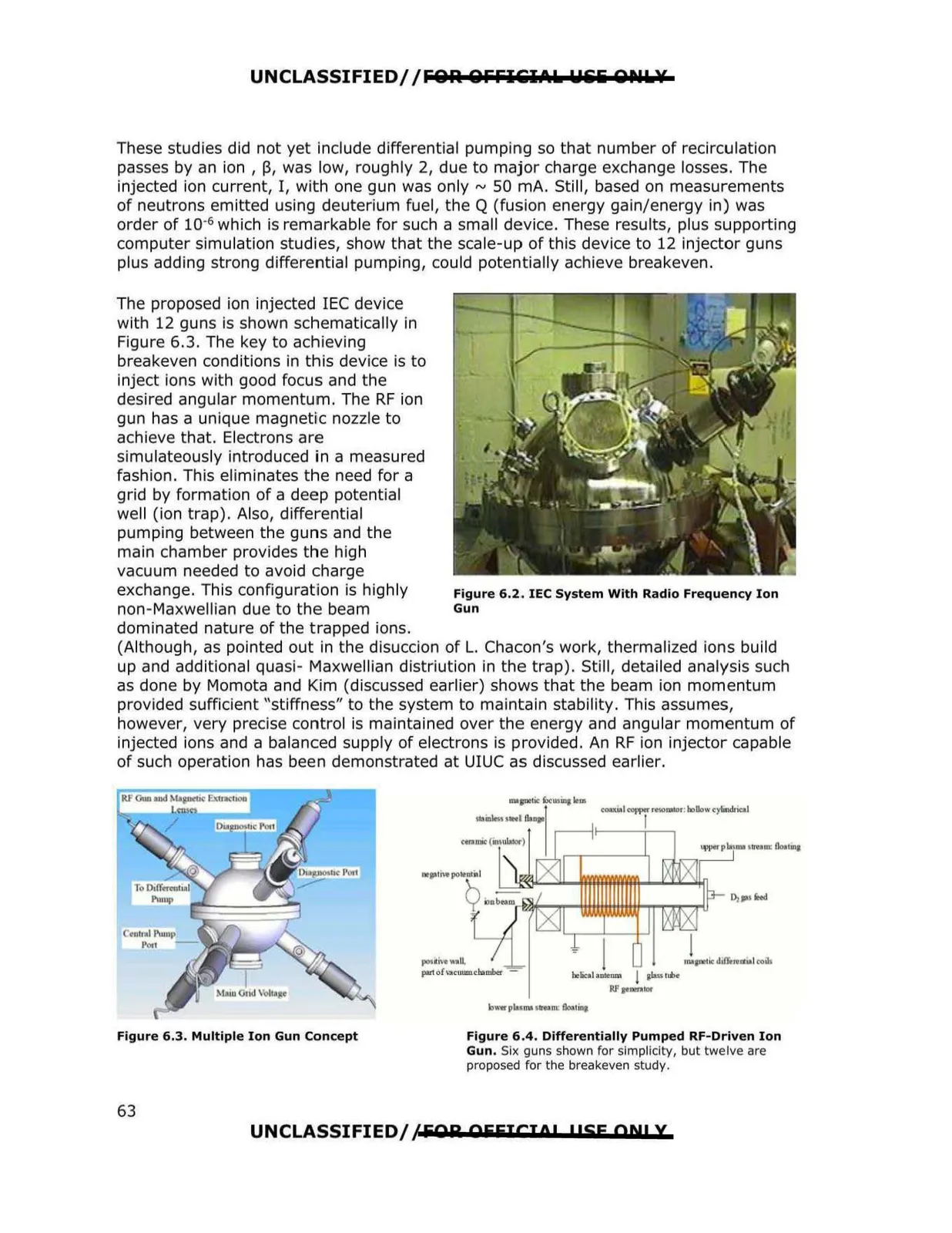
UNCLASSIFIED/ /FOA OFFl&il.t.k Wili Ql"lk¥ These studies did not yet include differential pumping so that number of recirculation passes by an ion , ~, was low, roughly 2, due to major charge exchange losses. The injected ion current, I, with one gun was only~ 50 mA. Sti ll, based on measurements of neutrons emitted using deuterium fuel, the Q (fusion energy gain/energy in) was order of 10-6 which is remarkable for such a small device. These results, plus supporting computer simulation studies, show that the scale-up of this device to 12 injector guns plus adding strong differential pumping, could potentially achieve breakeven. The proposed ion injected IEC device with 12 guns is shown schematically in Figure 6.3. The key to achieving breakeven conditions in this device is to inject ions with good focus and the desired angular momentum. The RF ion gun has a unique magneti,c nozzle to achieve that. Electrons are simulateously introduced in a measured fashion. This eliminates the need for a grid by formation of a deep potential well (ion trap) . Also, differential pumping between the guns and the main chamber provides the high vacuum needed to avoid charge exchange. This configurat'ion is highly Figure 6.2. IEC system With Radio Frequency Ion non-Maxwellian due to the beam Gun dominated nature of the trapped ions. (Although, as pointed out in the disuccion of L. Chacon's work, thermalized ions build up and additional quasi- Maxwellian distriution in the trap) . Still, detailed analysis such as done by Momota and Kim (discussed earlier) shows that the beam ion momentum provided sufficient "stiffness" to the system to maintain stability. This assumes, however, very precise control is maintained over the energy and angular momentum of injected ions and a balanced supply of electrons is provided. An RF ion injector capable of such operation has been demonstrated at UIUC as discussed earlier. mapctic ~utm1 lem coufal ~,pcrr1ti0111tot: OOIJaw c:ybndrtcl.l .,1,mi..,,..1111,.,. I pot 1C l\ew111 lL HIJt 1k dJl'P.1 1'tt1u.1 l colb ptrt ol ,'::.1 cui..Lmck.ntbe:r b,li<ol aa,.nm j p,s lli>• Rl'r"""t°' Figure 6.4. Differentially Pumped RF-Driven Ion Gun. Six guns shown for simplicity, but twelve are proposed for the breakeven study. UNCLASSIFIED/ }FOlil OFFICJO, 11SF ON! X Figure 6.3. Multiple Ion Gun Concept 63