AAWSAP DIRD, Inertial Electrostatic Confinement Fusion, March 2010
DOW-UAP-D125 · page 8 of 72
Text
This text came with the file. It may have mistakes. When the text and the image disagree, the image is right.
UNCLASSIFIED/;CfOA OFFI&IAk WSE 8Ptklf
Section I . IEC Background and Basics
Before considering detail, it is helpful to obtain a rough idea of how inertial electrostatic
confinement (IEC) fusion works.
Gas Feed
Line
High-Volugc -l-
Power Supply
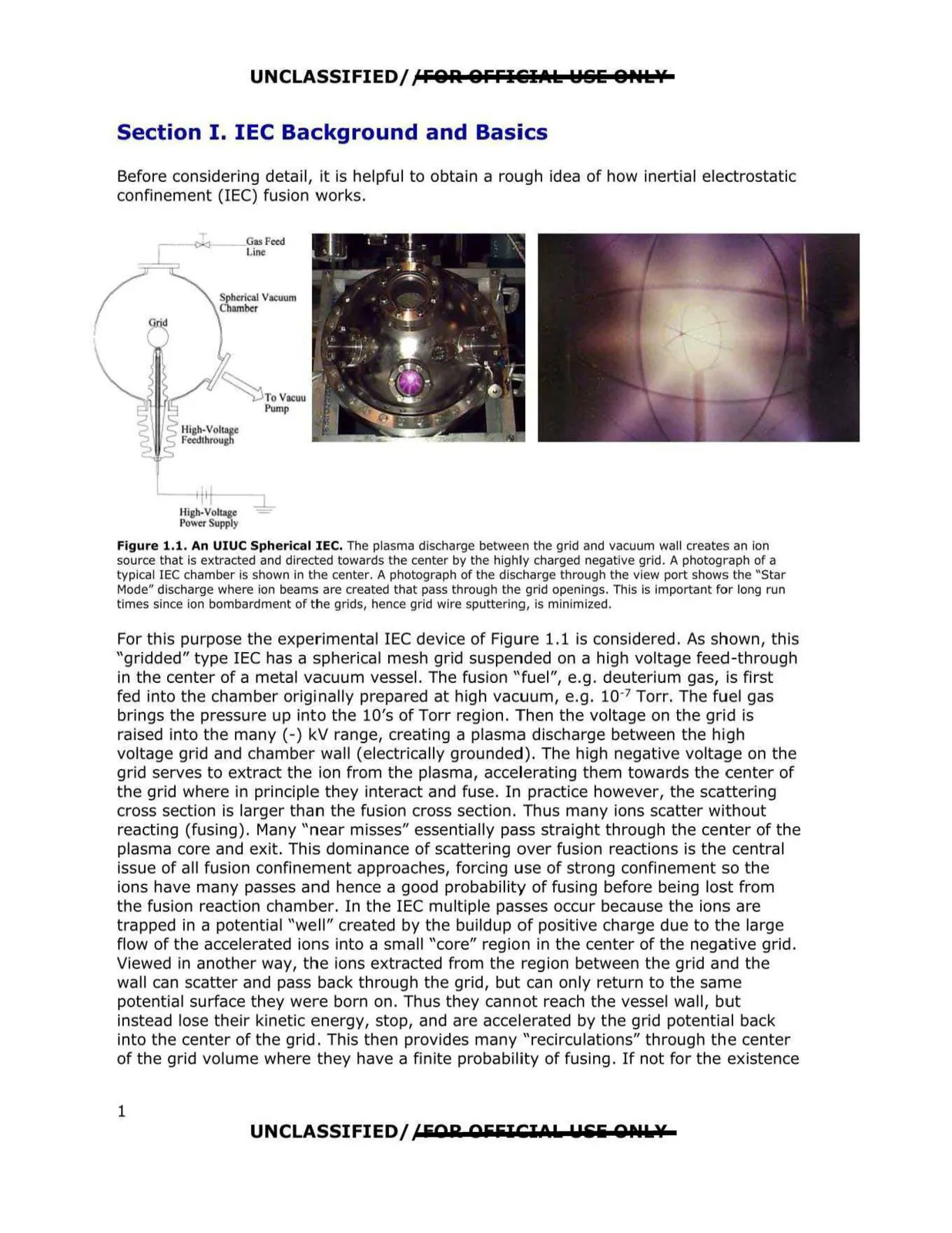
Figure 1.1. An UIUC Spherical IEC. The plasma discharge betwee·n the grid and vacuum wall creates an Ion
source that is extracted and directed towards the center by the highly charged negative grid. A photograph of a
typical IEC chamber is shown in the center. A photograph of the discharge through the view port shows the "Star
Mode" discharge where ion beams are created that pass through the grid openings. This is Important for long run
times since ion bombardment of the grids, hence grid wire sputtering, is minimized.
For this purpose the experimental IEC device of Figure 1.1 is considered. As shown, this
"gridded" type IEC has a spherical mesh grid suspended on a high voltage feed-through
in the center of a metal vacuum vessel. The fusion "fuel", e.g. deuterium gas, is first
fed into the chamber originally prepared at high vacuum, e.g. 10-7 Torr. The fuel gas
brings the pressure up into the 10's of Torr region. Then the voltage on the grid is
raised into the many (-) kV range, creating a plasma discharge between the high
voltage grid and chamber wall (electrical ly grounded). The high negative voltage on the
grid serves to extract the ion from the plasma, accelerating them towards the center of
the grid where in principle they interact and fuse. In practice however, the scattering
cross section is larger than the fusion cross section. Thus many ions scatter without
reacting (fusing). Many "near misses" essentially pass straight through the center of the
plasma core and exit. This dominance of scattering over fusion reactions is the central
issue of all fusion confinement approaches, forcing use of strong confinement so the
ions have many passes and hence a good probability of fusing before being lost from
the fusion reaction chamber. In the IEC multiple passes occur because the ions are
trapped in a potential "well" created by the buildup of positive charge due to the large
flow of the accelerated ions into a small "core" region in the center of the negative grid.
Viewed in another way, the ions extracted from the region between the grid and the
wall can scatter and pass back through the grid, but can only return to the same
potential surface they were born on. Thus they cannot reach the vessel wall, but
instead lose their kinetic energy, stop, and are accelerated by the grid potentia l back
into the center of the grid. This then provides many "recirculations" through the center
of the grid volume where they have a finite probability of fusing. If not for the existence
UNCLASSIFIED/ / EAR OFFI CI O Li !liF QNL¥
1