AAWSAP DIRD, Advanced Nuclear Propulsion for Manned Deep Space Missions, March 2010
DOW-UAP-D126 · page 22 of 37
Text
This text came with the file. It may have mistakes. When the text and the image disagree, the image is right.
UNCLASSIFIED//FOR OFFl@IAL YSE OHL¥
potentials, with the ring magnetically insulated against breakdown by the magnetic field
of a large toroidal current flowing through the ring. It is here proposed to give the
spacecraft a topologically equivalent shape, using the entire spacecraft for the
electrostatic energy storage (see Figure 4 ). There toroidal currents flowing azimuthally
around the outer shell of the spacecraft not only magnetically insulate the spacecraft
against the surrounding electron cloud but also generate a magnetic mirror field that
can reflect the plasma of the exploding fusion bomb. In addition, the expanding bomb
plasma can induce large currents, and if these currents are directed to flow through
magnetic field coils positioned on the upper side of the spacecraft, electrons from there
can be emitted into space surrounding the spacecraft by thermionic emitters placed on
the inner side of these coils, inductively charging (Reference 12) the spacecraft for
subsequent proton beam ignition pulses. A small high-voltage generator driven by a
small onboard fission reactor can make the initial charging, ejecting from the spacecraft
negatively charged pellets.
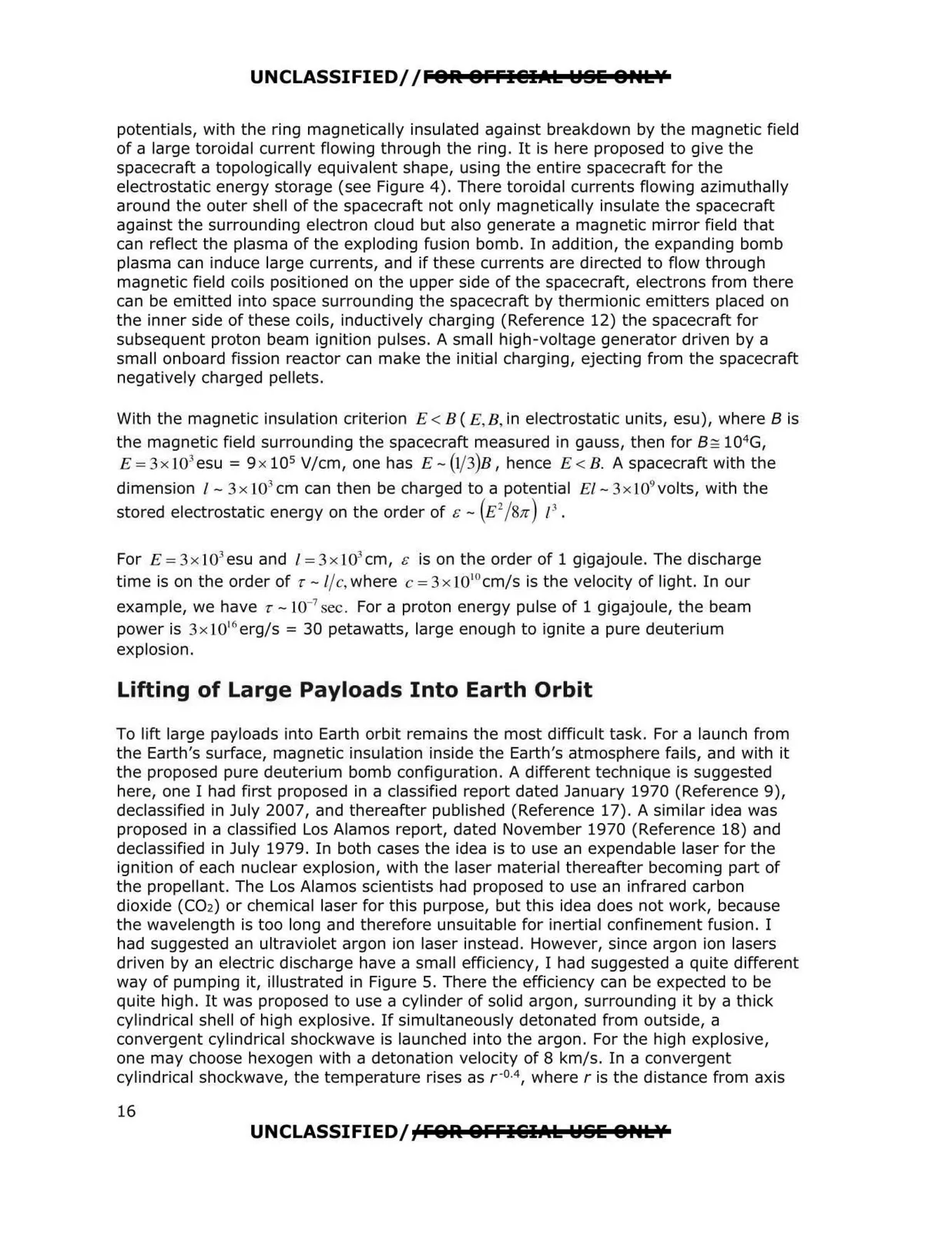
With the magnetic insulation criterion E < B ( E,B, in electrostatic units, esu), where Bis
the magnetic field surrounding the spacecraft measured in gauss, then for B= 104G,
E = 3 x l03 esu = 9 x 10⁵ V/cm, one has E-(1/ 3)B, hence E < B. A spacecraft with the
dimension / - 3 x l03 cm can then be charged to a potential El- 3x l09 volts, with the
stored electrostatic energy on the order of & - (£ 2/ 8,r) [ 3 •
For E = 3x 10³ esu and l = 3 x 103 cm, & is on the order of 1 gigajoule. The discharge
time is on the order of r -1/c, where c = 3x l0'0 cm/s is the velocity of light. In our
example, we have r - 10-7 sec. For a proton energy pulse of 1 gigajoule, the beam
power is 3x l016 erg/s = 30 petawatts, large enough to ignite a pure deuterium
explosion.
Lifting of Large Payloads Into Earth Orbit
To lift large payloads into Earth orbit remains the most difficult task. For a launch from
the Earth's surface, magnetic insulation inside the Earth's atmosphere fails, and with it
the proposed pure deuterium bomb configuration. A different technique is suggested
here, one I had first proposed in a classified report dated January 1970 (Reference 9),
declassified in July 2007, and thereafter published (Reference 17). A similar idea was
proposed in a classified Los Alamos report, dated November 1970 (Reference 18) and
declassified in July 1979. In both cases the idea is to use an expendable laser for the
ignition of each nuclear explosion, with the laser material thereafter becoming part of
the propellant. The Los Alamos scientists had proposed to use an infrared carbon
dioxide (CO2) or chemical laser for this purpose, but this idea does not work, because
the wavelength is too long and therefore unsuitable for inertial confinement fusion. I
had suggested an ultraviolet argon ion laser instead. However, since argon ion lasers
driven by an electric discharge have a small efficiency, I had suggested a quite different
way of pumping it, illustrated in Figure 5. There the efficiency can be expected to be
quite high. It was proposed to use a cylinder of solid argon, surrounding it by a thick
cylindrical shell of high explosive. If simultaneously detonated from outside, a
convergent cylindrical shockwave is launched into the argon. For the high explosive,
one may choose hexogen with a detonation velocity of 8 km/s. In a convergent
cylindrical shockwave, the temperature rises as r ·0A , where r is the distance from axis
UNCLASSIFIED/fFOR OFFI&I.t.L YSE OHLl/
16