AAWSAP DIRD, Advanced Nuclear Propulsion for Manned Deep Space Missions, March 2010
DOW-UAP-D126 · page 35 of 37
Text
This text came with the file. It may have mistakes. When the text and the image disagree, the image is right.
UNCLASSIFIED//POlt err1e1J1tt U.!I! er\tt I
Calculations done by Muller, Rafelski, and Greiner (Reference 22) show that for
molecular states 3sBr- JsBr, s3I- 79Au, and 92U- 92U, a twofold lowering of the distance of
separation leads to a lowering of the electron orbit energy eigenvalues by ~0.35 keV
and 1.4 keV, respectively. At a pressure of 100 Mb = 1014 dyn/cm2 where d/do = 1/2,
the result of these calculations can be summarized by (oE in keV)
tog oE = 1.3 x 10⁻² z - 1.4
(42)
replacing equation ( 40), where Z is here the sum of the nuclear charge for both
components of the molecule formed under the high pressure.
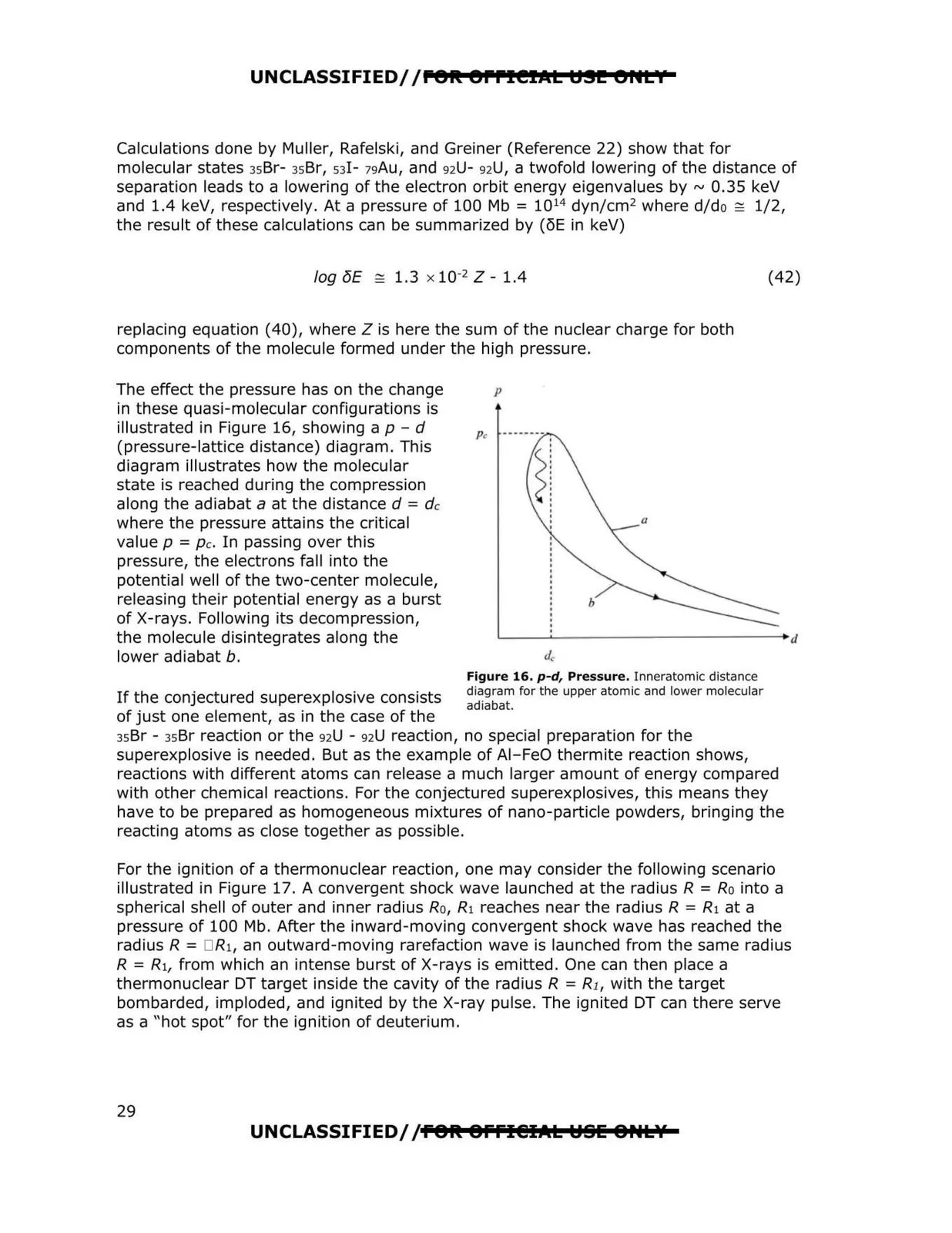
The effect the pressure has on the change
p
in these quasi-molecular configurations is
illustrated in Figure 16, showing a p - d
Pc
(pressure-lattice distance) diagram. This
diagram illustrates how the molecular
state is reached during the compression
along the adiabat a at the distance d = de
where the pressure attains the critical
value p = p,. In passing over this
pressure, the electrons fall into the
potential well of the two-center molecule,
releasing their potential energy as a burst
of X-rays. Following its decompression,
the molecule disintegrates along the
lower adiabat b.
d
Figure 16. p-d, Pressure. Inneratomic distance
If the conJ·ectured superexplosive consists
diagram for the upper atomic and lower molecular
adiabat.
of just one element, as in the case of the
3s8r - 3s8r reaction or the 92 LJ - 92 LJ reaction, no special preparation for the
superexplosive is needed. But as the example of AI-FeO thermite reaction shows,
reactions with different atoms can release a much larger amount of energy compared
with other chemical reactions. For the conjectured superexplosives, this means they
have to be prepared as homogeneous mixtures of nano-particle powders, bringing the
reacting atoms as close together as possible.
For the ignition of a thermonuclear reaction, one may consider the following scenario
illustrated in Figure 17. A convergent shock wave launched at the radius R = Ro into a
spherical shell of outer and inner radius Ro, R1 reaches near the radius R = R1 at a
pressure of 100 Mb. A~er the inward-moving convergent shock wave has reached the
radius R = □ R1, an outward-moving rarefaction wave is launched from the same radius
R = R1, from which an intense burst of X-rays is emitted. One can then place a
thermonuclear DT target inside the cavity of the radius R = R1, with the target
bombarded, imploded, and ignited by the X-ray pulse. The ignited DT can there serve
as a "hot spot" for the ignition of deuterium.
UNCLASSIFIED//fOll 8ffl@IAL YSIE 8Htl/
29