AAWSAP DIRD, An Introduction to the Statistical Drake Equation, March 2010
DOW-UAP-D127 · page 26 of 55
Text
This text came with the file. It may have mistakes. When the text and the image disagree, the image is right.
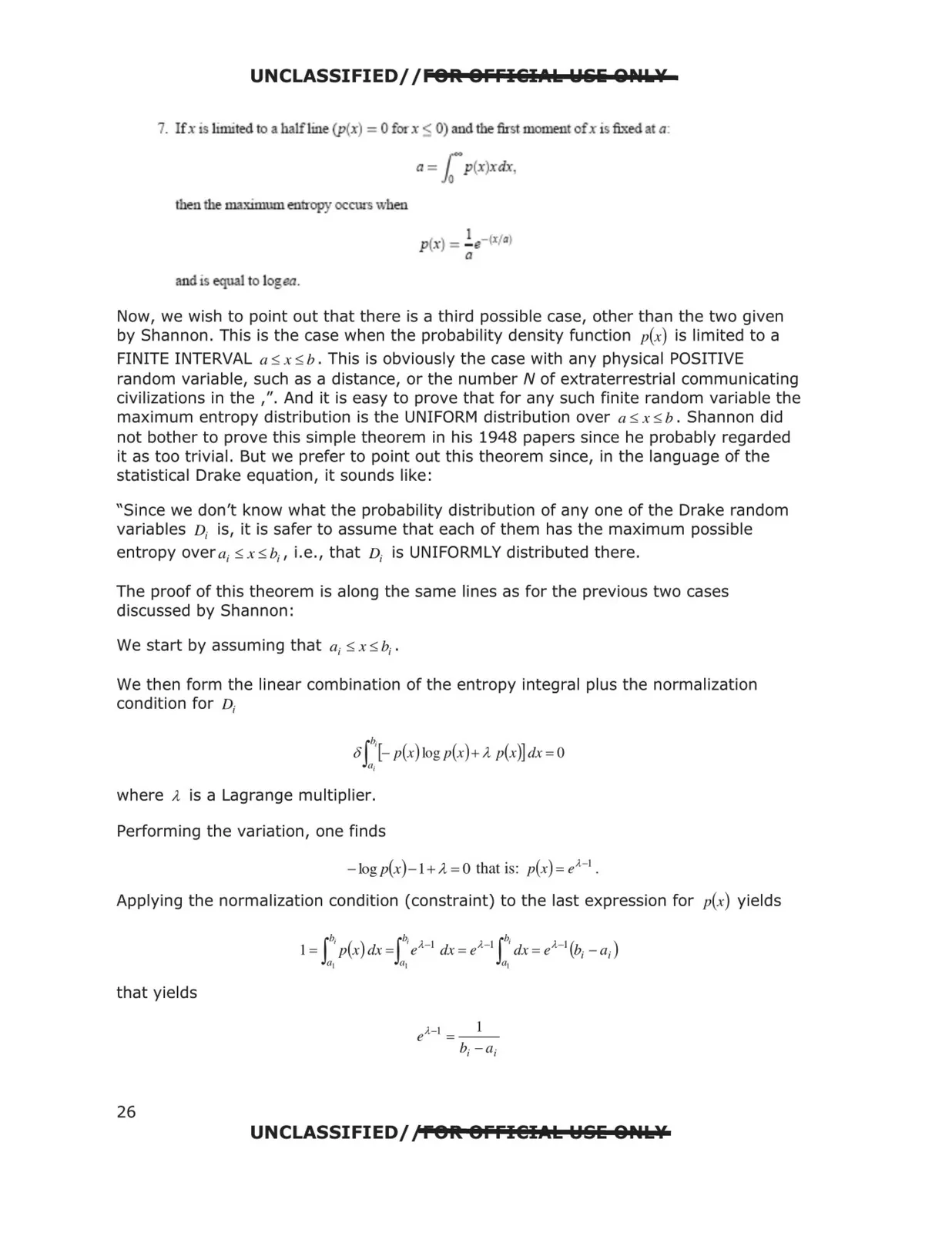
UNCLASSIFIED/ /fOR OFFI&IAk Wlii QPU,¥ 7. Ifx is limited to a half line (p(x) = 0 for x <0) and the fin.t moment ofx is ihted at a: a = f p(x dx then the maximwn en opy OCCW1! when p(x) =,! - f.r/al a and 1s equal to logea. Now, we wish to point out that there is a third possible case, other than the two given by Shannon. This is the case when the probability density function p(x) is limited to a FINITE INTERVAL a::; x::; b. This is obviously the case with any physical POSITIVE random variable, such as a distance, or the number N of extraterrestrial communicating civilizations in the,". And it is easy to prove that for any such finite random variable the maximum entropy distribution is the UNIFORM distribution over a -5, x -5, b. Shannon did not bother to prove this simple theorem in his 1948 papers since he probably regarded it as too trivial. But we prefer to point out this theorem since, in the language of the statistical Drake equation, it sounds like: "Since we don't know what the probability distribution of any one of the Drake random variables D; is, it is safer to assume that each of them has the maximum possible entropy over a; -5,x-5, h;, i.e., that D; is UNIFORMLY distributed there. The proof of this theorem is along the same lines as for the previous two cases discussed by Shannon: We start by assuming that a; -5, x -5, b; . We then form the linear combination of the entropy integral plus the normalization condition for D; where i is a Lagrange multiplier. Performing the variation, one finds - Iogp(x)- 1+1 = 0 that is: p(x)= e ,1,- i . Applying the normalization condition (constraint) to the last expression for p(x) yields b, ( ) f.b; ,l,-1 2-1 f.b; ,1,-1 ( ) I = f. p x dx = e dx = e dx = e b; - a,. a1 a1 a1 that yields ,l,-1 1 e = - h; - a; UNCLASSIFIED/ /POlt Offl@IAL WSi 9Nk¥ 26