AAWSAP DIRD, Technological Approaches to Controlling External Devices, March 2010
DOW-UAP-D130 · page 14 of 36
Text
This text came with the file. It may have mistakes. When the text and the image disagree, the image is right.
UNCLASSIFIED//FOR OFFI@Il.tk WSI: Ortklf
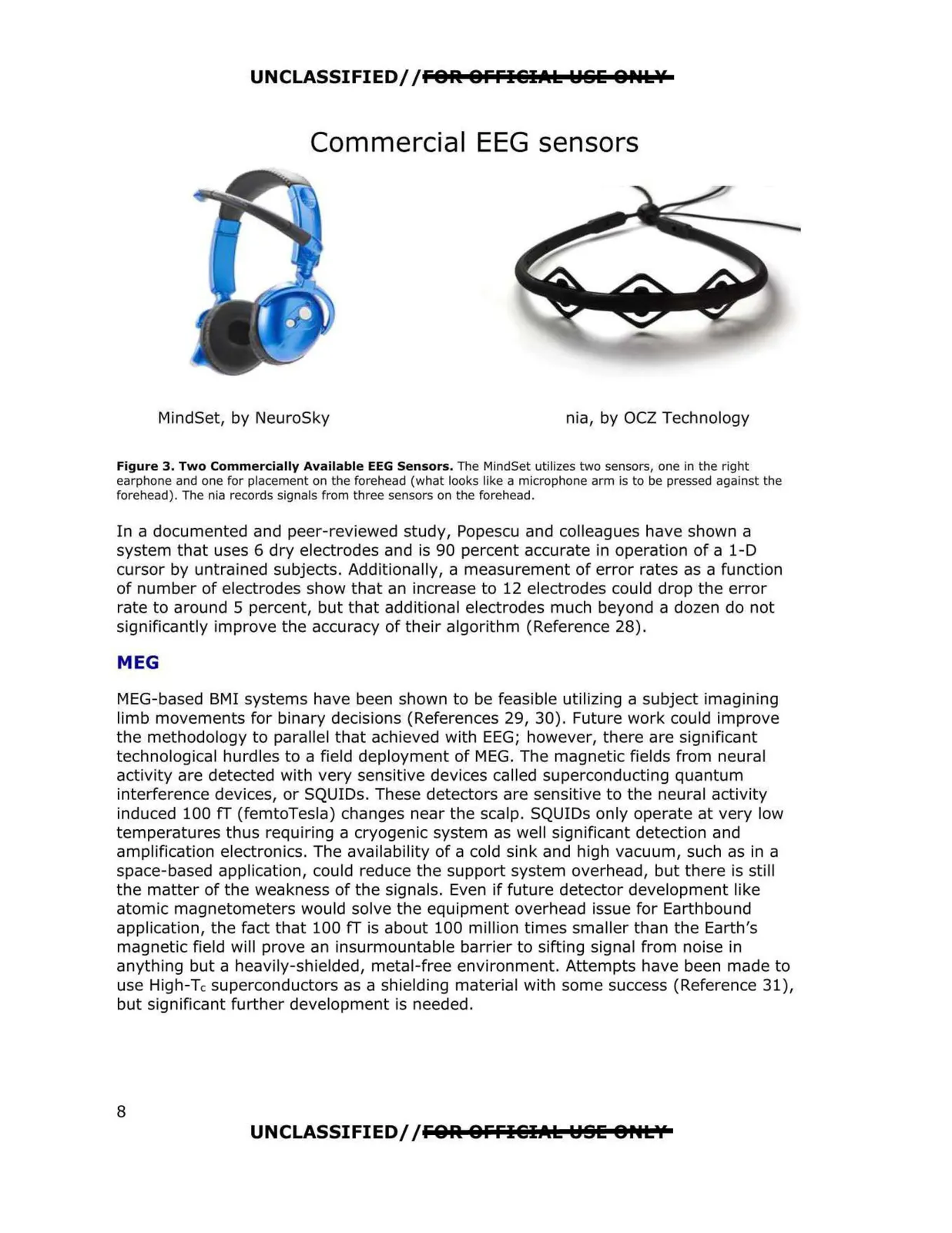
Commercial EEG sensors
Mindset, by NeuroSky
nia, by OCZ Technology
Figure 3. Two Commercially Available EEG Sensors. The Mindset utilizes two sensors, one in the right
earphone and one for placement on the forehead (what looks like a microphone arm is to be pressed against the
forehead). The nia records signals from three sensors on the forehead .
In a documented and peer-reviewed study, Popescu and colleagues have shown a
system that uses 6 dry electrodes and is 90 percent accurate in operation of a 1-D
cursor by untrained subjects. Additionally, a measurement of error rates as a function
of number of electrodes show that an increase to 12 electrodes could drop the error
rate to around 5 percent, but that additional electrodes much beyond a dozen do not
significantly improve the accuracy of their algorithm (Reference 28).
MEG
MEG-based BMI systems have been shown to be feasible utilizing a subject imagining
limb movements for binary decisions (References 29, 30). Future work could improve
the methodology to parallel that achieved with EEG; however, there are significant
technological hurdles to a field deployment of MEG. The magnetic fields from neural
activity are detected with very sensitive devices called superconducting quantum
interference devices, or SQUIDs. These detectors are sensitive to the neural activity
induced 100 fT (femtoTesla) changes near the scalp. SQUIDs only operate at very low
temperatures thus requiring a cryogenic system as well significant detection and
amplification electronics. The availability of a cold sink and high vacuum, such as in a
space-based application, could reduce the support system overhead, but there is still
the matter of the weakness of the signals. Even if future detector development like
atomic magnetometers would solve the equipment overhead issue for Earthbound
application, the fact that 100 fT is about 100 million times smaller than the Earth's
magnetic field will prove an insurmountable barrier to sifting signal from noise in
anything but a heavily-shielded, metal-free environment. Attempts have been made to
use High-Tc superconductors as a shielding material with some success (Reference 31),
but significant further development is needed.
UNCLASSIFIED//FOR OFFIEiIAk WSIE 8HL1/
8