AAWSAP DIRD, Technological Approaches to Controlling External Devices, March 2010
DOW-UAP-D130 · page 19 of 36
Text
This text came with the file. It may have mistakes. When the text and the image disagree, the image is right.
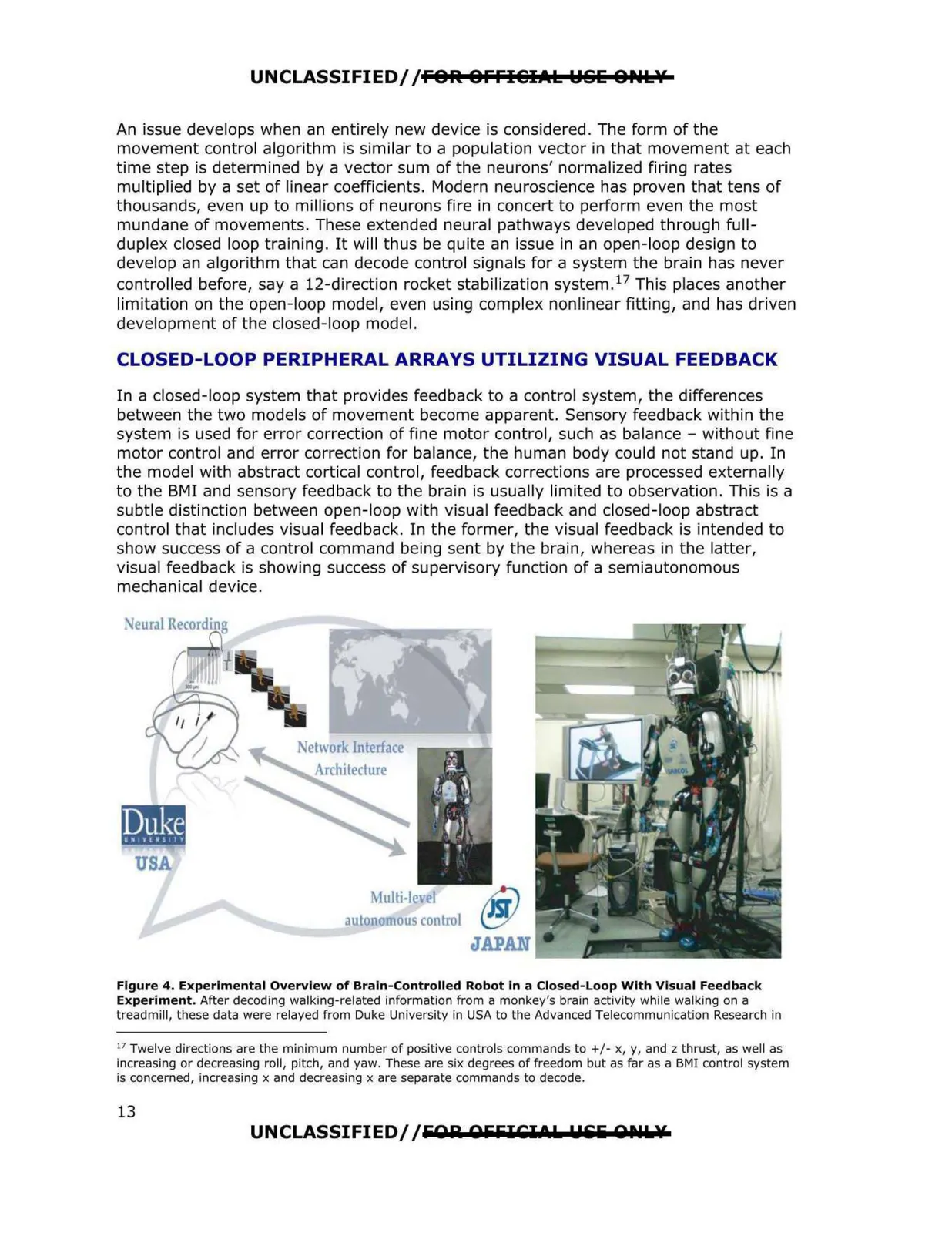
UNCLASSIFIED/ /FOR OFFI@Il.tk WSI: Ortklf An issue develops when an entirely new device is considered. The form of the movement control algorithm is similar to a population vector in that movement at each time step is determined by a vector sum of the neurons' normalized firing rates multiplied by a set of linear coefficients. Modern neuroscience has proven that tens of thousands, even up to millions of neurons fire in concert to perform even the most mundane of movements. These extended neural pathways developed through full duplex closed loop training. It will thus be quite an issue in an open-loop design to develop an algorithm that can decode control signals for a system the brain has never controlled before, say a 12-direction rocket stabilization system. 17 This places another limitation on the open-loop model, even using complex nonlinear fitting, and has driven development of the closed-loop model. CLOSED-LOOP PERIPHERAL ARRAYS UTILIZING VISUAL FEEDBACK In a closed-loop system that provides feedback to a control system, the differences between the two models of movement become apparent. Sensory feedback within the system is used for error correction of fine motor control, such as balance - without fine motor control and error correction for balance, the human body could not stand up. In the model with abstract cortical control, feedback corrections are processed externally to the BMI and sensory feedback to the brain is usually limited to observation. This is a subtle distinction between open-loop with visual feedback and closed-loop abstract control that includes visual feedback. In the former, the visual feedback is intended to show success of a control command being sent by the brain, whereas in the latter, visual feedback is showing success of supervisory function of a semiautonomous mechanical device. eural Recording JAPAN Figure 4. Experimental Overview of Brain-Controlled Robot in a Closed-Loop With Visual Feedback Experiment. After decoding walking-related Information from a monkey's brain activity while walking on a treadmill, these data were relayed from Duke University in USA to the Advanced Telecommunication Research in 17 Twelve directions are the minimum number of positive controls commands to +/- x, y, and z thrust, as well as increasing or decreasing roll, pitch, and yaw. These are six degrees of freedom but as far as a BMI control system is concerned, increasing x and decreasing x are separate commands to decode. UNCLASSIFIED/ /iiiOlil OiiiiiilCI0ls !lili OPII.¥ 13