AAWSAP DIRD, Technological Approaches to Controlling External Devices, March 2010
DOW-UAP-D130 · page 21 of 36
Text
This text came with the file. It may have mistakes. When the text and the image disagree, the image is right.
UNCLASSIFIED/,SfOR 8FFI€il.t.k Wlili QPIIL¥
microelectric design of chronic neural implants. In 2006, Fetz et al. illustrated an
intracranial operated neural implant that could function as neural prosthetic to assist
upper limb movement for individuals that suffered from spinal cord injuries. The
intriguing part of the Fetz design is its ability to function as an autonomous battery
operated device. This is a departure from traditional BMI devices that are cumbersome
and difficult to operate. Clearly this is a step forward in the development of microwire
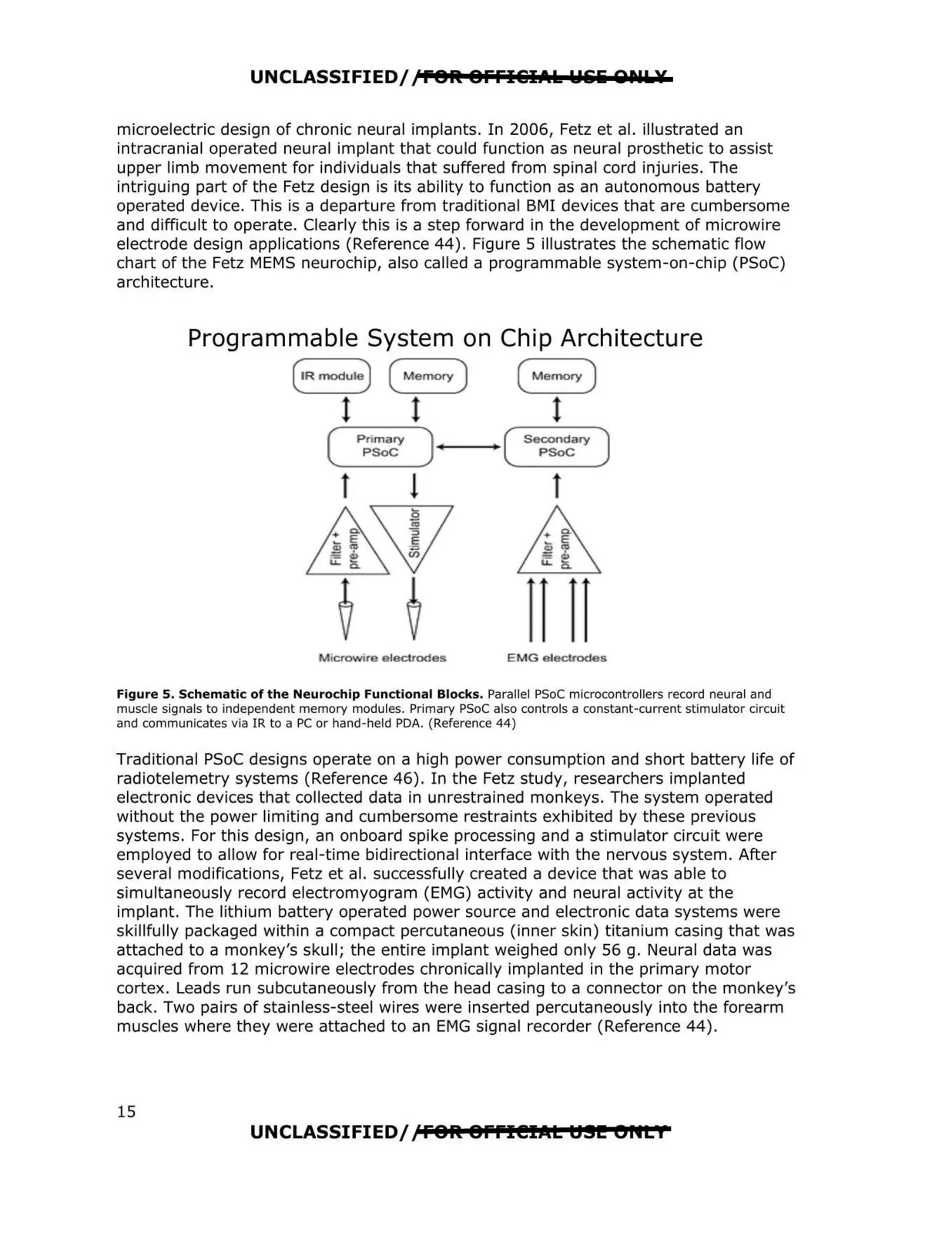
electrode design applications (Reference 44). Figure 5 illustrates the schematic flow
chart of the Fetz MEMS neurochip, also called a programmable system-on-chip (PSoC)
architecture.
Programmable System on Chip Architecture
(1R module) ( eITM>ry)
( MeITM>ry)
t
t
l
Prim ry
(
Secondary
PSoC
PSoC
(
)
J
l
!
l
o
:5"'
E
~w
;;:,
r.n
lf n
M icrowire e lectrodes
EMG
ecllod s
Figure 5. Schematic of the Neurochip Functional Blocks. Parallel PSoC microcontrollers record neural and
muscle signals to independent memory modules. Primary PSoC also controls a constant-current stimulator circuit
and communicates via IR to a PC or hand-held PDA. (Reference 44)
Traditional PSoC designs operate on a high power consumption and short battery life of
radiotelemetry systems (Reference 46). In the Fetz study, researchers implanted
electronic devices that collected data in unrestrained monkeys. The system operated
without the power limiting and cumbersome restraints exhibited by these previous
systems. For this design, an onboard spike processing and a stimulator circuit were
employed to allow for real-time bidirectional interface with the nervous system. After
several modifications, Fetz et al. successfully created a device that was able to
simultaneously record electromyogram (EMG) activity and neural activity at the
implant. The lithium battery operated power source and electronic data systems were
skillfully packaged within a compact percutaneous (inner skin) titanium casing that was
attached to a monkey's skull; the entire implant weighed only 56 g. Neural data was
acquired from 12 microwire electrodes chronically implanted in the primary motor
cortex. Leads run subcutaneously from the head casing to a connector on the monkey's
back. Two pairs of stainless-steel wires were inserted percutaneously into the forearm
muscles where they were attached to an EMG signal recorder (Reference 44).
UNCLASSIFIED/lf81l OfPltlJlcL U:!I! f>flt I
15